 NL
NL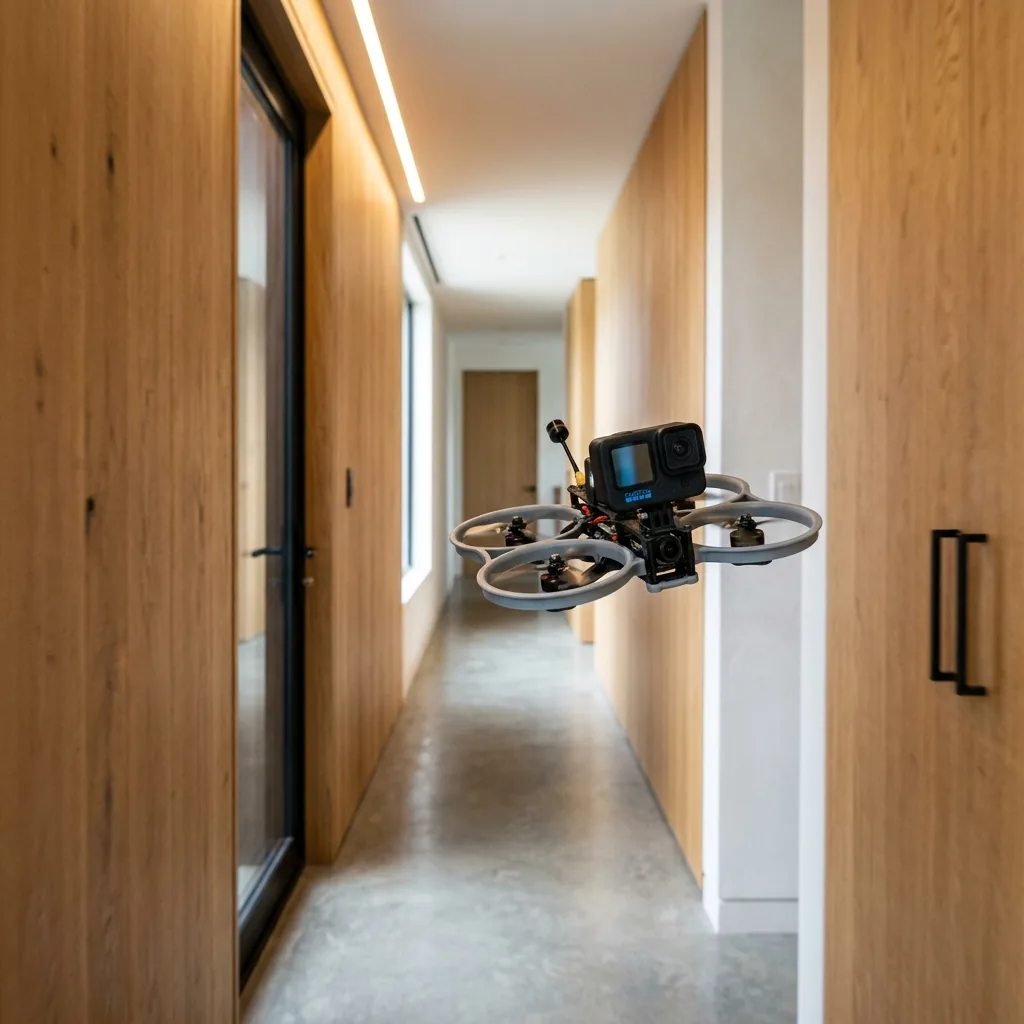
Answer-First: A FPV Cinewhoop is a highly specialized, compact drone featuring fully enclosed 360-degree propeller guards (ducts) designed specifically for close-proximity indoor filming near talent and delicate set decor. Standard camera drones are optimized for high-altitude, GPS-stabilized outdoor aerials. Cinewhoops, conversely, are operated manually in acro mode via FPV goggles, carry high-resolution action cameras like the GoPro Hero 12 Black, and navigate narrow hallways safely.
On modern commercial, narrative, and corporate film sets, the demand for dynamic, continuous camera movement has rapidly shifted from wide outdoor vistas to intricate indoor spaces. Production managers and Directors of Photography (DOPs) are constantly searching for creative ways to navigate tight locations—such as office layouts, historical building interiors, and active factories—without sacrificing safety or audio quality.
While standard consumer and professional camera drones are excellent tools for traditional outdoor aerials, they present severe operational and safety limitations inside a closed set. This is where the custom First-Person View (FPV) Cinewhoop has established itself as the surgical camera tool of choice. To help production departments make informed technical choices, we detail the eight key differences between standard camera drones and custom FPV Cinewhoops.
1. Propeller Guards and Ducts (Indoor Safety Protocols)
The most immediate and critical visual distinction between these two platforms lies in propeller protection. Standard camera drones feature exposed, spinning carbon-fiber or hard plastic blades. If a standard drone collides with an object, it triggers a catastrophic motor stall and crash, posing an unacceptable risk of lacerations to talent, damage to expensive set decors, or structural impact on historic walls.
Custom FPV Cinewhoops, by contrast, are constructed with fully enclosed, 360-degree aerodynamic ducted propeller guards. These ducts act as physical bumpers. If the Cinewhoop bumps into a wall, furniture, or even talent during a choreographed pass, it simply bounces off and continues flying. This mechanical shielding is the baseline safety feature that makes indoor close-proximity filming legally and operationally viable on professional sets.
2. Flight Dynamics & Pilot Perspective (Acro Mode vs. GPS Positioning)
Standard drones operate utilizing heavy automation, relying on global positioning systems (GPS), optical flow sensors, and sonar altimeters to hover statically when the pilot releases the control sticks. In indoor environments, however, GPS signals are blocked. In these GPS-denied environments, standard drones can drift unpredictably, causing sudden collision risks.
Custom FPV Cinewhoops operate on manual flight controllers in "Acro" (acrobatic) mode. The pilot controls the aircraft using FPV goggles, receiving a real-time, low-latency video feed directly from the drone's nose. In Acro mode, there is no automatic leveling or altitude holding. Every degree of roll, pitch, and yaw is directly and instantly controlled by the pilot. This direct control allows for highly organic, curvilinear movement lines, precise banking through tight doorways, and immediate corrections that automated systems would override or fight against.
3. Camera Payload and Stabilization Integration (GoPro Hero 12 vs. Integrated Gimbal)
A standard drone utilizes an integrated camera mounted on a active 3-axis mechanical gimbal. This gimbal counteracts the pitch and roll of the drone to maintain a perfectly flat horizon. While this is ideal for smooth landscape shots, a mechanical gimbal has physical tilt limits and cannot handle the rapid, banking turns required to maneuver through sharp corners indoors.
FPV Cinewhoops utilize a hard-mounted action camera—most commonly the GoPro Hero 12 Black or a stripped-down "naked" GoPro to minimize weight. The camera is locked at a fixed upward angle (typically 15 to 30 degrees) relative to the frame. The stabilization is handled entirely in post-production. Telemetry data from the camera's internal gyroscopes is processed using specialized software like Gyroflow or ReelSteady. This allows the editor to dial in the exact amount of smoothing required, lock the horizon, or allow the frame to bank naturally with the flight path for a highly visceral, immersive feel.
4. Physical Footprint & Navigating Narrow Hallways
Standard cinema drones are physically large. Even compact folding models have a wide footprint once the propellers are spinning, which prevents them from navigating tight pathways safely. A platform like the DJI Inspire 3 is simply too wide to pass through a standard interior doorframe (typically 80–90 cm wide) without keeping a dangerous margin.
FPV Cinewhoops are engineered on micro-frames (typically built around 2.5-inch or 3-inch propellers). Their overall footprint is often under 15 to 20 cm square. This micro-size allows our pilots at Drone Department to execute shots that fly through narrow hallways, navigate between light stands and C-stands, sweep under office desks, and fly directly through small gaps in set structures to reveal talent in a single, un-cut sequence.
5. Acoustic Profile (Quiet Motors for Set Audio)
Standard drones produce a loud, high-pitched whine that can easily disrupt set operations and ruin live audio recording. The noise is caused by high-pressure blade tips slicing through the air with no baffling.
To operate safely near actors and allow sound recordists to capture clean dialogue, custom FPV Cinewhoops can be built with specialized quiet motors and multi-blade propellers (typically 5 or 6 blades). The surrounding ducts also act as acoustic baffles, directing sound vertically rather than horizontally. While they are not silent, the sound signature is significantly lower in volume and pitch, making it much easier for audio engineers to clean up the dialogue in post-production.
6. Risk Mitigation and EASA Regulatory Compliance
When operating standard drones, EASA regulations require strict horizontal distance buffers from uninvolved people (ranging from 5 to 30 meters depending on the drone's weight class). For heavy cinema drones like the DJI Inspire 3, flying close to actors requires advanced permits and complex Specific category authorizations.
Because custom FPV Cinewhoops are lightweight—typically weighing under 250 to 500 grams including the GoPro Hero 12 battery—their kinetic energy is extremely low. Coupled with the fully enclosed propeller guards, the risk profile is significantly reduced. This low-risk profile makes it much easier to include them in our EASA Specific category SORA (Specific Operations Risk Assessment) filings, securing rapid municipal and regulatory approval for indoor filming near crew and talent.
7. Post-Production Pipeline and VFX Integration
Standard drones produce stabilized, color-graded, or raw footage that is ready to drop straight into the editorial timeline. The metadata from the lens and camera is standard and easily read by edit suites.
Operating FPV Cinewhoops requires a slightly more hands-on post-production workflow. The raw, wide-angle footage from the GoPro Hero 12 must be stabilized using the camera's gyro metadata. Crucially for visual effects (VFX) work, because the camera is rigidly fixed to the drone frame, VFX matchmove artists find it easier to track the camera's linear trajectory. There are no independent, moving gimbal axes to calculate, which simplifies the process of placing CGI elements into the scene.
8. Flight Autonomy vs. Operational Bursts
Standard camera drones are designed for flight endurance, with smart batteries that allow for 30 to 45 minutes of continuous hover time. This gives the director ample time to compose, wait for the perfect light, and run multiple takes back-to-back.
FPV Cinewhoops are built for power and responsiveness, which draws high current from lightweight Lithium Polymer (LiPo) batteries. As a result, flight times are limited to 3 to 6 minutes per pack. This requires a precise operational workflow. The pilot, camera assistant, and floor manager must carefully coordinate rehearsals, ensuring that when the drone takes off, everyone is in position to execute the shot instantly. At Drone Department, we manage this constraint by utilizing high-capacity field charging stations and a rapid battery-swapping system to keep the camera package ready for action.
Comparative Analysis: Standard Drones vs. Custom FPV Cinewhoops
| Feature | Standard Camera Drone | Custom FPV Cinewhoop |
|---|---|---|
| Propeller Protection | Exposed propellers (high risk of damage/laceration) | 360° ducted propeller guards (safe to bump walls/talent) |
| Stabilization | Mechanical 3-axis gimbal (real-time stabilization) | Hard-mounted camera; post-processed gyro stabilization (Gyroflow) |
| Flight Control | GPS assisted, auto-hover, obstacle avoidance braking | Manual "Acro" mode, pilot operated via FPV goggles |
| Typical Dimensions | 30 cm to 80+ cm diagonal (large footprint) | 12 cm to 18 cm diagonal (ultra-compact) |
| Acoustic Footprint | Loud, high-pitched whine (disrupts set audio) | Optimized quiet motors and ducted airflow (lower profile) |
| Camera Payload | Integrated custom sensor (e.g. Zenmuse X9-8K) | GoPro Hero 12 Black (naked or full housing) |
| Flight Time | 30 to 45 minutes per battery | 3 to 6 minutes per battery |
| Primary Location | Outdoors, high-altitude landscapes, open spaces | Indoors, narrow hallways, close-proximity fly-throughs |
Conclusion: Selecting the Right Tool for the Shot
Understanding these technical differences allows production managers to select the correct aerial tool for their creative needs. For sweeping, cinematic vistas, high wind resistance, and maximum camera sensor detail, standard drones like the DJI Inspire 3 are the industry standard. However, when the script calls for an immersive, single-take camera pass that glides through a window, snakes down a narrow hallway, and flies inches away from actors on set, the custom FPV Cinewhoop is the only tool that can deliver the shot safely and effectively.
At Drone Department, we operate a fleet of both heavy-lift cinema drones and custom-designed indoor FPV Cinewhoops. Our team of EASA Specific category certified pilots has years of experience coordinating complex shots on active film sets. Contact our production office today to discuss the technical requirements and safety protocols for your next indoor filming project.