 NL
NL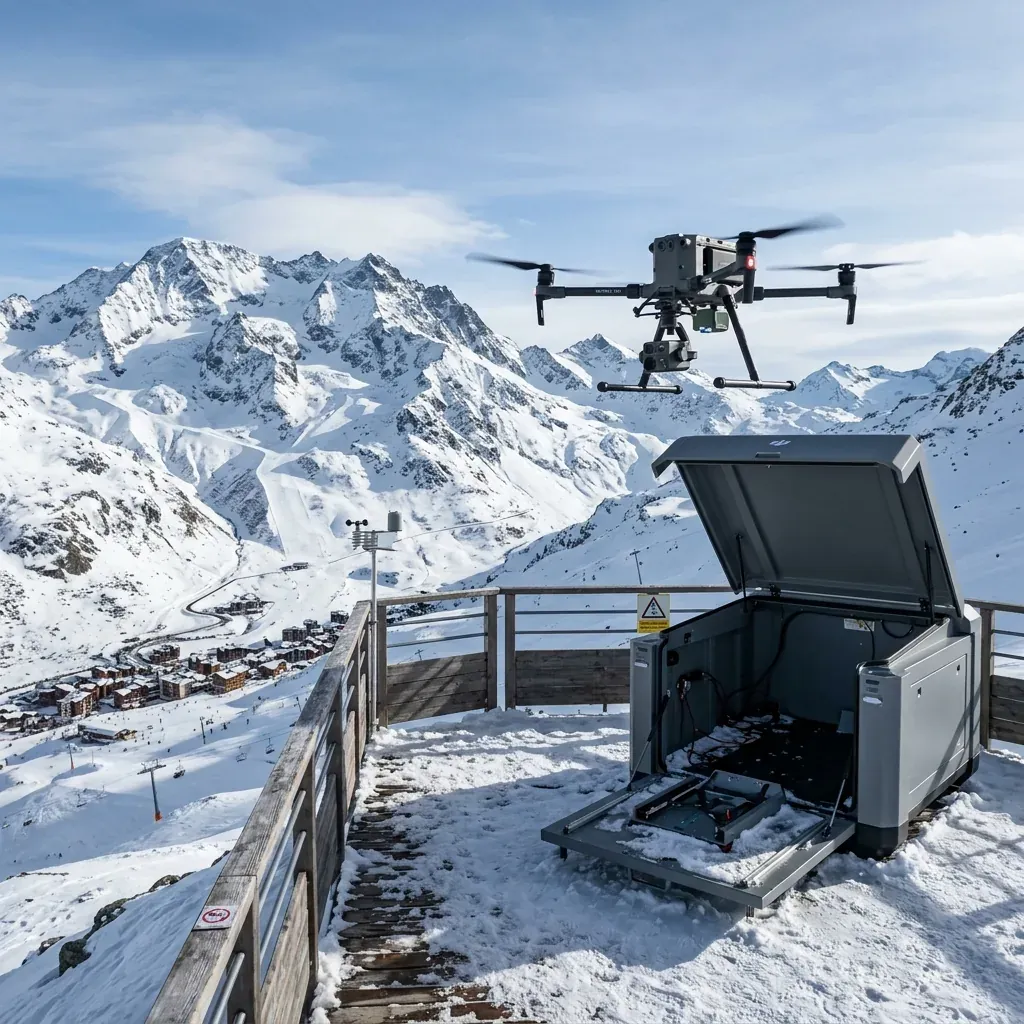
When an avalanche strikes in the French Alps, rescuers are racing against a brutal clock. Survival rates fall sharply after about 20 minutes, making every second between the emergency call and locating a victim incredibly valuable. A new video case study by drone manufacturer DJI offers an up-close look at how autonomous drone technology in the form of the DJI Dock 3 and the Matrice 4TD drone are helping responders gain critical aerial intelligence almost immediately after an alert. The result is faster decision-making, safer operations, and potentially a better chance of finding people before time runs out.
While drones have been used in search and rescue for years, the shift toward autonomous "drone-in-a-box" systems represents a massive technological leap forward. At Val Thorens, Europe’s highest ski resort sitting at 2,300 meters (7,545 feet) above sea level, these systems are being tested in some of the most demanding winter environments. Unlike conventional drone operations that require a pilot to transport, assemble, and launch equipment, the Dock 3 keeps the aircraft housed, charged, and ready for immediate deployment.
The critical 20-minute survival window
Avalanche rescue is one of the most high-stakes, time-sensitive operations in mountain safety. Survival statistics show that victims buried under snow have the highest probability of being recovered alive if found within the first 15 to 20 minutes. Beyond that window, asphyxiation becomes a severe threat. Traditionally, rescue teams must deploy on foot, on skis, or via helicopter. However, heavy snowfall, strong winds, and ongoing avalanche risks can make it dangerous for human teams to immediately enter the hazard zone.
This is where autonomous drones provide an immediate advantage. Rescuers can deploy the drone to scout the location without putting human lives at risk. The live aerial feed allows coordinators in the command center to assess the slide area, check for visible clues, and search for heat signatures using thermal sensors before ground teams even arrive.
Dock as first responder: 10-second autonomous takeoff
The primary advantage of the DJI Dock 3 is response speed. As soon as an emergency alert is triggered, an operator in the command center can launch a pre-programmed mission. Within 10 seconds, the dock canopy opens, and the Matrice 4TD drone takes off automatically. The base station keeps the drone charged, protects it from freezing temperatures, and performs automatic pre-flight diagnostic checks.
This concept, known as "Dock as First Responder," changes the dynamics of public safety. Instead of losing critical minutes transportting gear to the scene, the drone is often overhead, mapping the path and sending live updates, while the ski patrol is still gearing up. This head start is invaluable when minutes determine survival.
Matrice 4TD: thermal and optical eyes in alpine storms
The Matrice 4TD drone deployed from the Dock 3 is built for extreme weather and features a multi-sensor payload. It is equipped with a wide-angle camera, a zoom camera, and a thermal camera. This sensor suite is tailor-made for snowy mountain rescue operations:
- Thermal imaging: Even in low visibility or snow storms, the thermal camera can detect heat signatures from a victim's exposed skin or clothing, which is invisible to the human eye.
- Optical zoom: Redundant zoom capabilities allow command centers to closely inspect suspicious debris (such as a ski or a glove) from a safe altitude without flying too close to unstable slopes.
- Rugged design: The Matrice 4TD is rated to operate in wind speeds up to 12 m/s and temperatures as low as -20°C, making it resilient in typical alpine storm conditions.
Val Thorens: testing autonomous flight at 2,300 meters
Operating a drone-in-a-box system at 2,300 meters above sea level presents severe engineering challenges. Low temperatures drastically reduce battery efficiency, and thin air makes flight physics more difficult. The DJI Dock 3 addresses this by incorporating active temperature control inside the enclosure, keeping the drone's batteries pre-warmed so it is always ready to launch at peak performance.
"In the mountains, time and information are everything," says Olivier Gardet, first aid technical director of Val Thorens Ski Service. "The faster we can understand a situation, the faster we can make the right decision. The autonomous dock system gives us a crucial head start."
European regulation and EASA safety compliance
Running autonomous drone flights Beyond Visual Line of Sight (BVLOS) is heavily regulated in Europe. Under the European Union Aviation Safety Agency (EASA) framework, operating a drone dock system requires a Specific Category operational authorization.
This authorization is granted after a strict Specific Operations Risk Assessment (SORA) and verification of safety mitigations. The DJI Dock 3 is equipped with an integrated weather station, backup power, and autonomous return-to-home (RTH) protocols to ensure the aircraft returns safely if local conditions deteriorate beyond safe thresholds.
Frequently asked questions (FAQ)
Does the drone replace avalanche rescue dogs?
No, the drone works in tandem with dogs and ground teams. While dogs locate buried victims by scent, the drone provides immediate aerial overview, scanning large areas in seconds to help direct ground responders safely.
Can the thermal camera see through deep snow?
Thermal cameras cannot penetrate deep snow. However, they can quickly detect heat rising from partially buried victims, search equipment, or tracks left on the surface.
How does the system handle power cuts on the mountain?
The DJI Dock 3 is equipped with a built-in backup battery that keeps the dock fully operational for up to 5 hours in the event of a power outage, ensuring the drone can always return and land safely.