 NL
NL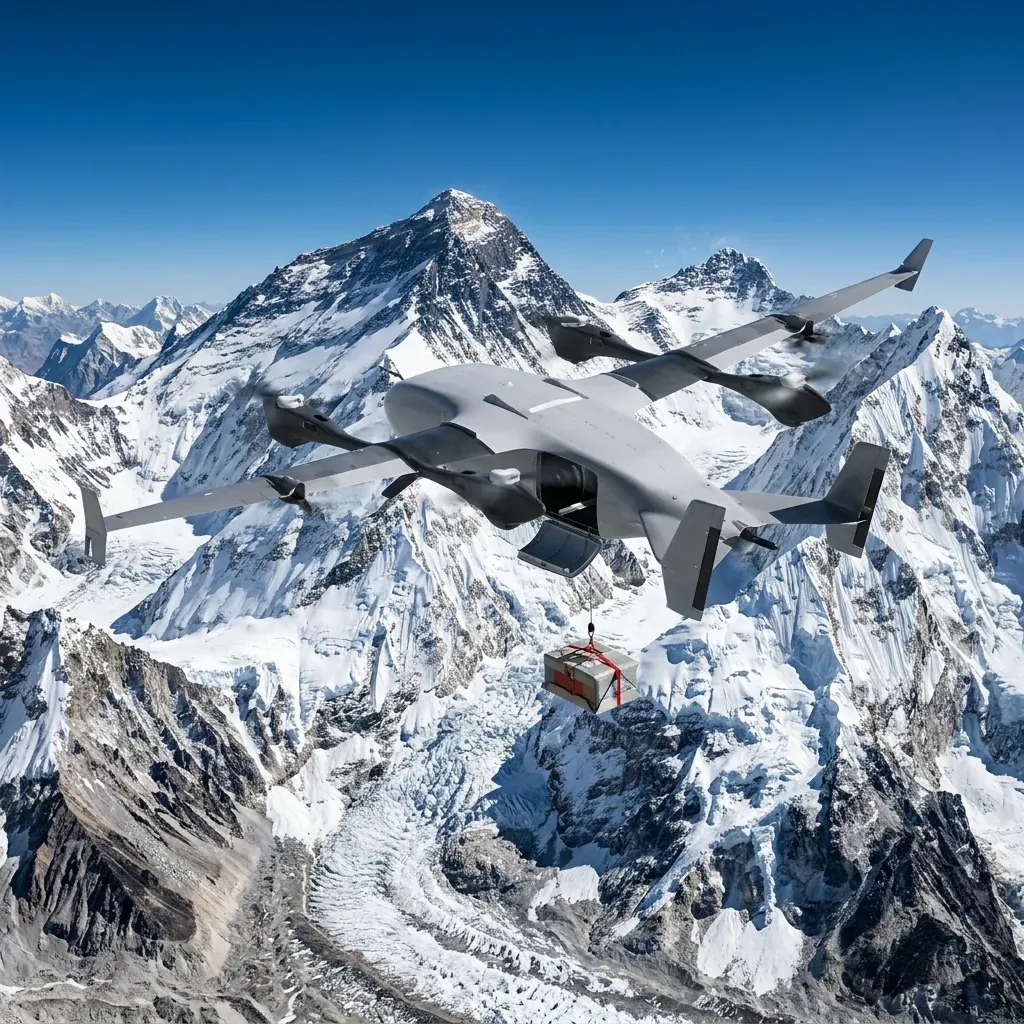
Global drone technology leader DJI has officially entered the long-range logistics market by unveiling its first lift-and-cruise eVTOL (electric vertical takeoff and landing) cargo aircraft: the DJI EV50. The aircraft's existence was announced alongside details of a historic high-altitude mission, during which the drone successfully reached 29,072 feet (8,861 meters) on the north slope of Mount Everest. Over a 12-day research campaign in China's Qomolangma National Nature Reserve, the drone completed 12 transport flights carrying ozone-measuring instruments for Peking University scientists under extreme meteorological conditions.
The introduction of the EV50 marks a clean break from the multirotor architectures that have defined DJI's catalog. By pairing multirotor takeoff capability with fixed-wing cruise efficiency, the EV50 represents a major step forward for autonomous middle-mile logistics. For commercial operators and enterprise logistics companies navigating the European Union Aviation Safety Agency (EASA) frameworks, this development highlights the rapid maturation of Beyond Visual Line of Sight (BVLOS) platforms designed to handle complex cargo operations in extreme environments.
Technical Specifications of the DJI EV50
The DJI EV50 is built on a lift-and-cruise eVTOL configuration, utilizing a 23-foot (7-meter) wingspan and an 12.1-foot (3.7-meter) fuselage. To achieve vertical lift and horizontal transition, the aircraft features an eleven-motor layout: eight vertical-lift rotors generate thrust for takeoff and landing, while three rear-facing pusher propellers propel the drone during forward cruise flight. During horizontal flight, the eight lift rotors lock in a streamlined position to minimize aerodynamic drag.
Detailed technical details published in China, as reported by Italian drone journal Quadricottero, indicate that the EV50 carries a maximum payload of 110 pounds (50 kilograms) and offers a flight range of 93 miles (150 kilometers). The drone achieves a top speed of 99 mph (160 km/h) when flying unloaded. Its cargo bay features a 270-liter volume (59 x 15.7 x 17.7 inches), designed to house standardized cargo containers. The airframe also supports DJI's Payload SDK, allowing operators to integrate custom sensors or multispectral imaging cameras.
To meet stringent airworthiness safety targets for BVLOS operations under the EASA Easy Access Rules and the FAA Part 107 framework, the EV50 is equipped with critical redundancy systems. The speed-measuring pitot tube is redundant and self-heating to prevent high-altitude icing. In addition, an emergency ballistic recovery parachute is integrated as a standard safety feature. The entire carbon-fiber airframe can be folded down to 7.9 x 4.6 x 3.9 feet by two operators in less than five minutes without tools.
DJI's Triple Everest Milestones
The EV50 campaign on the Chinese north slope was part of three distinct Everest operations announced by DJI on July 9, 2026. Working in partnership with Peking University's College of Environmental Sciences and Engineering, the EV50 flew reciprocating and spiral flight patterns to reach the upper troposphere, collecting data on ozone distribution and pollutants. The peak altitude of 29,072 feet (8,861 meters) surpassed the summit of Mount Everest itself, marking the first time a heavy-lift cargo drone has operated at this altitude for environmental research.
Simultaneously, on the Nepalese south side, DJI operated the **DJI FlyCart 100** cargo multirotor in partnership with local drone company Airlift. The FlyCart 100 successfully moved 22,207 pounds (10,073 kilograms) of supplies and garbage between Base Camp and Camp 1. Flying at altitudes above 20,669 feet (6,300 meters) in freezing conditions, the drone transported climbing gear, tents, and oxygen tanks up the mountain while carrying trash down, completing in 8 minutes a journey that takes Sherpas six to eight hours through the high-risk Khumbu Icefall.
To support safer mountaineering, DJI also deployed the **DJI Matrice 4E**. The drone scanned and mapped 1.1 square miles of the Khumbu Icefall at centimeter-level resolution in just 3.5 hours. Operating at 21,161 feet (6,450 meters) in sub-zero temperatures, the drone generated high-fidelity 3D models that allow rescue and climbing teams to monitor glacier shifts, locate crevices, and plan safer routes through the icefall.
| DJI Platform | Airframe Type | Max Payload Capacity | Maximum Range | Primary Application |
|---|---|---|---|---|
| DJI EV50 | eVTOL Fixed-Wing (11 motors) | 50 kg (110 lbs) | 150 km (93 miles) | Middle-mile logistics and scientific research |
| DJI FlyCart 100 | Heavy-Lift Cargo Multirotor | 40-50 kg (high altitude) | 28 km (unloaded) | Local cargo delivery and emergency logistics |
| DJI Matrice 4E | Enterprise Multirotor | Sensors (Lidar/RGB/Thermal) | N/A (40-50 min flight time) | Centimeter mapping and hazard monitoring |
Market Availability and Regulatory Hurdles
Despite the successful operational tests, DJI has not provided a commercial timeline, price list, or global distribution plan for the EV50. This rollout fits a domestic-first strategy outlined by DroneXL editor Haye Kesteloo, where new heavy-lift platforms are matured and operated extensively in China before being introduced globally. In contrast, the FlyCart 100 and Matrice 4E are already commercial products available through DJI's global dealer network.
For operators in the United States and Europe, the wait for the EV50 is complicated by political friction. In Washington, lawmakers are continuing to seek bans on Chinese-manufactured UAS technology, with DJI actively fighting its FCC Covered List designation in the Ninth Circuit Court of Appeals. If these restrictions remain in place, future heavy-lift platforms like the EV50 face significant hurdles during the equipment authorization phase, which could delay access for Western research and search-and-rescue teams.
The Global Race for Cargo eVTOL Integration
The successful deployment of the DJI EV50 on Mount Everest demonstrates that the division between traditional logistics aircraft and unmanned systems is disappearing. A 7-meter fixed-wing eVTOL capable of hauling 50 kg of payload over 150 km represents a major asset for urgent medical deliveries, offshore logistics, and emergency response operations. The main bottleneck is no longer the reliability of the hardware, but the integration of these platforms into shared civil airspace.
In Europe, the implementation of U-space frameworks will be critical to support these operations. Real-time deconfliction, automated flight authorizations, and digital traffic management are required to allow ztore cargo eVTOLs to fly safely alongside manned helicopters and airplanes. While the EV50 remains a China-only development for now, its Everest records prove that cargo eVTOL logistics are no longer a future concept, but an active operational capability.
Frequently Asked Questions (FAQ)
What is the DJI EV50?
The DJI EV50 is DJI's first eVTOL (electric vertical takeoff and landing) delivery drone, combining vertical lift capabilities with fixed-wing efficiency for long-range logistics.
How high did the DJI EV50 fly on Mount Everest?
The drone reached an altitude of 29,072 feet (8,861 meters) on the north slope of Mount Everest while carrying environmental measurement equipment for Peking University.
What are the payload and range specifications of the EV50?
The aircraft carries a maximum payload of 110 pounds (50 kg) and has an operational range of 93 miles (150 km) at a cruising speed of 99 mph (160 km/h).
When will the DJI EV50 be available outside of China?
DJI has not announced a pricing structure or release date for international markets, as the aircraft is currently undergoing testing with academic and logistics partners in China.