 NL
NL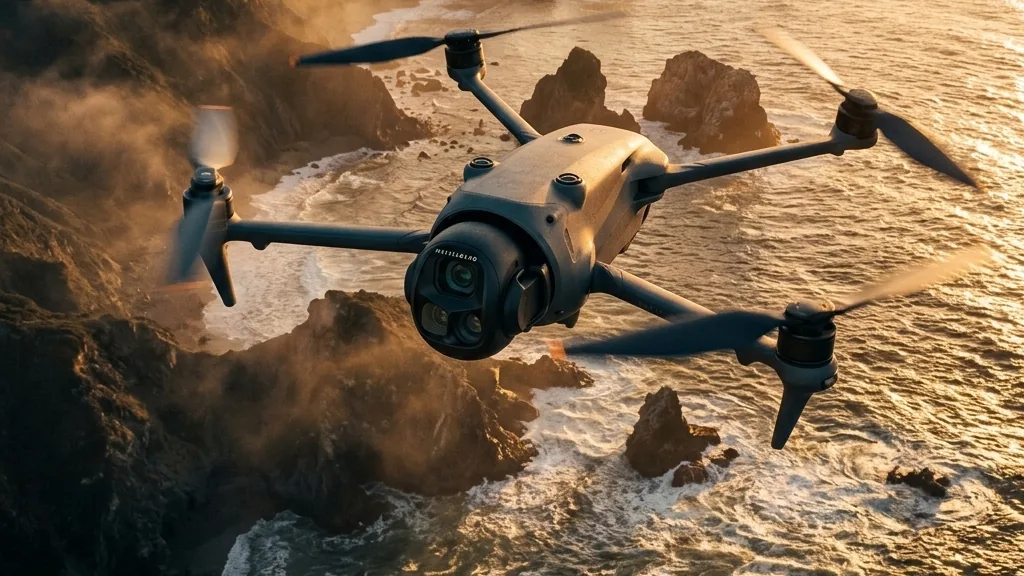
It has been over a year since DJI introduced the Mavic 4 Pro to the market, and since then, the landscape of aerial cinematography for high-end film and television productions has shifted significantly. Where we previously had to rely on heavy-lift systems like the DJI Inspire 3 or custom drones carrying a RED Komodo for every high-end shot, the Mavic 4 Pro - with its triple-camera system and revolutionary Infinity Gimbal - has proven to be a serious contender on professional sets.
Recently, an impressive compilation was released by Portuguese filmmaker and drone pilot escapewithmiguel, who spent a year traveling the world with this system. His video, Mavic 4 Pro – My Best Shots, is the perfect excuse for us as professional drone operators to take stock. How does this system truly perform in the field, and why has it become an indispensable tool for Directors of Photography (DOPs) and producers across Europe?
The Evolution of the Compact Cinema Drone
For years, there was a strict dividing line between consumer drones and professional cinema drones. Compact systems were fantastic for b-roll or quick establishing shots, but they lacked the dynamic range, lenses, and stabilization required to seamlessly integrate into a workflow alongside cameras like the ARRI Alexa or Sony VENICE.
With the introduction of the Mavic 4 Pro, we witnessed a paradigm shift. The drone is compact enough to fit in a backpack, making it extremely flexible for productions in hard-to-reach locations. Simultaneously, the integration of the upgraded Hasselblad sensor offers a level of image quality that meets the rigorous standards of the most demanding colorists. This makes it not just an ideal b-camera, but in many cases, the a-camera for specific aerial sequences.
Three Lenses for Unprecedented Creative Freedom
For a DOP, the choice of focal length is crucial for storytelling. A wide-angle lens can capture a vast, epic landscape, while a telephoto lens adds compression and isolates the subject from the background. Previously, changing a lens mid-flight meant the drone had to land, after which the team physically swapped the lens - a process that costs valuable time on a film set.
The triple-camera system of the Mavic 4 Pro eliminates this friction by providing three integrated focal lengths:
- 24mm Hasselblad Main Camera: Perfect for sweeping, misty mountain panoramas with maximum dynamic range.
- 48mm Medium Telephoto: Ideal for bridging distances without overly compressing the perspective.
- 166mm Telephoto: Adds extreme compression, which is fantastic for isolating intimate details of rugged coastlines.
In escapewithmiguel's compilation, it is beautifully demonstrated how this works in practice. He switches seamlessly between these lenses mid-air without losing a single second of flight time. This versatility allows us to deliver multiple creative options to the director in a single flight.
Infinity Gimbal: Mastering Complex Camera Movements
One of the most highly praised innovations of the Mavic 4 Pro is the Infinity Gimbal. Where previous generations of compact drones were limited in their pan and tilt range, this new gimbal offers a degree of freedom that we previously only experienced with the Inspire 3.
Thanks to the Infinity Gimbal, complex, multi-axis camera movements are now possible. Imagine shots where the drone flies backward while the camera slowly pans and tilts independently of the flight path - a maneuver that requires extreme precision and yields an incredibly dynamic, cinematic effect. It empowers us as operators to seamlessly connect large-scale landscapes with subtle, emotional camera movements that draw the viewer deeper into the story.
HDR and Hasselblad: Hollywood-Grade Color Grading
A great shot starts with good lighting, but it lives or dies in post-production. The footage in escapewithmiguel's compilation stands out due to its exceptional atmosphere, achieved by utilizing the highest HDR recording capabilities of the Hasselblad camera.
For high-end film productions, 10-bit color depth is of critical importance. It allows colorists to recover shadows and retain highlights in high-contrast scenes, such as during sunrise or sunset. This enables us to deliver footage that is not only technically perfect but also aligns flawlessly with the 'look and feel' of the rest of the film. The mood of a moment, whether it's the cold mist of a morning or the warm glow of a summer evening, is preserved without any loss of quality.
Mavic 4 Pro: Specifications Overview
| Feature | Specification | On-Set Advantage |
|---|---|---|
| Camera System | 24mm, 48mm, 166mm (Triple Lens) | Instantly switch focal lengths without landing the drone. |
| Gimbal | Infinity Gimbal | Allows for complex, multi-axis independent camera movements. |
| Color Profile | 10-bit D-Log M / HLG | Maximum dynamic range for Hollywood-grade color grading. |
| EASA Category | Specific (at Drone Department) | Flights in CTR and near populated areas allowed with proper permits. |
EASA Regulations and On-Set Safety
At Drone Department, we operate under the EASA Specific category. This grants us the authorization to execute complex flights that are restricted for standard operators, such as flying in controlled airspace (CTR) or closer to populated areas.
An additional benefit of compact systems like the Mavic 4 Pro is their lower weight and relatively quiet motors compared to heavy-lift drones. This significantly lowers the risk profile, which can accelerate the permit approval process, and it is also much more pleasant for the cast and crew on set regarding noise pollution. This makes the system the ideal choice for productions in densely populated areas or nature reserves with strict environmental regulations.