 NL
NL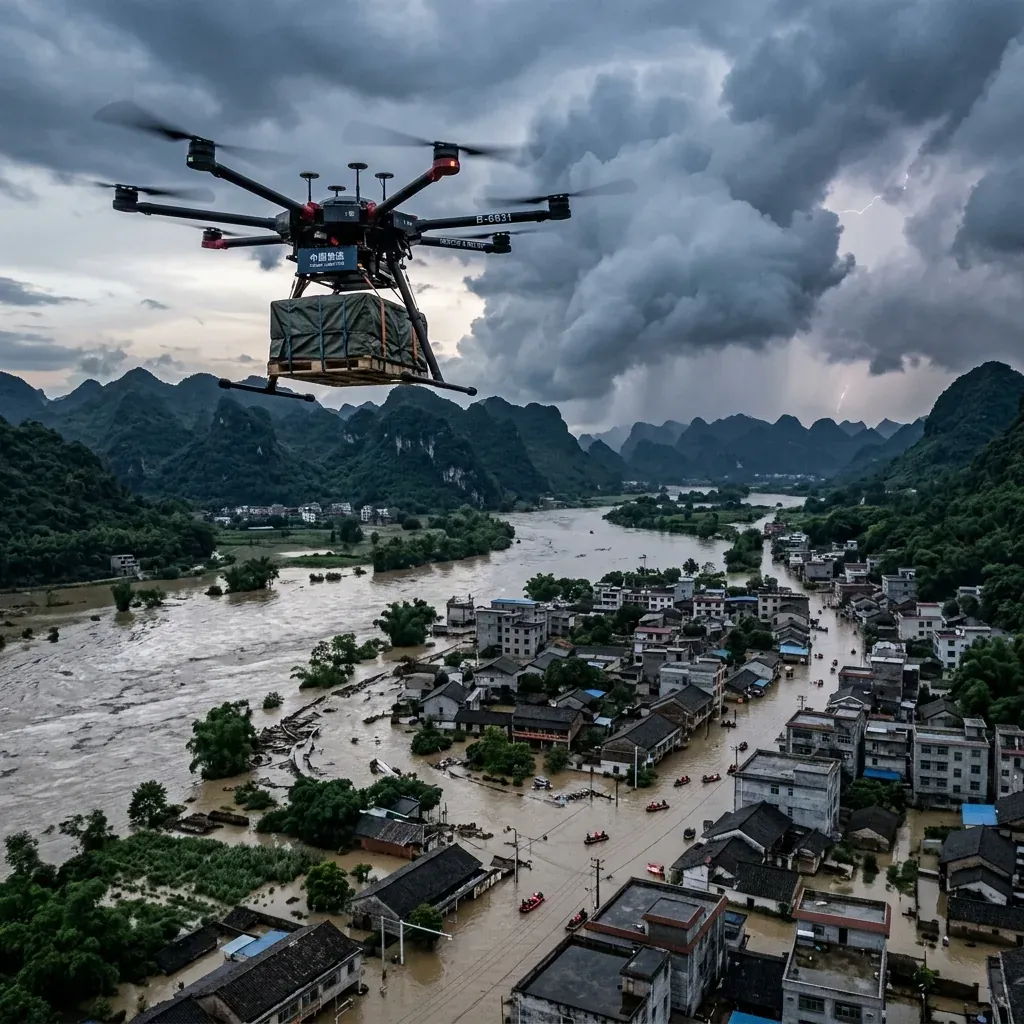
A dramatic flood rescue operation in the southern Chinese region of Guangxi has sparked intense debate within the global aviation community. Faced with a stranded truck driver on the roof of a fuel tanker surrounded by rapidly rising floodwaters, emergency response workers bypassed standard procedures. They deployed a heavy-lift agricultural cargo drone to physically hoist the man and fly him to safety. The rescue footage, which was broadcast by Hengzhou Radio and Television Station and went viral via global networks like CGTN and Xinhua, showcased a triumph of modern engineering. However, it also dropped a major legal question into the lap of aviation authorities: under current international regulations, carrying a human passenger on a standard commercial drone is strictly illegal.
As unmanned aviation technology specialists operating across European airspace, we at Drone Department monitor these operational milestones closely. While this incident proves that heavy-lift drones can act as crucial lifelines in extreme emergencies, it also brings up serious questions regarding system redundancy, liability, and regulatory constraints. In this analysis, we examine the details of the Guangxi drone airlift and evaluate the legality and feasibility of such emergency operations under the jurisdiction of the European Union Aviation Safety Agency (EASA) and the Federal Aviation Administration (FAA).
Analyzing the Guangxi Flood Rescue Operation
The rescue occurred on July 6, 2026, in Yunbiao Town, Hengzhou City, within the Guangxi region. Torrential rains from Typhoon Maysak caused widespread flooding, leaving over 15,000 residents stranded. A driver of a fuel tanker truck found himself cut off by rapid currents. With water rising quickly around the explosive cargo, rescue boats and helicopters were unable to safely reach the vehicle. Confronted with these limitations, emergency personnel decided to deploy two heavy-lift multirotor drones—typically used for crop spraying or industrial logistics.
The drone utilized had a wingspan of over 10 feet (3 meters) and a payload capacity of approximately 220 pounds (100 kilograms). Assisted by three smaller surveillance drones monitoring the flight path and wind shear, a rescue worker maneuvered the drone to drop a specialized harness to the driver. Once securely strapped in, the driver was lifted off the truck and carried over the raging floodwaters to dry land. In parallel, other teams used drones rigged with guiding ropes to pull inflatable rafts through the currents, demonstrating a highly coordinated drone-led rescue fleet.
While the operation successfully saved a life, a report by industry news outlet DroneXL points out that the flight directly violated standard aviation safety protocols. The heavy-lift drone was engineered and certified strictly to carry agricultural chemicals or logistics payloads, not to transport human beings. Had a single motor failed or a signal dropout occurred, the driver would have faced a catastrophic fall into the floodwaters, as these platforms lack the rigorous safety margins required for passenger transport.
Why Lifting Humans with Commercial Drones is Prohibited
Aviation regulations across the globe draw a strict line when it comes to carrying human cargo. In the United States, commercial drone flights are governed by the FAA Part 107 framework. This regulation is designed entirely for low-risk missions, such as mapping, aerial photography, and infrastructure inspections. Under Part 107, carrying a human passenger is explicitly illegal. While the FAA updated its rules in 2021 to allow flights over people under specific conditions, this is entirely separate from using the drone to physically lift or suspend a person.
In Europe, EASA enforces a similarly robust set of boundaries. According to the EASA Easy Access Rules, drone operations are split into three categories based on risk: Open, Specific, and Certified. Human transportation falls exclusively under the Gecertificeerde (Certified) category. This classification requires the drone, the remote pilot, and the operating organization to meet the same safety, redundancy, and airworthiness standards as commercial passenger airlines and helicopters.
The primary reason for this strict regulatory barrier is the lack of airframe redundancy on industrial cargo drones. Most crop-spraying drones are quadcopters or hexacopters designed for high payload-to-weight ratios, not maximum safety margins. If a motor fails, there is no backup system to maintain control. Furthermore, standard drones do not feature secondary navigation computers, ballistic recovery parachutes, or safety harnesses certified for human suspension. In the eyes of aviation regulators, using a crop duster to carry a person is an unacceptable safety risk.
EASA Regulations vs. Emergency Deviations in Europe
The Guangxi incident presents a challenging scenario for European emergency services. Under EASA rules, the use of a non-certified cargo drone to lift a person is illegal, regardless of the emergency. However, national regulations in various European countries provide legal exemptions for first responders and state organizations (such as the police, fire departments, and military) under strict conditions.
In a life-or-death scenario, a rescue crew might rely on the legal defense of necessity or "force majeure". If a human life is in immediate danger, and no other rescue option is available, first responders may make a tactical decision to bypass the drone rulebook to save a life. However, doing so carries significant legal and professional risks for both the drone pilot and the agency involved, as any technical failure resulting in injury would be subject to strict scrutiny.
| EASA Category | Typical Use Cases | Human Transport Allowed? | Emergency Exceptions? |
|---|---|---|---|
| Open (A1, A2, A3) | Recreational flights, light photography, visual mapping. | No, strictly prohibited. | No. Rules are absolute for civil operators. |
| Specific (STS, PDRA) | Industrial inspections, heavy agriculture, BVLOS mapping. | No, payload limited to sensors/cargo. | Tactical waivers available for State/SAR agencies. |
| Certified | eVTOL air taxis, passenger transport, heavy urban cargo. | Yes, with proper airworthiness certification. | Yes. Fully integrated into emergency response frameworks. |
The Technical Reality and the Future of Drone-Led Evacuation
While regulators remain cautious, the hardware capable of lifting adult humans is already widely available. Heavy-lift drones designed for construction logistics and agricultural spraying routinely carry payloads exceeding 220 pounds (100 kg). Drones have been utilized in disaster relief since researchers at Texas A&M University deployed them during the 2013 Moore tornado. However, their role has historically been limited to reconnaissance and delivering light supplies, rather than acting as transport vehicles.
To bridge the gap between technology and safety, the next phase of emergency response will require the development of dedicated, certified Search and Rescue (SAR) drones. These platforms will need to feature built-in redundancy, such as octocopter configurations capable of flying with multiple motor failures, secure encrypted control links, and emergency ballistic parachutes. Several European defense and aerospace start-ups are currently developing these specialized platforms to meet the demands of future disaster relief operations.
The Guangxi flood rescue has proven that the need for drone-led human extraction is real. Aviation authorities like EASA must proactively develop certification pathways that allow emergency services to legally and safely deploy heavy-lift passenger drones. Until then, using a standard cargo drone for human evacuation will remain a high-risk, legally gray intervention—even if it successfully saves a life.
The Path Forward for Emergency Drone Operations
The use of a heavy-lift drone to rescue a stranded truck driver in China highlights the growing capabilities of modern unmanned aerial vehicles. The fact that this successful rescue was technically illegal under current aviation laws exposes a growing gap between technology and policy. For the European market, it is vital that regulators and emergency services collaborate to establish safe, legal, and certified frameworks for drone-based human extraction.
Until certified emergency passenger drones are integrated into active service, pilots and incident commanders will continue to face difficult ethical decisions when lives are on the line. The Guangxi flood rescue will undoubtedly serve as a catalyst for EASA and global regulators to accelerate the integration of heavy-lift emergency drones. The technology is ready; now the regulations must evolve to support it.
Frequently Asked Questions (FAQ)
Is it legal to use a drone to rescue a person in Europe?
Under standard EASA regulations, it is illegal because commercial drones are not certified for carrying human passengers. In extreme emergency situations, first responders may invoke emergency waivers or legal necessity defenses, but this is handled on a case-by-case basis.
Which commercial drones are capable of lifting a human?
Large industrial drones, particularly heavy-lift agricultural crop sprayers or bulk logistics drones, have payload capacities ranging from 100 kg to 200 kg. This is theoretically sufficient to lift an adult, though these drones are not built with the safety systems required for passenger flight.
What are the main risks of lifting a person with a standard cargo drone?
The primary risk is a lack of system redundancy. Standard cargo drones lack backup motors, secondary flight controllers, or ballistic recovery systems. A single technical glitch or wind gust could lead to a catastrophic fall.
Is EASA working on regulations for passenger-carrying drones?
Yes. EASA is actively developing rules under the 'Certified' category to govern Urban Air Mobility (UAM), including electric vertical takeoff and landing (eVTOL) air taxis. These vehicles must meet safety standards equivalent to those of commercial passenger helicopters.