 NL
NL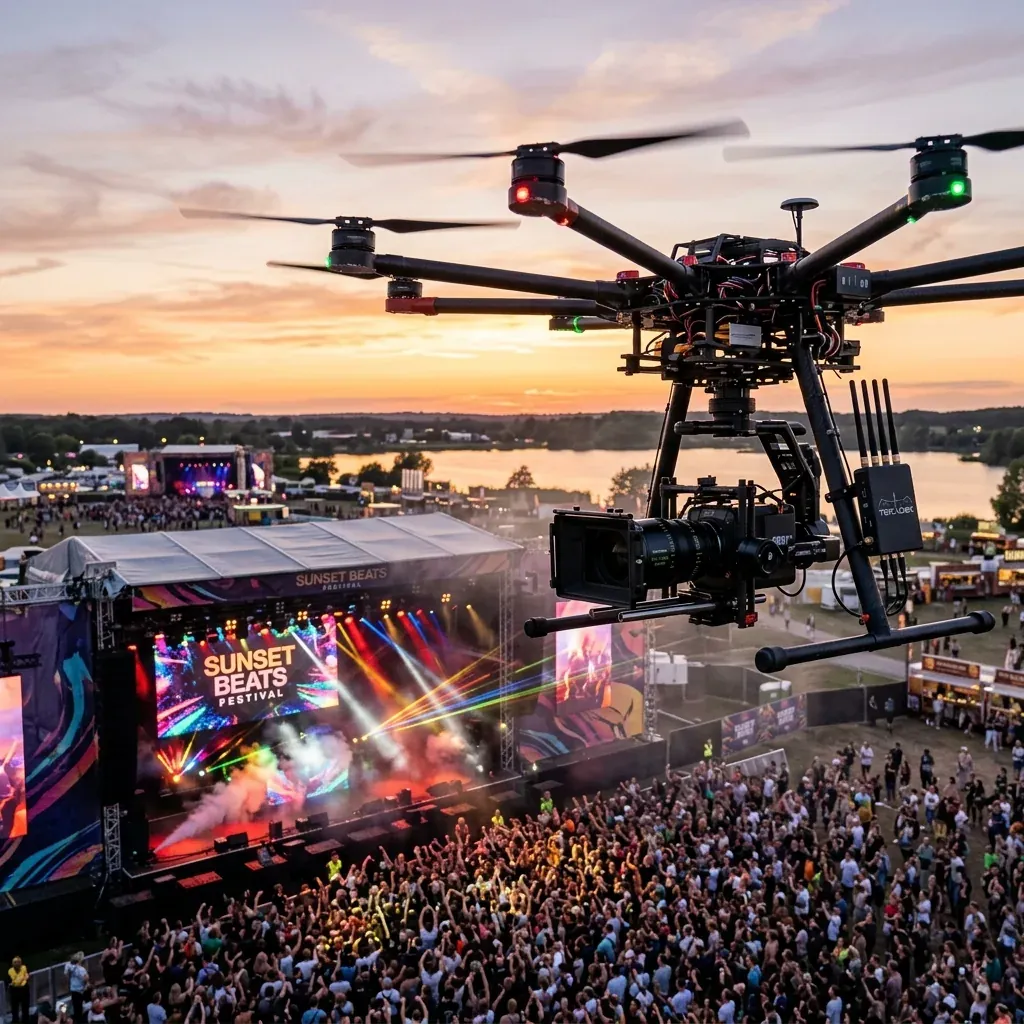
The coverage of large-scale music events and festivals is experiencing a technological revolution through the integration of professional live broadcast drones. Where heavy cranes, cable cams, and manned helicopters were once required to capture dynamic aerial overviews, flexible unmanned aircraft now rule the sky. This transition has been accelerated by the breakthrough of advanced wireless video transmitters capable of sending high-quality video feeds directly to a production truck with extremely low latency. During massive summer dance events and electronic music festivals, real-time integration into the live broadcast is essential to offer viewers at home the same intense visual experience as the crowds gathered on the ground.
To blend aerial feeds seamlessly with traditional ground-based cameras, the delay of the wireless link must be kept to an absolute minimum. In professional broadcasting, a latency of under 100 milliseconds is the benchmark. If the drone feed lags behind, the sync with stage audio and other cameras is lost, distracting the audience. Through the integration of low-latency SDI and HDMI video links, directors can now utilize live drone feeds as a main camera choice. This opens up unprecedented creative possibilities for live coverage of major artists, light shows, and elaborate festival fireworks displays.
The Rise of Wireless Live Video at Summer Dance Events
Massive dance festivals and outdoor summer dance events draw tens of thousands of attendees and are characterized by rapid successions of strobe lights, lasers, and pyrotechnics. Capturing this high-energy dynamic requires camera angles and motion that are constantly in flux. Drones fill this need perfectly, flying from a close-up of the DJ booth to a sweeping overview of the dancing crowd in seconds. However, the biggest challenge is the reliability of the wireless connection. Festival grounds are highly congested RF (radio frequency) environments due to the presence of thousands of smartphones, security radios, and production gear.
To guarantee a stable video signal under these demanding conditions, broadcast drones use professional transmission hardware. Companies like Teradek and DJI have engineered wireless transmitters specifically designed to avoid interference. The DJI Transmission system, for example, utilizes automatic frequency hopping (DFS) across the 2.4 GHz, 5.8 GHz, and DFS bands, shifting the feed to a clean channel the moment interference is detected. This ensures an uninterrupted live feed, even in the middle of a crowd of 50,000 dancing festival goers.
Technical Challenges and the Integration of SDI/HDMI Standards
Interfacing the wireless video link with the broadcast production truck requires professional connectivity standards. While consumer-grade drones often rely on Wi-Fi-based protocols outputting HDMI from a remote controller, production switchers demand a stable, uncompressed SDI (Serial Digital Interface) feed. SDI supports longer cable runs without signal degradation and is the industry standard for live TV and online streaming. Professional broadcast drones are therefore equipped with transmitters supporting both HDMI and 3G-SDI or 12G-SDI outputs.
The signal is transmitted wirelessly from the drone to a receiver array placed near the production vehicle. From the receivers, the video is routed via fiber-optic cables directly into the video switcher, allowing the director to cut to the drone feed instantly. By utilizing COFDM (Coded Orthogonal Frequency Division Multiplexing) transmission, the signal remains stable even when the drone flies behind large LED walls or stage scaffolding, which typically block traditional line-of-sight wireless links.
The Crucial Factor: Low Latency Under 100 Milliseconds
In live television and streaming, latency is the enemy of a smooth broadcast. A delay exceeding 200 milliseconds is noticeable to viewers, especially during music beats and live performances that require tight synchronization. By incorporating zero-delay chipsets (such as technology developed by Amimon, which powers many Teradek systems), the latency of the RF connection is kept under 1 millisecond. Including the camera's internal processing and switcher routing, the total end-to-end delay remains well below the 100-millisecond threshold.
This near-zero latency allows drone pilots and broadcast directors to coordinate in real time during the show. When a director requests a quick zoom or a sweeping movement over the stage, they see it on their monitor immediately. This enables rhythmic editing in sync with the music beats, amplifying the visual energy of the broadcast. At Drone Department, we deploy these systems to elevate live event coverage, which you can read about on our services page for live broadcast & events.
Aviation Regulations and Safety Above Festival Audiences
Operating drones near massive crowds requires strict compliance with aviation authorities. Under EASA (European Union Aviation Safety Agency) rules and UK CAA (Civil Aviation Authority) guidelines, flying directly over open assemblies of people is restricted. For festival operations, drone companies must obtain specific category operational authorizations, backed by a detailed SORA (Specific Operations Risk Assessment).
Safety is the primary concern for these operations. Drones deployed for live events, such as the DJI Inspire 3, are equipped with obstacles sensors and redundant flight controllers. Furthermore, certified professional drone pilots establish safety buffers, flying alongside or behind the crowds and utilizing zoom lenses to capture close-up crowd reactions safely. Festival flights require coordination with local authorities and event production teams, similar to the complex operations executed during major sports events, such as the Formula 1 Monaco drone show.
Comparative Analysis of Wireless Video Transmission Protocols
The following table outlines the different wireless video transmission protocols currently utilized for live drone broadcasts, comparing their key performance parameters:
| Transmission Protocol | Average Latency | Maximum Resolution | Interference Resistance | Primary Application |
|---|---|---|---|---|
| Zero-Delay RF (e.g. Teradek Bolt) | < 1 ms (System < 80 ms) | 4K UHD at 60 fps | High (licensed/excl. frequencies) | Direct live TV integration & studio regie |
| DJI Transmission (SDR) | Approx. 68 ms (System < 100 ms) | 1080p at 60 fps | Extreem High (auto DFS hopping) | Live festival stages & dynamic feeds |
| COFDM (Broadcast standard) | Approx. 150 ms | 1080i/1080p | Extreem High (NLOS capability) | News gathering & long-range operations |
| 5G / LTE Video Streaming | 200 to 500 ms | 1080p to 4K | Moderate (network dependent) | BVLOS monitoring & remote broadcasting |
Frequently Asked Questions (FAQ)
Why is low latency critical for live festival drones?
For live broadcasts, the video feed must match the audio and ground camera angles in real time. A latency of less than 100ms prevents jarring synchronization issues for viewers.
How do broadcast drones handle smartphone frequency interference?
Professional systems utilize software-defined radio (SDR) and automatic frequency hopping across DFS channels to dodge congested bands and find clear paths.
Are drones allowed to fly directly over festival crowds?
No, direct overflight of open assemblies is prohibited for safety reasons. Pilots fly in dedicated safety zones beside the stages, using long zoom lenses to capture the energy of the crowd.
What video outputs are used to link with production switchers?
Receivers on the ground convert the wireless signal into professional 3G-SDI or 12G-SDI connections, which feed directly into the event's central video switcher.
A New Visual Standard for Festival Broadcasts
Integrating live-drones with low-latency videolinks has fundamentally changed how outdoor music festivals are captured. By overcoming RF interference and delivering stable SDI feeds with under 100ms latency, drones have evolved from a novelty shot to an indispensable broadcast asset. Music fans at home can experience the show with more energy, while directors gain a powerful tool for dynamic storytelling. Ongoing advancements in wireless video technology ensure that live drone feeds will continue to shape the broadcast standard for the world's largest music events.