 NL
NL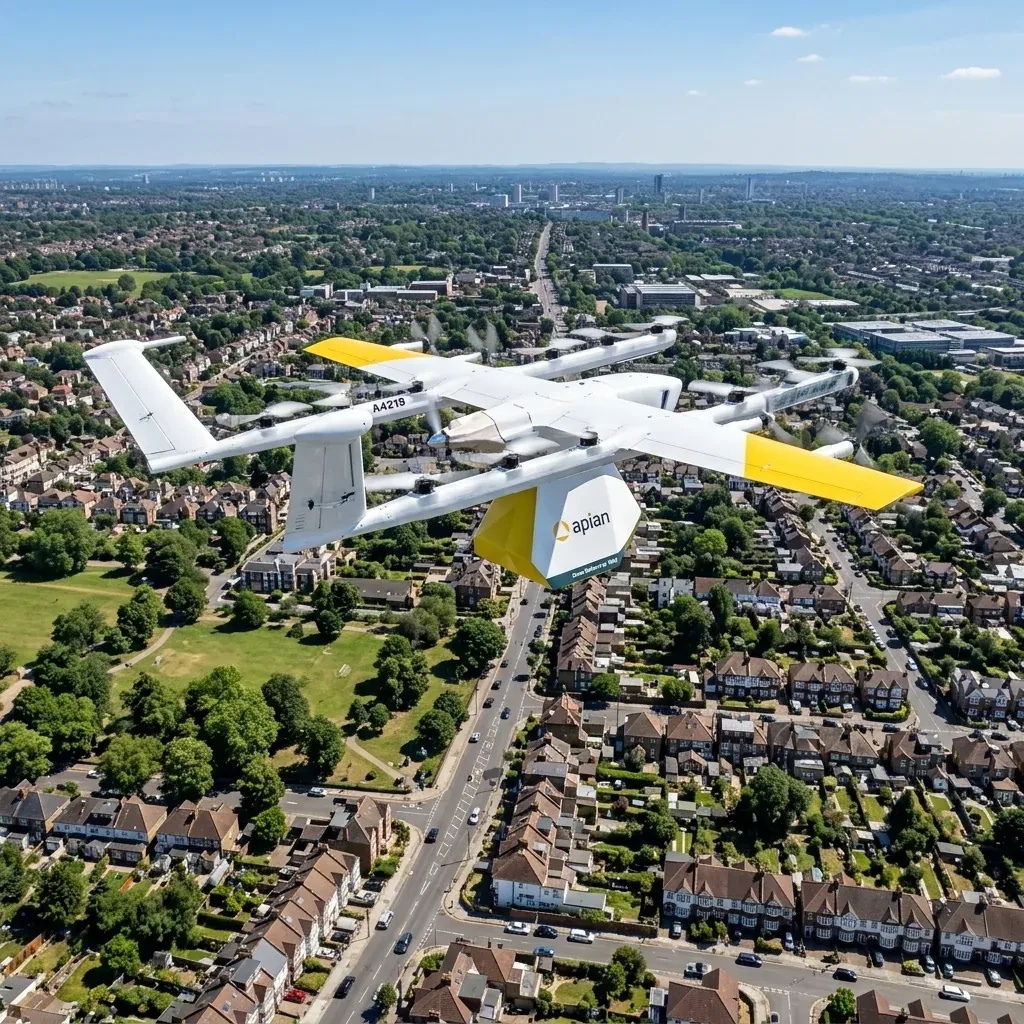
The British National Health Service, the NHS, is taking a major step toward modernizing its diagnostic logistics by deploying autonomous delivery drones across southwest London. This innovative network has been established by South West London Pathology (SWLP), a pathology consortium providing diagnostic testing services for approximately 1.8 million patients in the region. Since operations began in February 2026, drones from the British healthcare startup Apian and the Alphabet-owned drone operator Wing have been routinely transporting blood samples, urine tests, and tissue samples. This trial represents one of the first times unmanned aerial systems (UAS) have been integrated into routine medical logistics over a densely populated European urban environment.
The delivery drones operate along a set route between the Nelson Health Centre in Raynes Park and the pathology laboratory at St George’s Hospital in Tooting. While transporting samples by road using standard delivery vans or motorbikes usually takes around twenty minutes due to London's heavily congested streets, the drones complete the flight in just over three minutes. This represents an 85% reduction in transit times. The speed and predictability of drone transport are especially beneficial during the hot summer months, when extreme ground temperatures and traffic delays can compromise the integrity of temperature-sensitive biological samples. This initiative proves how modern, fit-for-purpose medical technology can directly improve patient outcomes and alleviate logistical pressure on healthcare networks.
Faster Diagnoses and Enhanced Patient Care Through Medical Drones
In medical diagnostics, time is a critical variable. SWLP processes more than 51 million laboratory samples annually for all NHS trusts and primary care GP clinics in southwest London. Historically, clinicians and laboratory staff had to rely on ground-based couriers to transport patient samples. However, traffic congestion, road works, and rush hours created significant unpredictability in delivery schedules. By taking medical transport to the air, SWLP has bypassed these ground-level limitations. The electric aircraft fly a direct flight path at a fixed altitude, unaffected by ground obstacles and traffic congestion.
More than 2,000 patients have already benefited from the faster turnaround times of diagnostic results. Getting samples to the lab in minutes rather than hours allows doctors to make clinical decisions and begin targeted treatments much faster. Dr Sabena Mughal, an NHS pediatric consultant and Director of Healthcare Partnerships at Apian, emphasizes the direct clinical impact: "Drone delivery is no longer just a futuristic concept in healthcare logistics; it has become an essential daily utility. By completing thousands of successful flights across London, we have enabled doctors to make faster decisions for heart attack patients and accelerated critical diagnostics for pediatric cases."
The Technology Powering the Wing and Apian Delivery Drones
The unmanned aircraft used for the London medical route are specifically designed for safe, quiet, and reliable package delivery in urban settings. The platform utilizes an eVTOL (electric vertical takeoff and landing) fixed-wing hybrid configuration developed by Wing in collaboration with Alphabet. With a wingspan of approximately 1.5 meters, the carbon-fiber aircraft combines the vertical takeoff and landing flexibility of a helicopter with the speed and aerodynamic efficiency of a traditional propeller plane. The drone lifts off vertically, transitions to forward horizontal flight at a cruising speed of roughly 100 km/h, and hovers at its destination to drop off its cargo.
Safety is the primary design consideration of the aircraft. It features a highly redundant twelve-motor configuration mounted on two parallel structural booms. If a single vertical rotor fails, the remaining lift motors automatically compensate to ensure the aircraft remains stable and can finish the flight or perform a safe landing. The medical samples themselves are stored inside a custom-designed, aerodynamic, and thermally insulated container suspended beneath the drone's fuselage. This protective capsule safeguards biological specimens against physical shock and ambient temperature fluctuations, preserving sample quality. Ground operations are simplified by Wing's automated winching mechanism: the drone hovers at a safe height and lowers the package on a tether, removing the need for specialized landing pads or physical handling of the aircraft on the ground.
Efficiency and Sustainability in London's Healthcare Infrastructure
In addition to faster clinical diagnostics, the transition to unmanned aviation aligns with the NHS's aggressive environmental targets. The NHS is responsible for approximately 4% of the United Kingdom's total carbon footprint. By replacing traditional delivery vans and courier motorcycles with electric drones, SWLP reduces the CO2 emissions per delivery by 98%. This reduction directly supports the NHS's net-zero goals, while also improving local air quality and reducing noise pollution in southwest London's residential neighborhoods.
From an operational standpoint, the financial benefits of drone integration are equally compelling. Initial data shows that drone transport is up to 23% cheaper than existing urgent courier services on specific routes. By eliminating driver costs, fuel expenses, and vehicle maintenance, the operational cost per flight is expected to decline further as the flight frequency increases. Simon Brewer, Managing Director of SWLP, highlights the strategic importance of this cost reduction: "We are investing heavily in laboratory automation and digital systems, but the value of these diagnostic tools is limited if patient samples are stuck on congested roads. Drones provide us with a faster, cheaper, and greener transport solution." Following this initial success, plans are underway to scale the network to connect additional hospitals, including St Helier, Croydon, and Kingston.
Regulatory Frameworks and the Path to Urban BVLOS Flights
Executing autonomous drone flights over densely populated urban areas requires close collaboration with the UK Civil Aviation Authority (CAA). The SWLP flights are conducted under a strict BVLOS (Beyond Visual Line of Sight) regulatory framework, meaning the aircraft is operated without a pilot keeping physical visual contact with it. To ensure safe integration into the shared airspace, the CAA applies a risk-based authorization process similar to the guidelines of the European Union Aviation Safety Agency (EASA).
In Europe, complex BVLOS operations are regulated under the [EASA SORA 2.5 framework](easa-easy-access-rules-sora-2-5.html). This safety methodology requires operators to prove that their aircraft, autopilot software, and communications systems have sufficient technical redundancy and failsafes to mitigate risks to people on the ground and other airspace users. This matches the broader [drone regulations](../drone-rules.html) active across the EU and the UK, which establish harmonized rules for commercial drone operations and the rollout of U-space (the automated traffic management system for drones). Utilizing type-certified aircraft and licensed professional drone pilots is critical to scaling these services safely and gaining public acceptance.
Comparative Analysis of Urban Medical Transport Methods
To demonstrate the performance advantages of autonomous aerial logistics over traditional ground-based courier methods, the following table compares key performance metrics on the route between Raynes Park and Tooting in London:
| Metric | Autonomous Medical Drone | Standard Delivery Van | Urgent Motorcycle Courier |
|---|---|---|---|
| Average travel time | 3 to 4 minutes | 20 to 30 minutes | 15 to 20 minutes |
| CO2 reduction per trip | 98% reduction | Baseline (0%) | Approx. 50% reduction vs. van |
| Logistical cost factor | Up to 23% cheaper | Standard | High (urgent premium) |
| Traffic sensitivity | None (direct air route) | Extremely high (congestion-prone) | High (limited filtering) |
| Weather constraints | Gale-force winds, heavy icing | Severe snow, flooding | Heavy rain, road ice |
Frequently Asked Questions (FAQ)
Why is the NHS using drones for sample transport in London?
Drones bypass urban traffic congestion entirely, reducing delivery times by up to 85%. This allows clinical laboratories to process tests faster, improving patient diagnosis and treatment speeds.
Are the patient samples safe during drone flights?
Yes. Samples are secured inside custom-designed, shock-absorbent, and temperature-controlled pods. The aircraft are equipped with twelve redundant motors and advanced autopilot systems to guarantee high operational safety.
How much cheaper is drone delivery compared to traditional couriers?
Currently, drone transport is up to 23% cheaper than urgent road-based couriers on specific routes, and costs are expected to decrease further as operations scale up.
What hospitals and medical centers are connected?
Drones fly daily between the Nelson Health Centre in Raynes Park and St George’s Hospital in Tooting. Future expansions are planned to connect St Helier, Croydon, and Kingston hospitals.
A New Horizon for Medical Drone Logistics
The successful integration of medical delivery drones in southwest London demonstrates that the future of medical logistics is vertical. By combining their expertise, SWLP, Apian, and Wing have built a fast, cost-effective, and zero-emission delivery network that directly improves patient care. The London project provides a clear blueprint for how urban centers can integrate unmanned systems into public services. As aviation authorities continue to develop BVLOS standards and U-space digital traffic management systems, medical drone deliveries are set to scale from local trials to nationwide infrastructure across the UK and continental Europe.