 NL
NL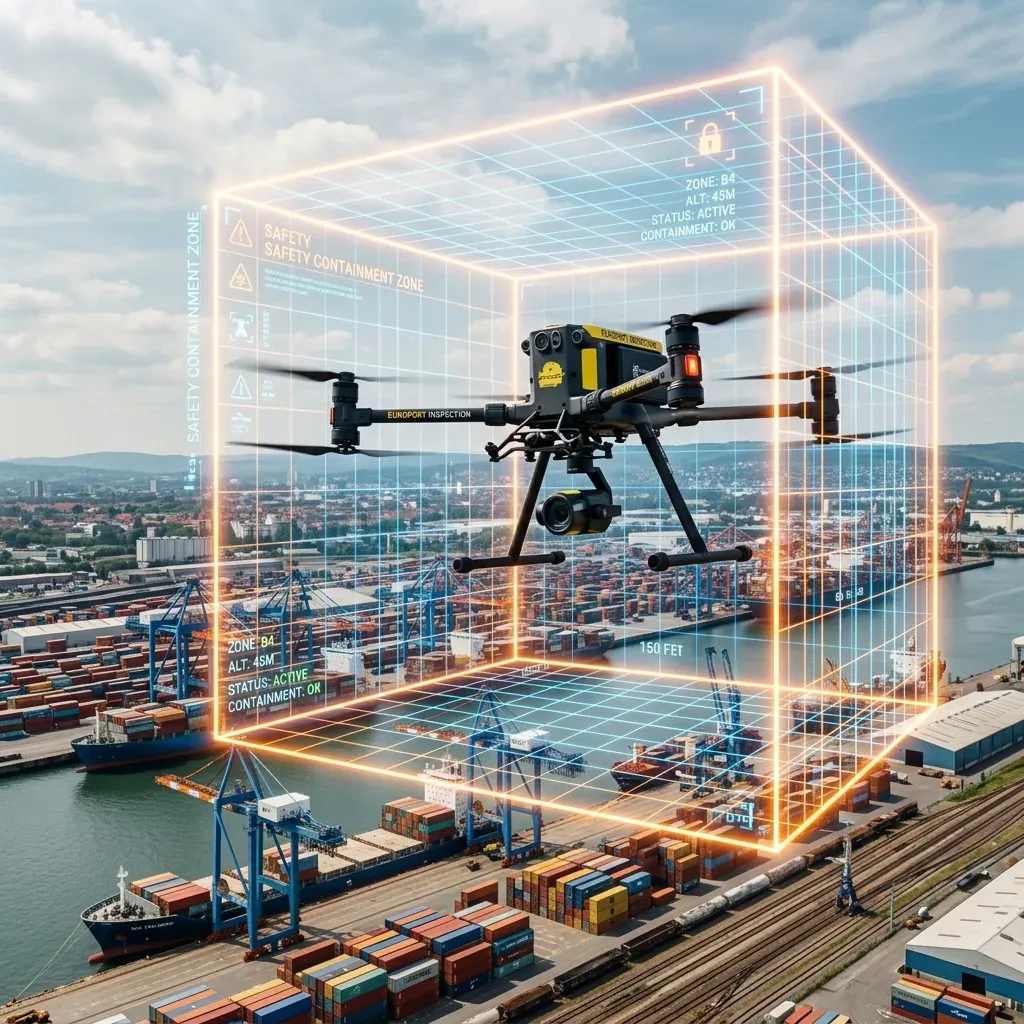
Within the European regulatory framework for unmanned aviation, the transition to the updated Specific Operations Risk Assessment, known as SORA 2.5, represents one of the most significant changes in recent years. A key element of this assessment is the concept of containment. This safety mechanism ensures that an unmanned aircraft (UA) remains strictly within the predefined flight geography and buffer zones, preventing fly-aways or uncontrolled incursions into higher-risk adjacent environments. While older SORA methodologies utilized a binary 'basic' versus 'enhanced' containment logic, the JARUS SORA 2.5 standards introduce three distinct levels of containment robustness: Low, Medium, and High.
This risk-proportionate structure aligns with the safety philosophy of the Specific category defined by EASA. Drone operators conducting complex missions must evaluate their operations, determine the required containment level, and implement the necessary technical and organizational measures. In this article, we cover the fundamentals of risk containment in SORA 2.5, how these levels are assigned in Step 8 of the risk assessment flow, and the technical implications for commercial drone operators across Europe.
What is containment in SORA 2.5?
Containment refers to the technical and operational safeguards designed to prevent a drone from escaping its designated flight volume during a critical failure. This includes mitigating fly-aways towards populated urban centers or busy air traffic zones. In SORA 2.5, this evaluation has been moved earlier in the process to Step 8. This adjustment ensures that containment robustness is established before the operational safety objectives (OSOs) are determined, offering a more logical flow to the risk assessment.
Determining the required containment level is based on three main criteria: the physical dimensions and speed of the drone, the assigned SAIL (Specific Assurance and Integrity Level) of the operation, and the population density or presence of assemblies of people within the adjacent area (specifically within a 1-kilometer radius of the flight boundary). Larger aircraft operating in closer proximity to people or critical infrastructure naturally demand higher levels of containment reliability.
The role of drone dimensions in containment
A critical factor that is frequently overlooked in practice is the so-called characteristic dimension of the drone. This refers to the largest physical measurement of the aircraft (typically the diagonal distance between the outermost rotor tips, including propellers). SORA 2.5 uses this measurement as a direct input for determining the required containment level, regardless of the SAIL classification. The reasoning is straightforward: a larger drone carries more kinetic energy and requires a longer stopping distance during an emergency landing or fly-away, which increases the probability of a lethal impact if it escapes the flight volume.
The SORA 2.5 methodology distinguishes three size categories based on the characteristic dimension:
- Less than 1 metre: Drones with a characteristic dimension below 1 metre (such as the DJI Mavic series or the DJI Inspire series) are considered relatively low risk. At lower SAIL levels, Low containment is generally sufficient for this size class.
- Between 1 and 3 metres: Drones in this range (such as larger cinema drones, multirotor inspection platforms, or custom heavy-lift aircraft) fall into an elevated risk category. From SAIL III onwards, these aircraft require at minimum Medium containment, regardless of the operating environment.
- Greater than 3 metres: Aircraft with a characteristic dimension exceeding 3 metres (such as large VTOL platforms, cargo drones, or fixed-wing UA systems) require at minimum Medium containment in virtually all scenarios, and High containment at higher SAIL levels. The kinetic energy and potential damage footprint during an escape are large enough that only the most rigorous safety measures are adequate.
It is important to note that the characteristic dimension does not function in isolation from the SAIL level and the environmental factors. The three parameters interact within a matrix: a small drone (under 1 metre) operating in a high-SAIL scenario (e.g. near an airport with high population density) may still require Medium or even High containment. Conversely, a 2-metre drone operating in a very remote, unpopulated area at SAIL II may qualify for Low containment. The size class therefore sets a minimum threshold, but the final determination always depends on the combination of all three factors.
The three containment levels in detail
1. Low containment
Low containment is the baseline safety requirement applicable to lower-risk flights, typically classified as SAIL I or II, or operations utilizing micro-drones weighing under 250 grams. The requirements for this level are primarily organizational and software-based, allowing the operator to submit a standard declaration of compliance stating that the drone will remain within the boundaries.
In practice, standard manufacturer safety features are sufficient. This includes properly configured software geofencing, a responsive Return-to-Home (RTH) routine triggered during a loss of signal, and thorough pre-flight checklists. No specialized emergency termination hardware or independent power supplies are required. The remote pilot remains responsible for verifying that boundary limits are accurately programmed in the ground control software.
2. Medium containment
As the operational complexity increases, resulting in a higher risk classification (typically SAIL III and IV, or when larger drones operate near populated areas), Medium containment becomes a mandatory requirement. Unlike the low level, the operator must support their declaration of compliance with concrete technical testing data and engineering analyses.
Technically, Medium containment introduces the requirement for an independent Flight Termination System (FTS). This safety system must be physically and electronically isolated from the primary flight control computer. If the main flight controller experiences a software crash or power failure, the remote pilot must be able to trigger engine termination via an independent radio frequency link. Authoritative bodies, such as the UK CAA or other national aviation regulators, verify these system schematics and reliability test logs during the operational authorization review.
3. High containment
High containment is the most stringent safety category, reserved for high-risk operations (SAIL V and VI) or flights where the adjacent area contains critical infrastructure or dense crowds. For this level, a simple self-declaration and internal test files are insufficient; the entire containment architecture must undergo independent verification by a competent aviation authority or an officially recognized qualified entity.
The technical standards for High containment are closely aligned with manned aviation certification. The flight termination hardware must feature full redundancy and be engineered according to rigorous industrial standards, such as ED-280. Additionally, the system must demonstrate an extremely low failure probability (typically less than 1 in 10,000 flight cycles), requiring extensive hardware safety reviews and software code audits to ensure no single point of failure exists.
Comparison of SORA 2.5 containment levels
To summarize the differences, the following table compares the method of proof, technical expectations, and typical SAIL classifications for each level:
| Containment Level | Characteristic Dimension | Method of Proof | Technical Requirements | Typical SAIL & Application |
|---|---|---|---|---|
| Low | < 1 m (at low SAIL) | Self-declaration by the operator | Standard software geofencing and automatic RTH functions | SAIL I & II; Rural operations using light enterprise drones |
| Medium | 1 - 3 m (or < 1 m at higher SAIL) | Declaration backed by test logs and system analyses | Independent Flight Termination System (FTS) with isolated link | SAIL III & IV; Cinema operations near urban structures |
| High | > 3 m (or 1 - 3 m at highest SAIL) | Independent verification by qualified entity or authority | Redundant, certified FTS (e.g. ED-280 compliance) with low failure rate | SAIL V & VI; Complex flights near airports or heavy assemblies |
This comparison highlights that the shift from Low to Medium containment carries the greatest operational and financial impact for drone companies, requiring them to retrofit their fleets with dedicated FTS hardware and compile detailed safety data sheets in their operations manual.
Implications for commercial operators in Europe
For drone operators across Europe, the introduction of these standardized SORA 2.5 containment levels means that operational authorizations can be pursued with greater predictability. Defining specific parameters in Annex E reduces the subjective interpretation differences that previously existed between national aviation authorities, facilitating cross-border operations.
However, this also places new demands on hardware compliance. Many consumer-grade and semi-professional drones lack the independent, isolated circuitry required for Medium containment. Operators performing inspections, mapping, or cinema video shoots in urban environments must evaluate whether their aircraft require custom retrofitting or if they should migrate to industrial enterprise platforms equipped with factory-certified termination links. For a broader look at recent regulatory changes, read our article on the updated Easy Access Rules and SORA 2.5.
We advise operators to evaluate their current fleet configurations against the new SORA 2.5 guidelines to prevent administrative delays during permit renewals. Proactively incorporating certified termination components is not only a regulatory step but also significantly enhances general flight safety. To learn more about our operational standards, view our pages on our drone pilots and our cinema-focused cinema drone operator services.
The future of risk containment in the Specific category
The structured containment levels in SORA 2.5 mark a positive step toward a mature drone ecosystem. By replacing ambiguous terms with clear Low, Medium, and High definitions, the drone industry gains a transparent set of technical goals. Although the engineering requirements for Medium and High containment require investment, they provide a reliable framework for approving complex operations. This framework encourages manufacturers to adopt safety-by-design principles and helps operators build a strong, verifiable culture of safety.
Frequently asked questions about SORA 2.5 containment
What is containment in SORA?
Containment refers to the technical and operational measures designed to ensure a drone does not escape its operational volume or safety buffer zone in the event of system failures.
When is Medium containment required?
Medium containment is mandatory for higher-risk operations, typically starting at SAIL III and IV, or when larger aircraft fly near populated areas or critical infrastructure.
Does Low containment require an independent Flight Termination System (FTS)?
No, Low containment is satisfied by software geofencing and standard automatic RTH safety logic on the main flight controller. An independent FTS is required starting at Medium containment.
How do operators prove containment compliance?
Low containment is demonstrated via self-declaration. Medium containment requires submitting engineering test logs and system analyses of the independent FTS. High containment requires formal verification by a civil aviation authority or a qualified entity.