 NL
NL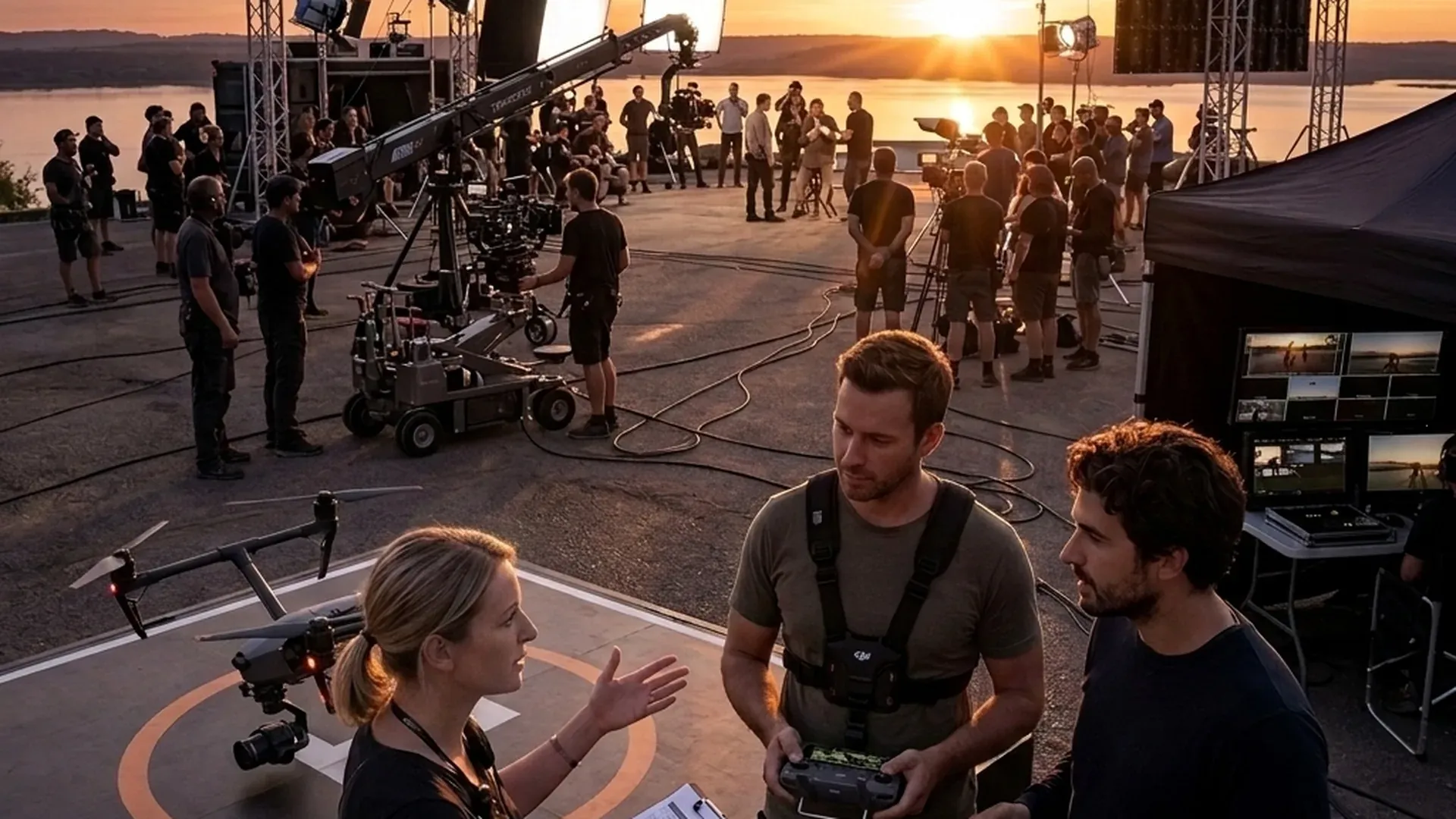
On high-end feature film sets, time is the single most critical currency. Every minute the main unit stands idle incurs heavy financial costs and threatens the call sheet schedule. The 1st Assistant Director (1st AD) is the engine driving the daily shooting schedule and overall logistics on floor. With the rapid expansion of aerial cinematography in major productions and commercial shoots, drone crews are increasingly embedded right at the core of main unit operations. However, in practice, deploying aerial cameras can occasionally trigger unexpected downtime if the operators are unfamiliar with main unit dynamics.
When an aerial team operates as an isolated department, friction quickly arises surrounding setup times, sensor calibrations, satellite locks, and ground safety protocols. Experienced drone operators distinguish themselves not only through precision piloting, but through their ability to integrate seamlessly with the 1st AD and the rest of the crew. By establishing an airtight workflow, rigorous pre-production planning, and clear communication channels, a specialized team ensures the drone is ready to roll just as swiftly as any traditional camera on a tripod or dolly.
The role of the 1st AD and the challenge of aerial shots
The 1st AD constantly balances the creative ambitions of the director against the strict realities of the daily schedule. For the 1st AD, every department must be fully prepared to roll the exact moment the set goes quiet. For ground camera units, this cadence is second nature: the gaffer adjusts lighting, the 1st AC measures focus distances, and the sound recordist confirms quiet on set. Drones, however, introduce unique variables into the equation, including weather shifts, airspace authorizations, battery cycles, and cast safety underneath the flight path.
If a drone crew only begins unboxing equipment or calibrating compasses when the 1st AD calls for turnaround, unacceptable gaps open up in the shooting schedule. Professional drone crews understand this pace and work proactively ahead of time. By monitoring the 1st AD's radio channel continuously and anticipating shifts in the shot list, the team stands fully calibrated and flight-ready ahead of time. This enables the 1st AD to maintain momentum without compromising safety or visual excellence.
Furthermore, partnering with certified [professional drone pilots](../services/drone-pilot-team.html) ensures that all operating permits, SORA risk assessments, and local airspace clearances are secured long before principal photography begins. This prevents the 1st AD from encountering legal or regulatory roadblocks on set.
Why delays happen during drone operations on main unit
To eliminate set delays, it is vital to recognize where operational bottlenecks typically occur. One primary cause is a breakdown in synchronization between the aerial team and the ground crew. When executing complex tracking shots involving actors or vehicles, the flight path must be thoroughly rehearsed with the stunt coordinator and director. If this briefing is delayed until the motors start spinning, valuable flight time and production minutes are wasted.
A second major bottleneck revolves around wireless video transmission. Main unit Directors of Photography (DoPs), directors, and 1st ADs require real-time monitoring at video village via wireless transmission systems like Teradek. If drone operators spend time troubleshooting wireless video frequencies or running long cables after the call to roll, set rhythm grinds to a halt. Veteran crews operate dedicated wireless video transmitters pre-configured into the main unit monitoring ecosystem.
Finally, unexpected technical issues can stall production. Unplanned firmware prompts, uncharged battery sets, or RF interference on 2.4 GHz or 5.8 GHz bands from on-set wireless gear can halt progress. Teams operating flagship [cinema drones](../services/cinema-drones.html) maintain complete equipment redundancy, featuring back-up aircraft and multi-band video feeds ready for immediate deployment.
Pre-production and technical recce: the foundation of a tight shooting day
The key to avoiding on-set delays lies in early preparation. Experienced drone operators join the tech recce during pre-production alongside the 1st AD, DoP, and location manager. During this site walkthrough, take-off and landing zones are designated, structural obstacles mapped, and sun angles evaluated for optimal lighting conditions.
Incorporating this information directly into the call sheet ensures every crew member understands the aerial plan. The 1st AD can schedule setup windows accurately and pinpoint the precise windows when aerial coverage should occur. This is especially vital when capturing shots during golden hour or rapidly changing natural light, where every single second counts.
Additionally, pre-production establishes seamless radio communication protocols. Drone pilots are equipped with dedicated headsets tuned directly to the 1st AD and floor manager, ensuring commands like "quiet on set", "action", and "cut" are received instantly without delay.
On-set workflow: direct communication, safety buffers, and rapid battery swaps
Once principal photography commences, professional drone operators enforce strict protocols to maintain set continuity. This starts with the [Inspire 3 dual-operator workflow](inspire-3-dual-operator-workflow.html), dividing responsibilities strictly between the pilot and the camera operator. The pilot focuses 100% on flight safety and navigation, while the camera operator communicates directly with the DoP regarding framing, tilt, and lens choices.
Managing battery cycles is another cornerstone of set efficiency. Seasoned aerial crews utilize a dedicated mobile charging hub (often built into a custom production vehicle or flight case). While battery Set A is airborne, Sets B and C are actively charging and pre-warmed to operating temperatures. This ensures the 1st AD never waits for batteries to charge. A trained dual crew executes a complete battery swap in under 60 seconds.
Furthermore, professional teams implement strict safety buffers. Rather than flying down to 15% battery warnings, aircraft are planned to land at 25% capacity. This leaves ample safety margin for impromptu retakes ("one more for safety") without risking emergency landings or unexpected delays.
Comparison of traditional vs streamlined drone set integration
The table below highlights the operational differences between an ad-hoc drone setup and a fully integrated main unit workflow:
| Operational Phase | Ad-Hoc Drone Setup | Integrated Main Unit Workflow |
|---|---|---|
| Pre-Production | No tech recce, figuring out setup zones on arrival | Active recce participation & zones printed on call sheet |
| 1st AD Communication | Indirect verbal messages between takes | Direct radio headset linked to 1st AD channel |
| Video Village Feed | Standalone monitor or loose HDMI cables | Zero-latency wireless feed directly to main video village |
| Battery Management | Waiting on AC power charging between flights | Rotational charging hub with pre-warmed battery sets |
| Average Setup Delay | 10 to 20 minutes delay per aerial sequence | Under 2 minutes (standby the instant AD calls) |
Frequently asked questions about drone integration with the 1st AD
How does the drone crew avoid holding up the 1st AD on set?
By working proactively ahead of schedule. The team sets up equipment during ground camera setups, monitors the AD radio channel, and stands fully calibrated and airborne-ready the moment the 1st AD calls for the aerial shot.
What is the drone operator's role during safety briefings?
Before the first flight, the pilot conducts a concise safety briefing with the 1st AD, director, and stunt crew, outlining no-fly zones, emergency protocols, and minimum safe clearance distances from cast and crew.
How is the drone camera feed transmitted to the director and DoP?
High-grade wireless transmitters route the live feed directly to video village monitors, allowing the DoP and director to view uncompressed real-time visuals and offer feedback instantly.
What happens if weather conditions suddenly change?
The pilot monitors wind gusts and weather radar continuously. Any adverse weather trends are communicated immediately to the 1st AD so the schedule can adapt fluidly without lost time.
Maximizing efficiency and creative scope without losing time
The successful deployment of aerial cameras on major film sets depends entirely on main unit integration. When drone operators speak the language of feature film sets and align with the 1st AD's priorities, aerial filming transforms from a potential logistical hurdle into a reliable creative tool. Thorough pre-production, rapid battery rotations, and constant radio communication ensure set delays are completely eliminated.
The result is a fast-paced set environment, maximum shooting time, and breathtaking cinematographic imagery that elevates the director's visual story. For production companies and 1st ADs, collaborating with a dedicated professional drone team guarantees uncompromised visual standards delivered strictly within schedule and budget constraints.