 NL
NL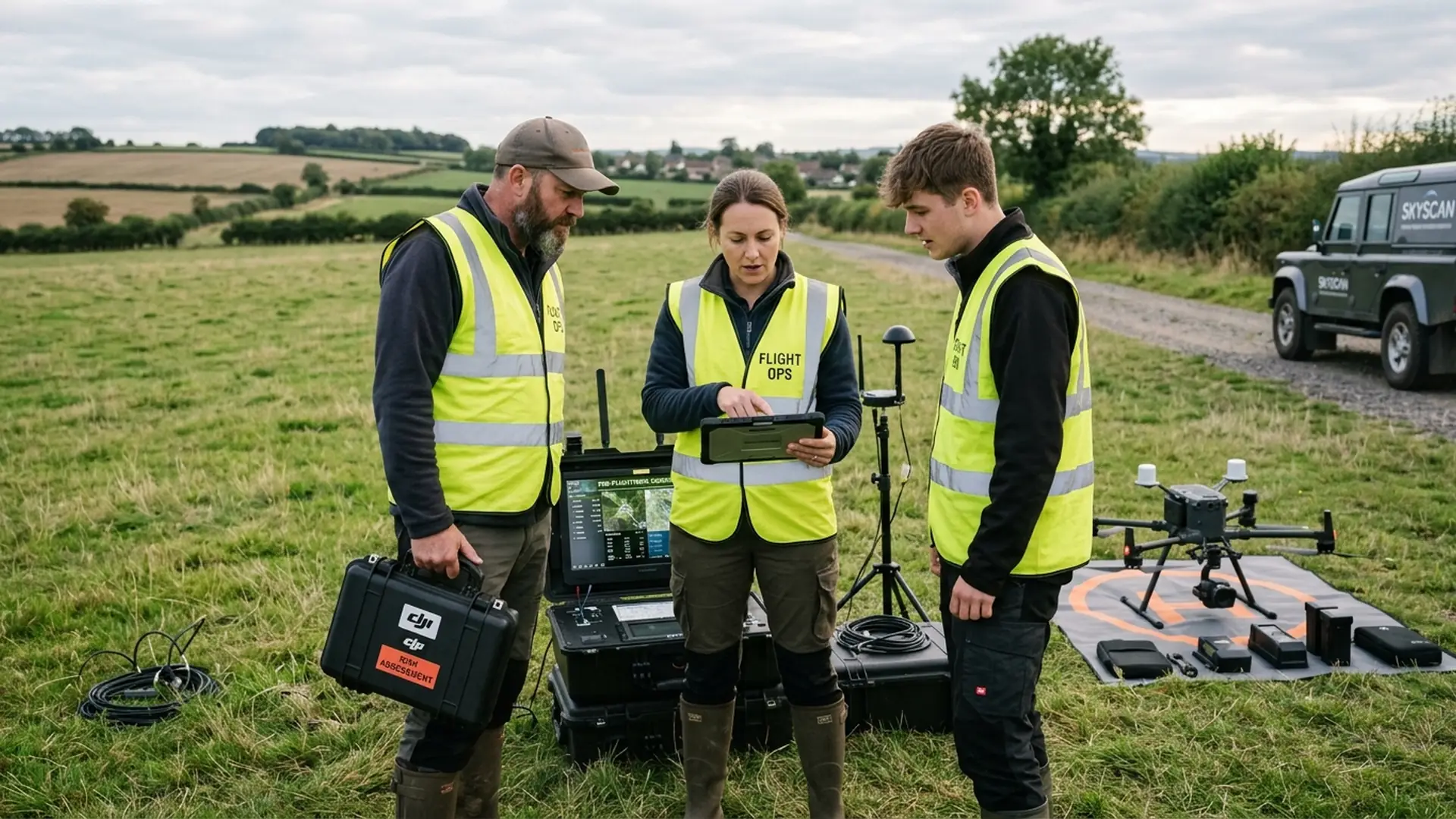
Towards the end of a long commercial shooting schedule or an intensive flight testing day, a curious psychological shift frequently occurs on the airfield. Technically, nothing about the unmanned aircraft system has fundamentally changed. The standard operating procedures (SOPs) remain identical, the manufacturer flight envelope limits have not budged, and the meteorological conditions remain nominally within legal parameters. Yet somehow, the decisions being made at four in the afternoon can feel strikingly different from those made at nine in the morning.
Across commercial drone operations in Europe, from complex film productions with heavy-lift cinema drones to high-stakes live broadcast productions and BVLOS test trials, human factors and Aeronautical Decision Making (ADM) represent the ultimate barrier between routine operations and catastrophic loss. While crewed aviation has spent over half a century embedding Crew Resource Management (CRM) into standard flight training, the uncrewed aviation sector must now systematically cultivate these same competencies.
The subtle erosion of risk tolerance under operational pressure
When an operations crew has traveled across borders, client stakeholders are observing live telemetry on monitor banks, and early-morning technical delays have compressed the flight window, psychological pressure inevitably accumulates. The weather forecast for tomorrow may predict poor visibility, project budgets are on the line, and there is one remaining flight objective that everyone desperately wants to complete.
In a purely rational analysis, none of these commercial pressures should influence the airworthiness or go/no-go determination of an aircraft. In real-world environments, however, they exert a profound influence. The certified wind limit of a DJI enterprise platform does not expand simply because a director is watching. Battery chemistry does not generate surplus capacity because the crew drove four hours, and C2 command links do not become more resilient under time constraints. What changes is the crew's willingness to operate closer to the structural edge of safety.
Crucially, this shift is rarely accompanied by an explicit announcement. Teams do not hold a briefing where they openly decide to accept hazardous risk levels. Instead, the drift manifests subtly through shifts in conversational language:
- "Technically, we are still within published parameters."
- "We have flown in gusts stronger than this on past jobs."
- "Let us just get this final run wrapped up while the gear is rigged."
- "It looks calm at ground level; fifty meters up should be fine."
Checklist compliance versus operational maturity
Modern regulatory frameworks governed by the European Union Aviation Safety Agency (EASA) and the Specific Operations Risk Assessment (SORA) methodology rely heavily on quantitative thresholds and mitigation checklists. While robust boundaries are foundational to flight safety, checklists cannot substitute for mature operational judgment.
There is a profound gap between basic compliance and genuine operational maturity. Compliance asks only: "Does every isolated variable remain inside its allowable limit?" Operational judgment asks: "What does the simultaneous combination of these marginal conditions mean for overall system resilience?"
In complex commercial missions, risk rarely announces itself as an unambiguous single red alarm. Instead, it surfaces as multiple concurrent amber conditions that seem benign in isolation:
- Ambient wind and gusts hover at 90 percent of the maximum certified operating threshold.
- The pilot in command and visual observer experience cognitive fatigue after seven hours on set.
- Cold temperatures slightly depress battery discharge curves under high-torque motor maneuvers.
- Local RF congestion causes intermittent telemetry packet drops on the ground control station.
Individually, every single item passes a binary pre-flight checklist. Collectively, they place the aircraft in a fragile state where any secondary anomaly will instantly overwhelm the crew. This is why our cinema drone operators are specifically trained to evaluate cumulative risk rather than isolated variables.
The hidden weight of saying no on a commercial set
Aviation psychology refers to the compulsive drive to finish a mission as get-there-itis or mission completion bias. In the drone sector, this tension is exacerbated by the immediate consequence of not flying: a disappointed client, a disrupted production schedule, or the perceived embarrassment of packing up equipment without delivering assets.
As documented in human performance guidelines by the International Civil Aviation Organization (ICAO), experiencing operational pressure is inevitable. The hazard arises when that pressure silently distorts safety calculations. Mature operators recognize that saying no is not an operational failure, but an active safety intervention.
| Operational Domain | Binary Compliance (Checklist) | Mature Operational Judgment (CRM) |
|---|---|---|
| Meteorological Limits | Gusts measuring 13 m/s against a 14 m/s limit (Cleared to fly). | Urban turbulence eddies reduce precision maneuver margins (Hold / No-Go). |
| Power Management | Battery capacity reading 22% at the start of a final trajectory run. | Insufficient thermal reserve during unexpected headwind hover (Battery Swap). |
| Crew Duty & Fatigue | Crew hours remain within statutory 10-hour duty limitations. | FPV pilot reflexes measurably slowed after consecutive high-speed takes (Stand Down). |
| Client Deliverables | Prioritizing 100% shot capture regardless of operational friction. | Communicating risk boundaries early and offering safe alternative setups. |
Practical frameworks for crew resource management
To prevent commercial urgency from degrading safety margins, professional flight crews implement structured decision-making tools. One of the most effective techniques is the 'Consequence-Free Query': "Would we proceed with this flight if there were zero commercial or logistical consequences to standing down?"
If the response triggers hesitation, external pressure has compromised the objective safety assessment. Professional operators counter this through three core practices:
- Inviolable Go/No-Go Gates: Pre-determined decision gates established before flight that cannot be negotiated in real time.
- Crew Empowerment and Abort Authority: Every crew member, from the visual observer to the telemetry technician, possesses unconditional authority to call an immediate 'Hold' or 'Abort'.
- Guarding Against Operational Drift: Actively monitoring for the normalisation of deviance, where small safety compromises gradually become accepted standard practice over time.
In high-speed, dynamic environments such as our indoor FPV drone flights and motorsports coverage, this shared mental model is what separates reliable teams from risky operators.
Cultivating a proactive safety culture across flight crews
The hallmark of an exceptional drone operator is not immunity to pressure, but the self-awareness to identify when that pressure is attempting to write the safety argument. Recognizing this influence enables teams to pause, recalibrate the flight plan, or make the difficult decision to pack away the gear.
That final choice can feel thoroughly unsatisfying on set. There is no footage to review, no mission log celebrating completion, and no dramatic aerial photography to show the client. Yet standing down when conditions dictate is frequently the most professional and consequential decision a flight crew will make. Long-term commercial success in uncrewed aviation is built upon flights that return safely to the ground every single time.
Frequently Asked Questions
How does pilot fatigue specifically impact commercial drone safety?
Fatigue causes cognitive tunnel vision and degradation of situational awareness. Pilots tend to fixate on the camera monitor or gimbal framing while failing to notice battery voltage dips, wind shear, or micro-obstructions entering the flight path.
How should a remote pilot handle an insistent client demanding a flight in marginal conditions?
Professional pilots ground their communication in objective data, regulatory airspace limits, and manufacturer boundaries. Providing alternative solutions (such as postponing the flight until a calmer weather window or altering the flight profile) protects both the client's asset and the production's safety record.
What is 'normalisation of deviance' in drone operations?
This occurs when operators incrementally breach operating margins without experiencing immediate negative outcomes. Over time, the crew mistakenly perceives these hazardous behaviors as safe standard practice, leading inevitably to severe incidents.
Why is a designated Visual Observer essential for Aeronautical Decision Making?
The Visual Observer maintains continuous line of sight across the entire operational area, unburdened by the cognitive load of aircraft control. This allows the VO to provide objective, real-time alerts regarding non-participating persons, approaching aircraft, and localized weather changes.