 NL
NL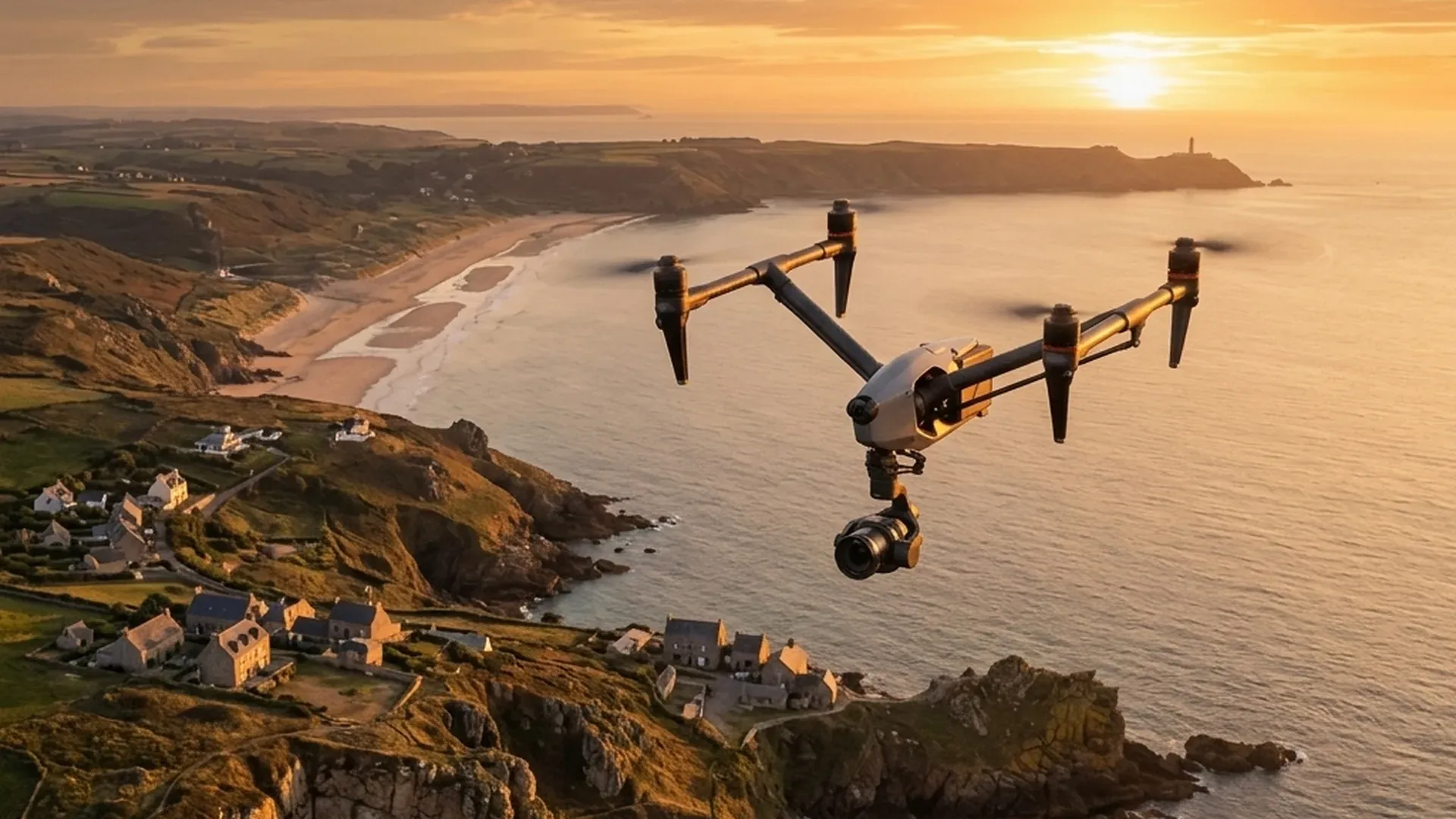
The golden hour—the fleeting window of daylight right before sunset or just after sunrise—is celebrated by cinematographers for its warm amber hues, soft directional shadows, and dramatic sky gradients. For film productions and drone operators, capturing footage during this period offers unmatched production value. However, the rapidly fading ambient light presents one of the most demanding technical hurdles in professional aerial cinematography. As natural light diminishes, traditional digital camera sensors are forced to digitally amplify gain, introducing heavy noise grain, color degradation, and severe dynamic range compression.
In modern high-end cinema drones, such as the DJI Inspire 3 housing the Zenmuse X9-8K Air gimbal camera or custom cinema FPV rigs carrying Sony FX3 and RED Komodo-X sensors, Dual Native ISO technology has emerged as the ultimate game-changer. By incorporating twin analog gain circuits at the sensor level, pilots can step up to a higher base sensitivity without sacrificing signal-to-noise ratio (SNR). In this article, we break down the architecture of Dual Native ISO (ISO 800 and ISO 4000) and present a real-world case study captured during a challenging coastal shoot.
Understanding Dual Native ISO Architecture
In a conventional camera sensor, a single analog amplifier circuit sits behind each photosite (pixel). The sensor operates on a single 'native' ISO baseline, such as ISO 800. Increasing the ISO setting to ISO 3200 or ISO 6400 applies digital gain to the voltage signal before analog-to-digital conversion. While this brightens the image, it simultaneously multiplies the noise floor generated by the sensor electronics.
Conversely, a Dual Native ISO sensor features two physically distinct amplification circuits per pixel. When switching to the secondary native ISO setting, the hardware configuration switches at the silicon level:
- Low Native ISO (e.g., ISO 800): Engineered for daytime shooting and high-contrast daylight conditions. Maximizes highlight retention and full-well capacity to prevent blown-out skies.
- High Native ISO (e.g., ISO 4000): Utilizes a lower-capacitance read circuit per pixel, boosting voltage output per captured photon. This yields a clean, noise-free signal in low-light environments without digital grain.
Switching to High Native ISO at ISO 4000 delivers an image signal with noise characteristics virtually identical to ISO 800, while providing an additional 2.3 stops of light sensitivity. This enables an expert drone videographer to maintain pristine 8K and 4K recordings well into twilight.
Case Study: Coastal Infrastructure Filming at Sunset
During a recent marine production for a maritime engineering client, Drone Department was tasked with capturing cinematic aerial sequences of an offshore wind farm and harbor breakwater during dusk. The creative brief called for a continuous FPV sequence capturing the transition between golden sunset reflections, deep blue ocean waters, and artificial harbor navigation lights.
The flight sequence commenced at 21:15 during golden hour and extended through blue hour until 21:45. Below is the breakdown of camera sensor parameters and lighting conditions throughout the shoot:
| Time Window | Lighting Condition | Selected ISO | Aperture / Shutter | Dynamic Range & Noise Performance |
|---|---|---|---|---|
| 21:15 - 21:25 | Golden Hour (Sun low on horizon) | ISO 800 (Low Native) | f/4.0 | 1/50s (ND8 Filter) | 14.7 stops range. Excellent highlight detail in clouds and sun flare. |
| 21:25 - 21:35 | Post-Sunset (Sun below horizon) | ISO 1250 (Digitally Boosted) | f/2.8 | 1/50s (ND4 Filter) | Mild grain visible in deep ocean shadows. |
| 21:35 - 21:45 | Blue Hour & Twilight | ISO 4000 (High Native) | f/2.8 | 1/50s (No ND Filter) | Noise drops instantly! Deep blacks remain clean, harbor lights retain color fidelity. |
As demonstrated in the flight data, the critical transition occurred at 21:35. At ISO 1250 and ISO 2500, noise artifacts began creeping into the shadow areas of the water. The moment the camera sensor engaged the High Native ISO setting at ISO 4000, the secondary circuit activated. Shadow noise collapsed, shadow detail in the water reappeared, and dynamic range returned to its full sensor potential.
Practical Low-Light Aerial Filming Best Practices
Maximizing Dual Native ISO performance during dynamic drone flights requires deliberate exposure management and knowledge of Log gamma curves. Our flight crews adhere to four essential guidelines for low-light aerial shoots:
- Avoid Intermediate ISO Steps: If your dual native baselines are ISO 800 and ISO 4000, shooting at ISO 3200 will yield significantly more noise than shooting at ISO 4000! ISO 3200 represents maximum digital amplification of the lower circuit, whereas ISO 4000 is the clean baseline of the secondary circuit.
- Manage ND Filter Transitions: As twilight approaches, step down your ND filter density promptly. Switching to ISO 4000 introduces a sudden gain boost; ensure ND filters (such as ND4 or ND8) are managed to prevent clipping background highlights.
- Expose To The Right (ETTR): When capturing Log profiles (such as DJI D-Log or Sony S-Log3), push your exposure histogram slightly to the right without clipping highlights. Shadow noise can then be cleanly brought down during color grading.
- Deploy Experienced FPV Pilots: Low-light filming requires precise speed and smooth motion blur management. A certified FPV drone operator ensures flight trajectories maintain organic motion without introducing jitter at slower shutter speeds.
Production Advantages for Enterprise and Film Clients
For film directors, producers, and commercial clients, operating Dual Native ISO drone systems extends the usable shooting window significantly. Where traditional aerial shoots were forced to wrap as soon as the sun dipped below the horizon, crews can now continue filming well into the blue hour. This produces stunning footage of illuminated city skylines, industrial complexes, and atmospheric landscapes that previously required heavy, expensive helicopter rigs.
Furthermore, cleaner raw footage reduces post-production overhead. Colorists avoid applying heavy spatial and temporal noise reduction plugins, which dramatically speeds up rendering times for 8K ProRes RAW and CinemaDNG workflows.
The Future of Low-Light Aerial Cinematography
The convergence of advanced sensor engineering and agile drone platforms makes twilight and night aerial cinematography more accessible and spectacular than ever before. Mastering Dual Native ISO (ISO 800/4000) empowers production teams to turn low-light challenges into cinematic masterpieces. Stay connected with our latest industry developments on our drone news portal or contact our team directly to discuss your upcoming aerial film production.
Frequently Asked Questions About Dual Native ISO
What is the difference between standard ISO and Dual Native ISO?
Standard ISO digitally amplifies a single sensor circuit, creating heavy noise at higher values. Dual Native ISO utilizes two physical amplification circuits on the sensor, allowing a high ISO setting (like ISO 4000) to perform with the same noise-free clarity as the low base ISO (ISO 800).
Which Drone Department cinema platforms feature Dual Native ISO?
Our DJI Inspire 3 (Zenmuse X9-8K Air) features dual native ISO at ISO 800 and ISO 4000. Additionally, our custom cinematic FPV drones carry cinema cameras such as the Sony FX3 and RED Komodo-X, which also feature dual base ISO architectures.
Is night drone filming legal in Europe under EASA regulations?
Yes, night flying (Night VFR) is permitted under European EASA drone regulations (Specific Category or Open Category under defined conditions). Our pilots hold all necessary certifications and operate drones equipped with compliant anti-collision lighting to execute legal night operations.