 NL
NL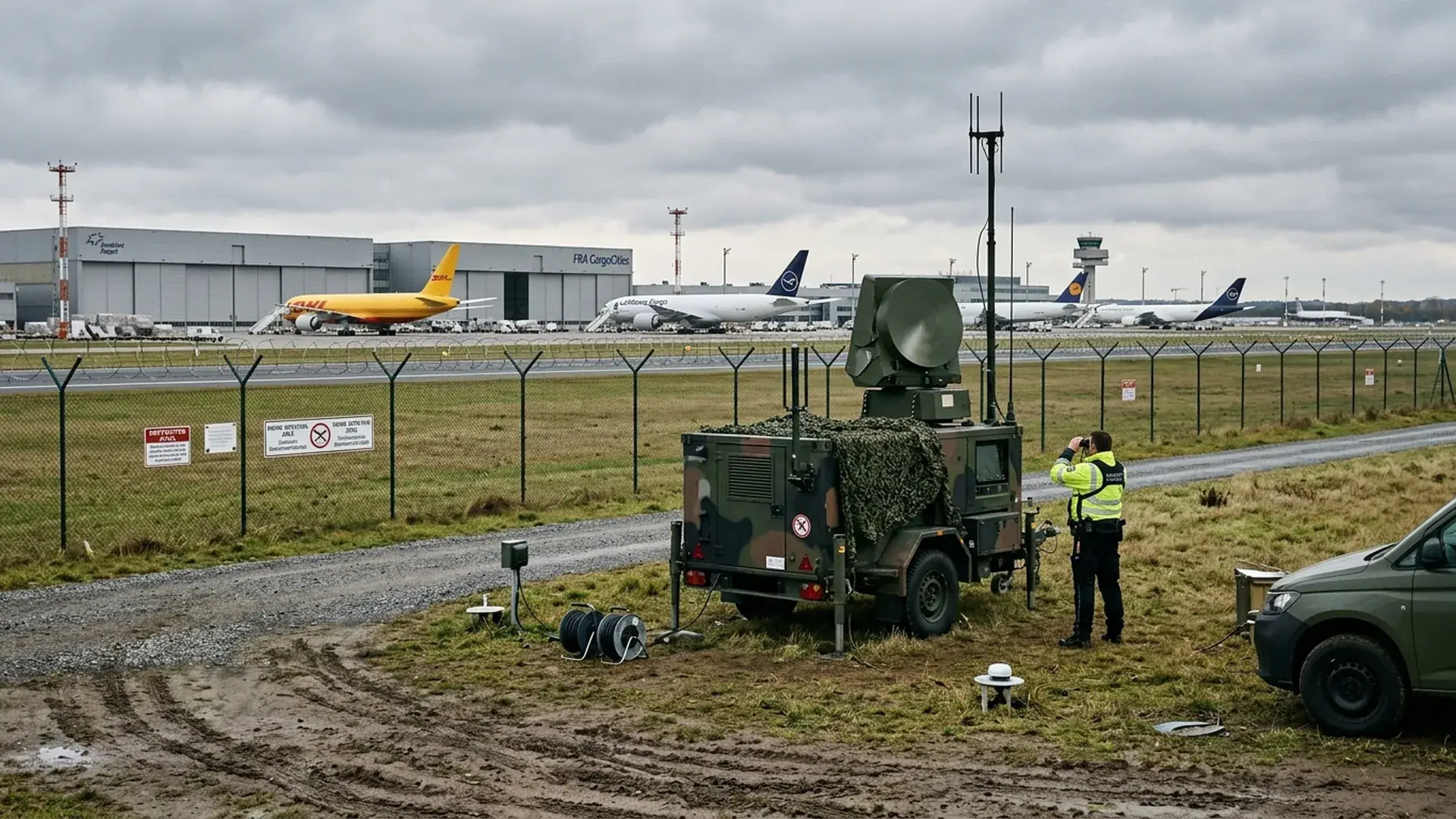
The recent discovery of multiple uncrewed aerial vehicles equipped with military explosives near Leipzig/Halle Airport has triggered high-level security alerts across European aviation authorities. German Chancellor Friedrich Merz explicitly warned during a press briefing that Germany and its European partners face "tangible and real threats" aimed at critical transport and logistics hubs. Leipzig/Halle is far from an ordinary airport; it serves as Germany's second-largest air cargo node, the central European aviation hub for DHL, and a pivotal logistical staging area for NATO heavy air transport and Ukrainian Antonov cargo fleets.
This incident signals a perilous evolution in uncrewed aerial threats. While past airport airspace disruptions across Europe were primarily caused by negligent hobbyists or uncoordinated photography flights, the presence of military-grade high explosives points towards coordinated sabotage in a hybrid warfare context. This unprecedented escalation is accelerating the adoption of multi-layered Counter-UAS (C-UAS) defense systems and prompting tighter regulatory scrutiny for certified commercial drone pilots operating in European airspace.
The Leipzig/Halle incidents: what investigators uncovered at the critical hub
The sequence of events unfolded when airport ground personnel discovered a crashed uncrewed aerial system on the restricted perimeter grounds adjacent to the active runway. Explosive ordnance disposal teams and federal criminal investigators confirmed that the drone was outfitted with a substantial charge of Hexogen (RDX) military explosives and an electronic detonator that malfunctioned upon impact. During that same operational night, the flight crew of an inbound cargo aircraft reported an aerial collision with an unidentified flying object during final approach.
Subsequent sweeping operations by federal police and intelligence units yielded a second and third uncrewed aircraft in nearby open terrain, sharing identical construction signatures and explosive payloads. Germany's Federal Public Prosecutor (Bundesanwaltschaft) has assumed control of the investigation under anti-terrorism and state-security statutes. Interior Minister Alexander Dobrindt and Chancellor Merz indicated that intelligence services possess concrete indicators pointing toward foreign state-sponsored actors conducting asymmetric probing of critical European logistics nodes.
Hybrid warfare and critical transport infrastructure vulnerabilities across Europe
The transition from reconnaissance drones to armed, weaponized aerial platforms marks a decisive turning point in European civil defense. Air transport hubs represent intricate, sprawling infrastructures where square kilometers of open runways, jet fuel storage depots, cargo terminals, and instrument landing system (ILS) antennas cannot be defended solely by physical perimeter fences.
Targeting Leipzig/Halle carries profound symbolic and practical ramifications. In addition to high-volume commercial logistics, the airport regularly accommodates Antonov An-124 heavy-lift transports ferrying crucial industrial machinery and humanitarian aid. Disrupting or compromising flight operations at such a hub sends disruptive shockwaves across international supply chains and multi-modal freight networks.
Counter-UAS technologies: multi-layered defense mechanisms for modern airports
In response to the Leipzig threats, European civil aviation stakeholders and air navigation service providers are rapidly deploying comprehensive, multi-sensor C-UAS (Counter-Unmanned Aircraft Systems) architectures designed to detect, track, and safely neutralize rogue aerial vehicles before they breach restricted perimeters.
Radar detection, RF spectrum monitoring, and electro-optical tracking
Conventional primary airport radars are calibrated to track commercial airliners and intentionally filter out small, low-velocity radar cross-section (RCS) targets like birds and micro-drones. Modern C-UAS solutions employ 3D micro-Doppler radars capable of recognizing the distinctive harmonic frequencies generated by rotating drone propellers. Combined with radio frequency (RF) spectrum scanners that intercept command-and-control (C2) links and high-definition thermal PTZ tracking cameras, perimeter defense systems can identify encroaching drones in mere seconds.
Neutralization tactics: RF jamming, spoofing, and kinetic interceptors
Neutralizing rogue drones within an active airport environment requires extreme precision to prevent collateral aviation hazards. Omnidirectional RF and GNSS jammers can force uncrewed aircraft into fail-safe landing modes, but risk interfering with aircraft navigation systems and air traffic control radios. As a result, authorities are increasingly deploying directional protocol-manipulation spoofing, net-deploying interceptor drones, and high-precision kinetic countermeasures to eliminate threats without disrupting civil avionics.
Comparative analysis of airport drone detection and countermeasure systems
The following breakdown highlights the primary detection and mitigation technologies currently being integrated into major European airport security programs:
| Technology System | Operational Mechanism | Effective Range | Key Advantages | Operational Limitations |
|---|---|---|---|---|
| 3D Micro-Doppler Radar | Tracks micro-Doppler signatures of propeller rotation | 3 - 7 km | 24/7 all-weather performance through fog, rain, and darkness | Higher capital expense; potential blind zones behind terminal structures |
| RF Spectrum Monitoring | Intercepts telemetry, C2 links, and video frequencies | 5 - 10 km | Pinpoints both the aircraft coordinates and the remote pilot position | Ineffective against fully autonomous drones maintaining strict radio silence |
| Thermal & AI Optical Sensors | Visual and infrared computerized pattern recognition | 1.5 - 4 km | Provides immediate visual verification of payload and physical threat | Constrained by atmospheric visibility, heavy fog, and direct line of sight |
| Targeted RF & GNSS Jamming | Disrupts radio control and satellite positioning bands | 1 - 3 km | Rapid electronic override of standard commercial drones | Risk of unintended electromagnetic interference with civil avionics |
| Kinetic Net-Capture Drones | Captures hostile drones via ballistic tethered nets | 2 - 5 km | Zero electromagnetic side-effects; captures payload intact for forensics | Engagement time subject to launch readiness and interceptor sprint speed |
Implications for certified commercial drone operators and EASA airspace access
For licensed commercial drone enterprises operating across Europe, heightened security awareness creates both regulatory demands and operational distinctions. Oversight bodies including the European Union Aviation Safety Agency (EASA) and national civil aviation authorities are accelerating enforcement around controlled airspace perimeters.
Heightened CTR enforcement and stricter SORA authorization audits
Operators executing missions such as industrial inspections, live broadcast feeds, or film production with heavy-lift cinema drones will experience more rigorous validation procedures when flying inside airport Control Zones (CTR). Navigating the official Dutch CTR and no-fly zones map and securing explicit air traffic approvals are essential safeguards to prevent false-positive alarms and ensure safe co-existence with manned traffic.
Accelerated U-Space rollout and Direct Remote ID compliance
The Leipzig events highlight why the European U-Space digital airspace framework is vital. In a mature U-Space environment, every certified flight transmits live telemetry, operator registration data, and aircraft position via Direct Remote ID (DRI). This enables automated airport defense networks to instantly differentiate between authorized industrial operations and non-cooperative rogue intruders. For established enterprises offering commercial drone services, adhering to pristine compliance standards reinforces credibility and operational freedom.
European aviation resilience and the safeguarding of critical logistics nodes
The Leipzig airport drone discoveries signify an undeniable paradigm shift in European critical infrastructure defense. The integration of weaponized uncrewed platforms into asymmetric threat playbooks means that low-altitude airspace security can no longer be treated separately from cybersecurity and physical gate defense. Germany's push to expand federal defense and electronic counter-measure mandates reflects a broader continental commitment to hardening transport corridors.
For the commercial drone industry, the path forward relies on transparency, collaboration, and rigorous professional standards. By fostering close integration between civil aviation authorities, law enforcement, airport managers, and certified operators, Europe can safeguard its skies against malicious threats while enabling legitimate drone technology to thrive safely.
Frequently asked questions about airport drone security and hybrid threats
What exactly was discovered near Leipzig/Halle Airport?
Multiple uncrewed aerial vehicles equipped with military-grade high explosives (Hexogen/RDX) and detonators were discovered on and around Leipzig/Halle Airport. German federal authorities and the Federal Public Prosecutor are investigating the incidents as a targeted hybrid attack on critical transport logistics.
What is C-UAS and how does it protect airport perimeters?
Counter-Unmanned Aircraft Systems (C-UAS) are integrated multi-layered defense platforms combining micro-Doppler radar, radio frequency scanners, electro-optical/infrared cameras, and effectors (such as directional jammers or net-capturing drones) to detect, track, and neutralize hostile drones in seconds.
How do these incidents impact legitimate commercial drone operators in Europe?
Commercial operators face heightened scrutiny in CTR airspaces, mandatory Direct Remote ID verification, accelerated U-Space integration, and stricter SORA compliance when conducting operations near industrial, aviation, or port infrastructure.
How does EASA's U-Space framework prevent rogue drone intrusions?
EASA's U-Space establishes digital airspace management where all authorized commercial flights continuously broadcast telemetry and pilot identity. Non-cooperative or rogue drones stand out instantly on air traffic displays, enabling rapid counter-measure deployment.