 NL
NL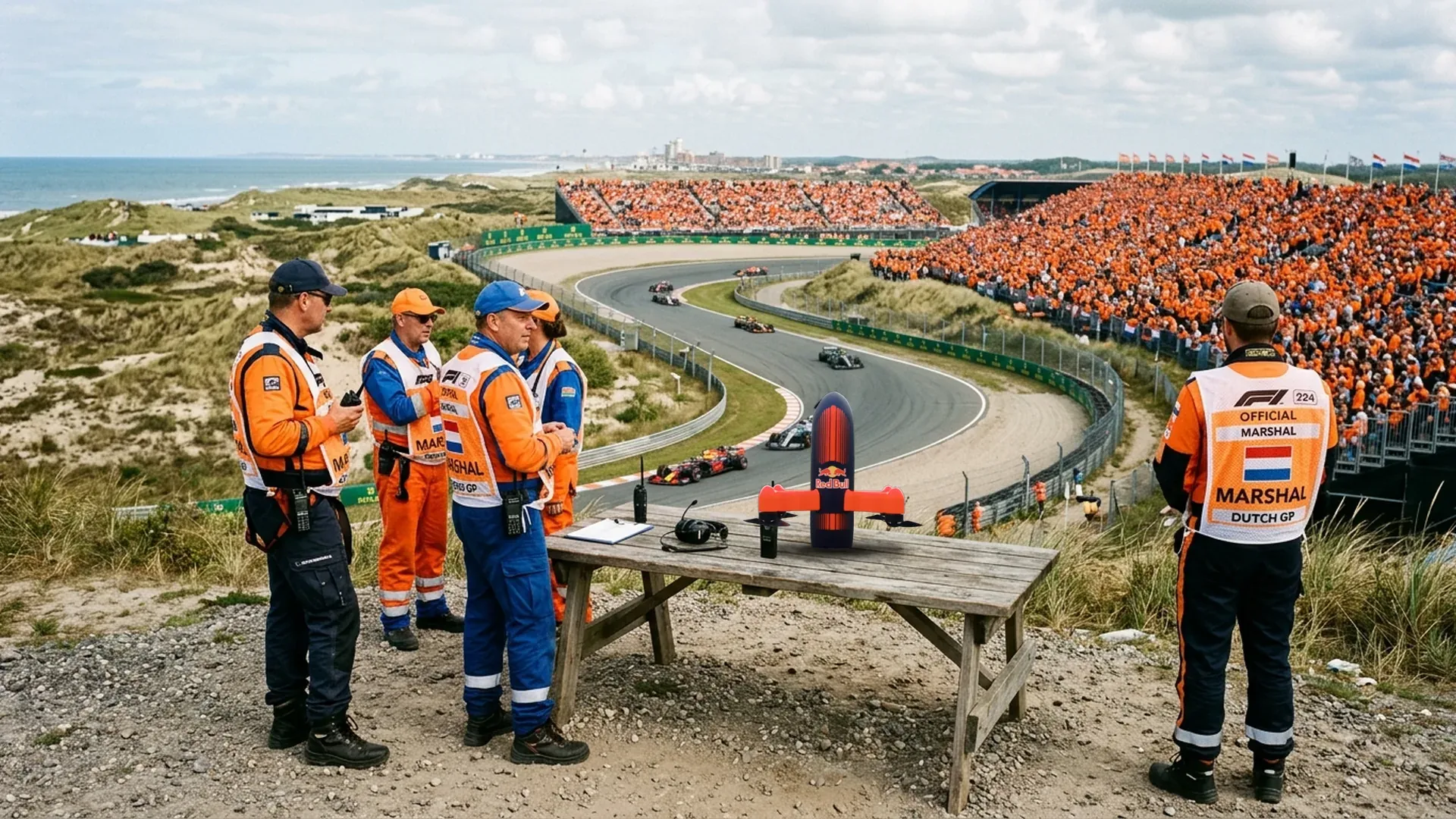
During the race weekend of the Formula 1 Heineken Dutch Grand Prix at Circuit Zandvoort, extensive temporary airspace restrictions will be in effect from Thursday, August 20 through Sunday, August 23, 2026. The Dutch Minister of Infrastructure and Water Management, acting in concert with the Minister of Defence, has enacted an official decree establishing three Temporary Restricted Areas (Tijdelijke Gebieden met Beperkingen or TGBs). This airspace regulation manages the high concentration of air traffic along the North Holland coast and guarantees public safety around the premier racing spectacle.
For commercial drone operators and recreational pilots alike, this decree establishes an absolute flight ban for unmanned aircraft systems (UAS) across Zandvoort and surrounding coastal zones. Formally detailed in Staatscourant Publication No. 27250 by the Dutch Human Environment and Transport Inspectorate (ILT Aviation Authority), unauthorized drone flights within these restricted sectors constitute criminal offenses subject to rigorous judicial penalties.
In this comprehensive regulatory overview, we break down the geographic parameters of the three TGB sectors, review the strictly regulated exceptions for certified safety and broadcast flights, and provide an urgent advisory regarding misleading NOTAM radius displays.
Geographic Breakdown of the Three Zandvoort TGB Sectors
To accommodate different operational phases during the Grand Prix weekend, the airspace structure is divided into three distinct operational polygons and timelines. On Thursday preceding the race sessions, a localized containment zone surrounds the circuit grounds. On Friday, Saturday, and Sunday, two substantially larger sectors (West and East) activate throughout the Uniform Daylight Period (UDP).
The maritime and coastal zone (TGB Zandvoort F1 West) extends across the North Sea coastline and beach corridor up to 1,500 feet above mean sea level (AMSL). This airspace accommodates TV broadcast helicopters, emergency services, and regulated commercial banner-towing aircraft. The inland zone (TGB Zandvoort F1 East) reaches up to 1,300 feet AMSL and interfaces directly with the 8 nautical mile control radius surrounding Amsterdam Airport Schiphol (EHAM ARP).
| TGB Sector | Active Operational Period | Altitude Ceiling | Primary Operational Function |
|---|---|---|---|
| TGB Zandvoort | Thursday, Aug 20, 2026 (UDP) | Surface to 1,500 ft AMSL | Broadcast camera test flights & circuit infrastructure checks |
| TGB Zandvoort F1 West | Friday, Aug 21 to Sunday, Aug 23 (UDP) | Surface to 1,500 ft AMSL | North Sea beach corridor, racetrack airspace & coastal operations |
| TGB Zandvoort F1 East | Friday, Aug 21 to Sunday, Aug 23 (UDP) | Surface to 1,300 ft AMSL | Dune reserve and inland corridor bordering Schiphol CTR/TMA |
Comprehensive UAS Flight Prohibition and Certified Exceptions
Within all three designated TGB zones, flights conducted by civil unmanned aircraft systems (drones), model aircraft, paragliders, tethered kites, and paramotors are strictly forbidden. Parachute descents landing inside these coordinates are likewise prohibited. These restrictions apply universally across the Open category without exemption for sub-249g consumer aircraft.
Only a select group of certified, coordinated aerial operations are authorized to enter the airspace:
- Emergency Service Coordinated Flights: National Police Aviation Unit (Landelijke Eenheid Luchtvaart), Search and Rescue (SAR) assets, Helicopter Emergency Medical Services (HEMS/trauma), and fire brigade monitoring.
- Coordinated Broadcast Drones (Live Race Coverage & FPV): Accredited and authorized broadcast drones operating under contract with Formula One Management and race organizers to capture dynamic live feeds and high-speed FPV tracking footage along the circuit, backed by strict radio coordination and approved SORA operational authorisations.
- Coordinated VLOS Drone Operations for Crowd Management: Visual Line of Sight (VLOS) UAS missions commissioned directly by the Dutch GP organizers, executed exclusively by licensed operators possessing certified ILT exemptions and operational authorisations.
- Authorized Evening Drone Light Shows: Coordinated drone shows commissioned by event organizers during evening festivities, under the strict condition that all helicopter transport to and from temporary landing areas (TUG) has ceased.
- Official TV Broadcast Helicopters: Licensed film helicopters operating under contract with Formula One Management to deliver live international race coverage up to 1,200 ft AMSL.
- Royal Netherlands Air Force Ceremonial Flights: On Sunday, August 23 between 14:30 and 15:00 local time, exclusive airspace priority is reserved for military flybys coordinated via specialized ASO-DIS flight controllers.
In professional live production environments, specialized services such as action & motorsports drone filming and live broadcast & events emphasize why precision airspace integration and regulatory compliance are essential. Without specific national aviation authority clearance and direct two-way radio channels, operating drones near major sporting spectacles is prohibited.
High-Speed Broadcast Drones: The Engineering Behind F1 Live Tracking
Among the most innovative permitted exceptions in professional aerial operations during Formula 1 weekends is the deployment of custom high-speed broadcast drones. Standard cinema camera platforms cannot match the blistering acceleration and cornering speeds generated by contemporary F1 machinery.
A pioneering benchmark in this field is the custom engineering project created by Dutch aerial specialists Dutch Drone Gods, who teamed up with Red Bull Advanced Technologies to design the RBD1 rocket FPV drone. Engineered to accelerate from 0 to 300 km/u in just four seconds with a top speed exceeding 350 km/u, the drone proved capable of chasing Max Verstappen around a complete Grand Prix circuit on live broadcast feeds.
Equipped with custom aerodynamic fuselages, high-output brushless drivetrains, and ultra-low latency HD video transmission links, these specialist broadcast systems operate within strictly designated safety windows. Inside an active TGB sector, their flights require bespoke SORA risk authorisations, dedicated pilot licensing, and direct telemetry integration with race control.
Critical Advisory: NOTAM B0872/26 Radius vs Actual TGB Boundaries
Aviation authorities and safety agencies issue an urgent warning to drone pilots relying solely on standard mobile flight planning apps. Prior to the Grand Prix, a flight notice was distributed under reference NOTAM B0872/26, illustrating a circular restricted zone with a radius of 1 nautical mile (NM) around the circuit centroid.
However, this 1 NM circular graphic represents only a fraction of the legal restriction area. The true statutory boundaries established in the Staatscourant decree consist of extensive multi-point polygon coordinates spanning kilometres into the coastal dunes of Bloemendaal, offshore North Sea waters, and eastern approach routes.
Air Traffic Control the Netherlands (LVNL) and the European Union Aviation Safety Agency (EASA) frameworks dictate that statutory gazette publications supersede simplified map overlays. Pilots launching outside the 1 NM circle but within the TGB polygon remain fully liable for unauthorized airspace penetration.
Airspace Coordination via Dedicated VHF Frequency and HeliCentre
To ensure deconfliction among police air units, VIP transport shuttles, banner-towing planes, and broadcast aircraft, a designated Aeronautical Station Operator (ASO) manages tactical communications. Authorized aircraft entering the TGB must maintain continuous listening watch on VHF frequency 128.315 MHz.
For permitted UAS operators without airborne VHF transceivers, mandatory tactical coordination is conducted telephonically via dedicated briefing contacts. Aviation provider HeliCentre manages the centralized operational briefing for all registered airspace participants and civil stakeholders.
While flights within the TGB sectors are exempt from monitoring Amsterdam Info (124.300 MHz), standard Visual Flight Rules (VFR) and pilot-in-command separation responsibilities remain fully mandatory at all times.
Counter-Drone Detection and Legal Penalties for Non-Compliance
Throughout the Grand Prix weekend, Dutch national police and security authorities deploy state-of-the-art radio frequency sensors and counter-UAS detection platforms around Zandvoort. These systems detect drone telemetry, command uplinks, and exact pilot ground positions in real time.
Operating an unauthorized drone inside an active TGB constitutes a serious aviation violation under Article 33 of the Dutch Air Traffic Decree (Besluit luchtverkeer 2014). Prosecutors enforce a strict zero-tolerance policy: offenders face immediate confiscation of aircraft and flight controllers, substantial administrative and criminal fines, and potential criminal records.
Professional aerial teams utilizing heavy-lift cinema drones or organizing commercial drone shows strongly advise all pilots to avoid the Zandvoort coastal corridor entirely throughout the Dutch Grand Prix weekend.
Aviation Safety and Regulatory Compliance during World-Class Sporting Events
The stringent airspace management protocol at Circuit Zandvoort highlights the increasing importance of structured unmanned traffic integration during major European sports events. When dense crowds, rapid emergency response requirements, and live broadcast aircraft converge in compact airspace, absolute discipline is non-negotiable.
Commercial operators and recreational hobbyists should consistently verify flight paths against official aviation publications and current drone news developments. Respecting temporary airspace restrictions ensures safety for drivers, race fans, and aviation crews alike.
Frequently Asked Questions
Does the Zandvoort drone flight ban apply to sub-249g lightweight drones?
Yes. The TGB decree bans all unmanned aircraft systems regardless of weight, class rating, or C0/Open category status. Operating sub-249g consumer drones in these sectors is prohibited.
Why is NOTAM B0872/26 insufficient for determining flight boundaries?
NOTAM B0872/26 displays a generic 1 NM radius circle, whereas the actual TGB decrees encompass much larger polygonal areas across dunes, coastline, and inland corridors. Flying outside the 1 NM circle but within the TGB coordinates remains illegal.
Can certified commercial drone pilots fly during the Dutch Grand Prix?
Only operators specifically commissioned by the Dutch GP organization for crowd safety or sanctioned evening light shows, with formal ILT exemptions and ASO radio coordination, are allowed to fly. All other commercial operations are banned.
What are the penalties for unauthorized drone flights in TGB airspace?
Violations under Article 33 of the Besluit luchtverkeer 2014 are prosecuted as aviation offenses, carrying heavy financial fines, immediate equipment seizure, and potential prosecution.