 NL
NL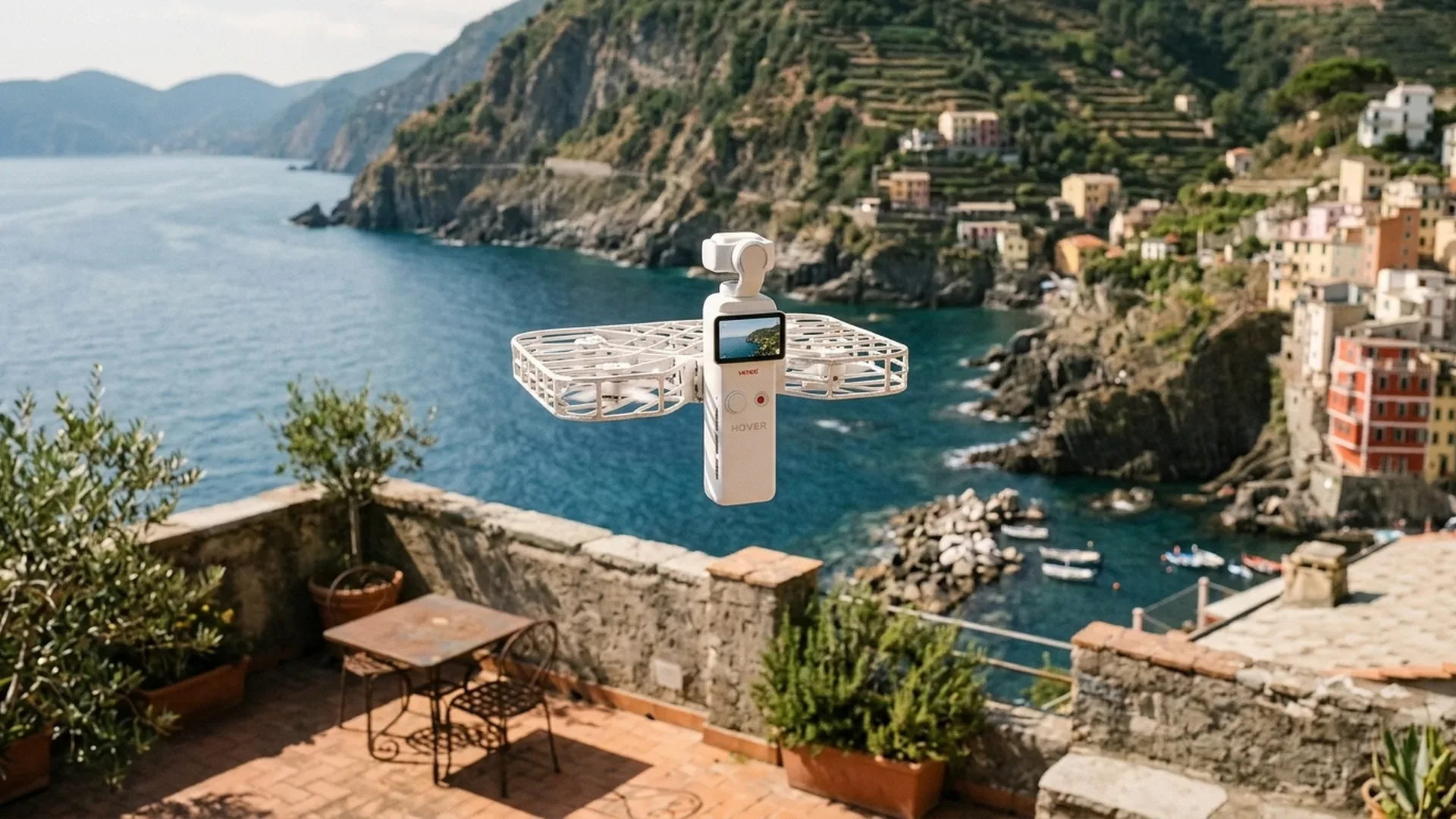
The consumer camera and aerial imaging landscape is witnessing a convergence of form factors. Mobile content creators, vloggers, and documentary filmmakers have historically faced a trade-off: carry a handheld mechanical gimbal for ground-level stabilization and vlogging, or pack an autonomous mini drone for elevated perspectives and tracking shots. With the announcement of the HOVERAir VERSA, developer ZeroZero Robotics has merged these distinct tools into a unified 2-in-1 capture ecosystem.
The VERSA operates natively as a pocket-sized 3-axis mechanical gimbal camera and transforms on demand into an autonomous, self-flying camera via snap-on caged propeller assemblies. Weighing just 230 grams in flying configuration, the device qualifies comfortably for the European Union C0 class under EASA Open A1 regulations, offering extensive operational freedom in urban areas and close proximity to people.
Modular architecture: bridging pocket gimbal stability and autonomous flight
ZeroZero Robotics, co-founded in 2014 by Stanford PhDs MQ Wang and Tony Zhang, pioneered the portable self-flying camera category with enclosed rotor designs and holds more than 140 core patents. While previous releases such as the HOVERAir X1 focused exclusively on palm-launched autonomous tracking, the VERSA represents a major evolutionary step by functioning equally well as a dedicated ground camera.
In handheld mode, the device measures a compact 36 by 31 by 147 millimeters. The ergonomic handle features an integrated color preview display, responsive tactile controls, and a smooth 3-axis mechanical gimbal on top. This configuration provides true optical-mechanical stabilization for walking shots, street interviews, and low-light vlogging without requiring extra bulk or complex setup routines.
When an aerial shot is required, creators attach the lightweight snap-on cage module containing four enclosed propellers. The assembled flying configuration measures 176 by 31 by 147 millimeters while maintaining an overall flight weight of only 230 grams. Optical sensors detect the attached rotor module instantly, prompting the onboard software to switch into flight control mode. Much like professional indoor FPV cinewhoops, the fully enclosed propeller guards ensure safe operation around bystanders and tight indoor spaces.
Sensor capabilities: 1/1.3-inch CMOS, 4K 60fps and 10-bit H-Log
Imaging specifications on the HOVERAir VERSA have been engineered to meet modern production demands. The camera houses a 1/1.3-inch CMOS sensor capable of recording 4K video at up to 60 frames per second. For high dynamic range workflows, it records 4K at 30 frames per second in 10-bit HDR and 10-bit H-Log, delivering up to 17.5 stops of dynamic range.
Still photography is handled at 12 megapixels. The optical system delivers a natural 98-degree field of view with an Ultra-Wide mode reaching 106 degrees. This wide perspective ensures that framing remains expansive during arm-length handheld shots and tight aerial orbits. Storage includes 64 GB of built-in flash memory, supplemented by a microSD card slot supporting up to 1 TB.
The integration of 10-bit log recording is especially beneficial for creators looking to color-match footage alongside larger cinema drones or mirrorless cameras in post-production suites like DaVinci Resolve, reflecting trends observed across modern compact filmmaking gear such as the DJI Osmo Pocket 4.
Flight envelope, environmental tolerance, and intelligent shooting modes
Despite its pocket footprint, the VERSA offers capable flight metrics. A single battery provides up to 14 minutes of airborne operation, sufficient for multiple autonomous tracking passes and orbit sequences. Top flight speed reaches 36 kilometers per hour (approximately 22 mph or 10 m/s), backed by Level 5 wind resistance.
The maximum take-off altitude is rated at 3,500 meters above sea level, with the maximum flight altitude capped at 120 meters above ground level in accordance with aviation standards. The proprietary OmniTerrain visual positioning system enables the drone to maintain stable low-altitude position holds over diverse surfaces including water, sand, grass, and snow without spatial drift.
The flight system incorporates a broad suite of creative automated routines:
- AI Tracking and Auto Framing: Visual recognition algorithms continuously track subjects (runners, cyclists, or speakers), keeping them centered in frame.
- Palm Take-off and Landing: The aircraft launches directly from an open hand and lands back safely with palm detection.
- Cinematic Trajectories: Pre-programmed flight paths including Orbit, Bird's Eye, and Zoom Out.
- Creative Camera Modes: Automated moves such as Inception Shot (360-degree barrel roll during straight flight), Dolly Zoom, Motion Timelapse, standard Timelapse, and 3D Worlds.
Multimodal control: from gesture recognition to dedicated remotes
A key strength of the VERSA platform is the breadth of its control options. Solo creators can pilot the aircraft without touching a mobile device by utilizing voice commands and intuitive hand gestures to initiate follow sequences or trigger photo bursts.
For extended range and precise pathing, users can connect the drone to a smartphone application or pair it with the wearable HOVERAir Beacon. The beacon can be strapped to a wrist or bike handlebar, establishing an active radio beacon lock that prevents subject loss when sightlines are briefly occluded by trees or structures. For conventional manual piloting, ZeroZero Robotics offers a physical joystick attachment as well as the MiCo controller.
Technical comparison: HOVERAir VERSA versus market alternatives
To evaluate how the HOVERAir VERSA fits into the current ecosystem of mobile imaging tools, the table below highlights key specifications across comparable solutions:
| Specification | HOVERAir VERSA | DJI Osmo Pocket 3 | DJI Neo / Mini Series |
|---|---|---|---|
| Device Category | 2-in-1 Handheld Gimbal + Flying Camera | Handheld Gimbal Camera Only | Flying Camera Drone Only |
| Weight | 230 g (flight configuration) | 179 g | 135 g (Neo) / 249 g (Mini 4) |
| Image Sensor | 1/1.3-inch CMOS (12 MP) | 1-inch CMOS | 1/2-inch (Neo) / 1/1.3-inch (Mini 4) |
| Video & Color Profiles | 4K 60fps, 10-bit HDR / H-Log (17.5 stops) | 4K 120fps, 10-bit D-Log M / HLG | 4K 30fps (Neo) / 4K 100fps D-Log M (Mini 4) |
| Stabilization | 3-axis mechanical gimbal (both modes) | 3-axis mechanical gimbal | 1-axis mechanical + EIS (Neo) / 3-axis (Mini 4) |
| European EASA Class | Open A1 (< 250 g / C0) | N/A (Ground Device) | Open A1 (C0) |
European regulatory classification and Open A1 compliance
For European operators, device weight is the central factor in regulatory compliance. Under the European Union Aviation Safety Agency (EASA) regulatory framework, unmanned aircraft weighing under 250 grams operate within the least restrictive Open A1 subcategory.
Because the HOVERAir VERSA weighs only 230 grams with propeller guards attached, pilots are not required to hold an A1/A3 drone pilot certificate to operate it for leisure or light commercial filming. However, registration as a drone operator with the relevant national civil aviation authority remains mandatory due to the onboard camera sensor. Operators can fly close to uninvolved individuals (though not over assemblies of people), while the fully shrouded propeller cages provide added passive safety against accidental contact.
For full details on flight restrictions and airspace zones across EU member states, visit our detailed guide on European drone regulations.
The transition toward unified visual storytelling platforms
The introduction of the HOVERAir VERSA signifies an important milestone in creator-focused hardware. By unifying mechanical gimbal stabilization with autonomous self-flying capabilities, ZeroZero Robotics has created a truly versatile hybrid tool that reduces kit volume and streamlines on-the-go production.
For solo filmmakers, travelers, and content creators, the ability to switch from stabilized ground b-roll to dramatic overhead reveals without swapping devices offers distinct practical advantages. While high-end commercial cinema and broadcast productions continue to demand dedicated heavy-lift platforms and experienced certified drone pilots, the VERSA demonstrates how portable consumer technology is expanding creative possibilities across Europe.
Frequently asked questions about the HOVERAir VERSA
What makes the 2-in-1 modular design of the HOVERAir VERSA unique?
The HOVERAir VERSA functions natively as a pocket-sized handheld gimbal camera with 3-axis mechanical stabilization. By snapping on the enclosed modular propeller cage, the device instantly transforms into an autonomous self-flying camera without requiring users to carry two separate devices.
Does the HOVERAir VERSA comply with EASA Open A1 regulations in Europe?
Yes, with a flight weight of 230 grams, the VERSA sits well below the European 250-gram limit (C0 class). This allows operators across European Union member states to fly in the Open A1 subcategory without mandatory pilot exams (A1/A3 certificates), requiring only basic operator registration.
Does the VERSA support professional color grading profiles?
Yes, its 1/1.3-inch CMOS sensor captures 4K video in 10-bit HDR and 10-bit H-Log with up to 17.5 stops of dynamic range, enabling creators to color-grade footage seamlessly alongside professional cinema and mirrorless camera systems.
What control methods are available for the HOVERAir VERSA in airborne mode?
The drone provides versatile control options including gesture recognition and voice commands for hands-free operation, palm take-off and landing, smartphone control via the companion app, the wrist-worn HOVERAir Beacon, and traditional stick remotes like the MiCo controller.