 NL
NL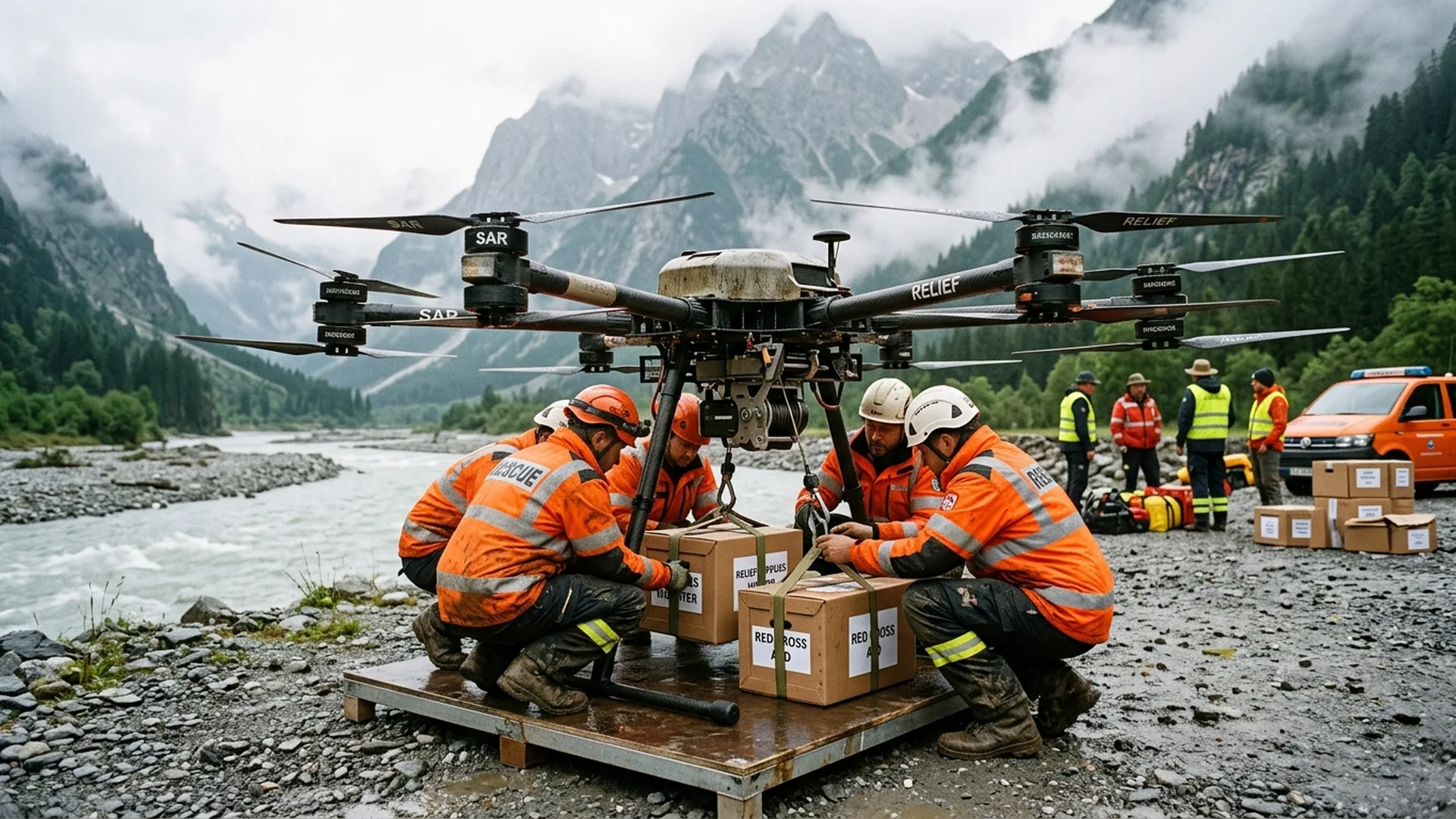
Following a catastrophic glacial collapse and destructive flash floods throughout the Bhote Koshi and Trishuli river valleys, the Government of Nepal has issued an urgent international appeal to foreign partners for heavy-lift cargo drones. The surge of debris, mud, and water swept away more than 35 bridges and severed dozens of kilometers of critical mountain highways, stranding thousands of residents across cut-off Himalayan valleys. While Nepali authorities staged their first provisional 130-pound cargo delivery flight four days after the disaster in Bidur, the stark contrast with neighboring China illustrates how uncrewed aviation systems have matured into indispensable emergency infrastructure.
Across the border in Tibet's Gyirong County, China's National Fire and Rescue Administration deployed a coordinated armada of 47 uncrewed aircraft alongside 681 rescue personnel within 48 hours. Orbiting high above the mud-buried border crossing, a Wing Loong long-endurance aircraft carrying cellular base stations restored mobile reception for over 6,000 user connections and hundreds of emergency calls during its opening sortie. This dual response in the Himalayas highlights a pivotal global transition: moving beyond improvised drone flights toward a rehearsed, doctrine-driven disaster aviation architecture.
The logistical gridlock in central Nepal
The scale of devastation in central Nepal was immediate and overwhelming. According to reporting from The New York Times, hundreds of lives were lost and thousands remain unaccounted for after a massive slab of glacier fractured at an altitude above 5,200 meters. The resulting slurry tore down river gorges at speeds exceeding 180 km/h, causing the Trishuli River to rise by nine meters in under thirty minutes.
With key transit arteries impassable, ground rescue teams faced severe physical barriers. In Devighat, near Bidur, a coalition of volunteer drone operators and armed police personnel organized an initial flight test across the swollen river. Utilizing a multirotor rated for 220 pounds (100 kg), the team transported 59 kg of essential rations, dry food, and medical supplies to the opposite bank in a three-minute round trip. Although Nepali commercial operators have logged extensive high-altitude flight hours operating DJI FlyCart units and Freefly Systems Alta X platforms on Mount Everest, a structured operational framework was missing to mobilize this private capacity immediately.
Airborne cellular relay and coordinated heavy-lift fleets
The synchronized response on the northern slope of the Himalayas demonstrates the tangible advantages of pre-planned disaster drone integration. When ground cellular towers operated by Nepal Telecom and Ncell were knocked offline across three districts, technicians faced arduous overland treks and helicopter drop-offs to transport generators to remote ridgelines. In contrast, Chinese emergency coordinators immediately launched airborne cellular repeaters to blanket the impact zone.
Replicating protocols refined during major flooding in Guangxi earlier this summer, long-endurance uncrewed aircraft provided continuous voice and data channels for trapped residents and field teams. Concurrently, heavy-lift multirotor drones were integrated directly into the tactical supply chain, executing scheduled shuttle runs to deliver tools, satellite communication packs, and food rations to forward rescue squads stationed at blocked border checkpoints.
Comparative analysis: manned helicopters versus cargo drones and relay UAVs
During large-scale natural disasters, each aerial platform fulfills a distinct operational role. While crewed helicopters remain irreplaceable for mass evacuations and heavy machinery transport, uncrewed systems excel in rapid last-mile logistical support and persistent communications:
| Operational Metric | Crewed Rescue Helicopter | Heavy-Lift Cargo Drone | Airborne Relay UAV (MALE) |
|---|---|---|---|
| Primary Mission | Mass casualty evacuation and primary search | Point-to-point payload delivery (food, medicine, gear) | Emergency cellular coverage and wide-area ISR |
| Typical Payload Capacity | 800 - 2,500 kg | 30 - 200 kg per flight | 50 - 300 kg (specialized telecom arrays) |
| Terrain & Weather Limits | Vulnerable to fog, downdrafts, and confined gorges | Operates in narrow ravines; zero runway requirement | Operates above weather (up to 7,000m+); anti-icing |
| Hourly Operating Cost | € 3,000 - € 7,000 per hour | € 150 - € 400 per hour | € 800 - € 1,800 per hour |
| Crew Risk Profile | High risk during severe alpine weather flights | Zero onboard crew risk; ground operator safety | Zero onboard crew risk; satellite beyond-line-of-sight |
Regulatory bottlenecks versus disaster response readiness
A vital lesson emerging from Nepal's crisis is that technological availability does not equate to operational readiness without administrative agility. Earlier in the year, commercial heavy-lift drone operators faced strict permit reviews from the Ministry of Home Affairs, which briefly suspended test permits over regulatory stakeholder consultations. When flash floods struck months later, regional district officers lacked established mechanisms to requisition, coordinate, and integrate private uncrewed fleets into active airspace.
Establishing emergency operational waivers and pre-authorized airspace corridors is essential to ensure that life-saving technology is not grounded by bureaucracy during the initial 72-hour golden window. The same principles apply to commercial uncrewed aviation across Europe, where operations adhere to strict airspace controls, but must possess pre-defined pathways to support civil protection agencies during acute regional emergencies.
European perspectives: EASA frameworks and civil protection
For European disaster management agencies, rescue organizations, and the European Union Aviation Safety Agency (EASA), the events in the Himalayas offer timely operational data. European member states face mounting climate-driven risks, including flash floods across alpine valleys, catastrophic river swelling such as the Ahr Valley disaster, and severe Mediterranean wildfires.
Within the European regulatory framework, heavy cargo drone operations operate under the Specific category governed by SORA (Specific Operations Risk Assessment), or under the Certified category for large-scale autonomous transport over populated areas. While the EU Civil Protection Mechanism (rescEU) has expanded its thermal reconnaissance capabilities, the formal inclusion of heavy-lift logistics drones (carrying 50 to 200 kg payloads) and airborne telecom relays remains an active area of expansion.
The progression from lightweight sensor drones to heavy industrial workhorses mirrors broader trends across commercial aviation. While specialized drone fleets are deployed daily for high-end cinema drone productions, demanding live broadcast operations, and technical surveys, the demand for certified flight teams capable of maneuvering complex payloads in extreme conditions continues to grow across the entire spectrum of professional drone services.
From Mountain Expeditions to an Integrated Disaster Drone Doctrine
Nepal's international appeal for heavy-lift cargo drones signals a definitive turning point in modern emergency management. Heavy uncrewed cargo aircraft are no longer experimental novelties reserved for high-altitude mountain expeditions or future urban logistics concepts; they are critical life-saving instruments for disaster resilience.
Governments and emergency response agencies that invest in certified heavy-lift fleets, qualified pilot rosters, and automated airspace integration protocols today will be equipped to transform disaster logistics tomorrow. The operational lessons from the Trishuli Valley will influence global disaster response doctrines for years to come.
Frequently asked questions about disaster relief cargo drones
Why are heavy-lift cargo drones critical in mountainous disaster relief?
When flash floods and landslides destroy bridges and roads, ground access to remote mountain villages is severed. Heavy-lift cargo drones fly autonomously across steep gorges and swollen rivers to deliver essential supplies like medicines, food, and communication gear without needing airstrips or exposing flight crews to severe weather hazards.
How do airborne relay drones like the Wing Loong restore emergency communications?
Medium-Altitude Long-Endurance (MALE) drones equipped with cellular base stations orbit high above disaster zones. They provide wide-area 4G and 5G connectivity directly to ground handsets, allowing stranded survivors to make emergency calls and enabling rescue coordinators to maintain continuous command links even when terrestrial telecom masts are destroyed.
How does EASA regulate heavy cargo drone operations in Europe?
Under EASA regulations, heavy cargo drones exceeding 25 kg operated Beyond Visual Line of Sight (BVLOS) fall within the Specific category, requiring a validated SORA (Specific Operations Risk Assessment) or certified airworthiness approvals. In emergency scenarios, national aviation authorities can authorize expedited operational corridors and temporary reserved airspace.
What payload capacity differences exist between commercial and industrial cargo drones?
Standard heavy multirotors like the DJI FlyCart 30 carry up to 30 kg in dual-battery configuration (or 40 kg in single-battery mode), making them ideal for rapid medical and ration drops. Next-generation industrial heavy-lift platforms, such as the FlyCart 100 and 200 series, scale payload capacities from 100 kg to 200 kg for high-volume emergency logistics.