 NL
NL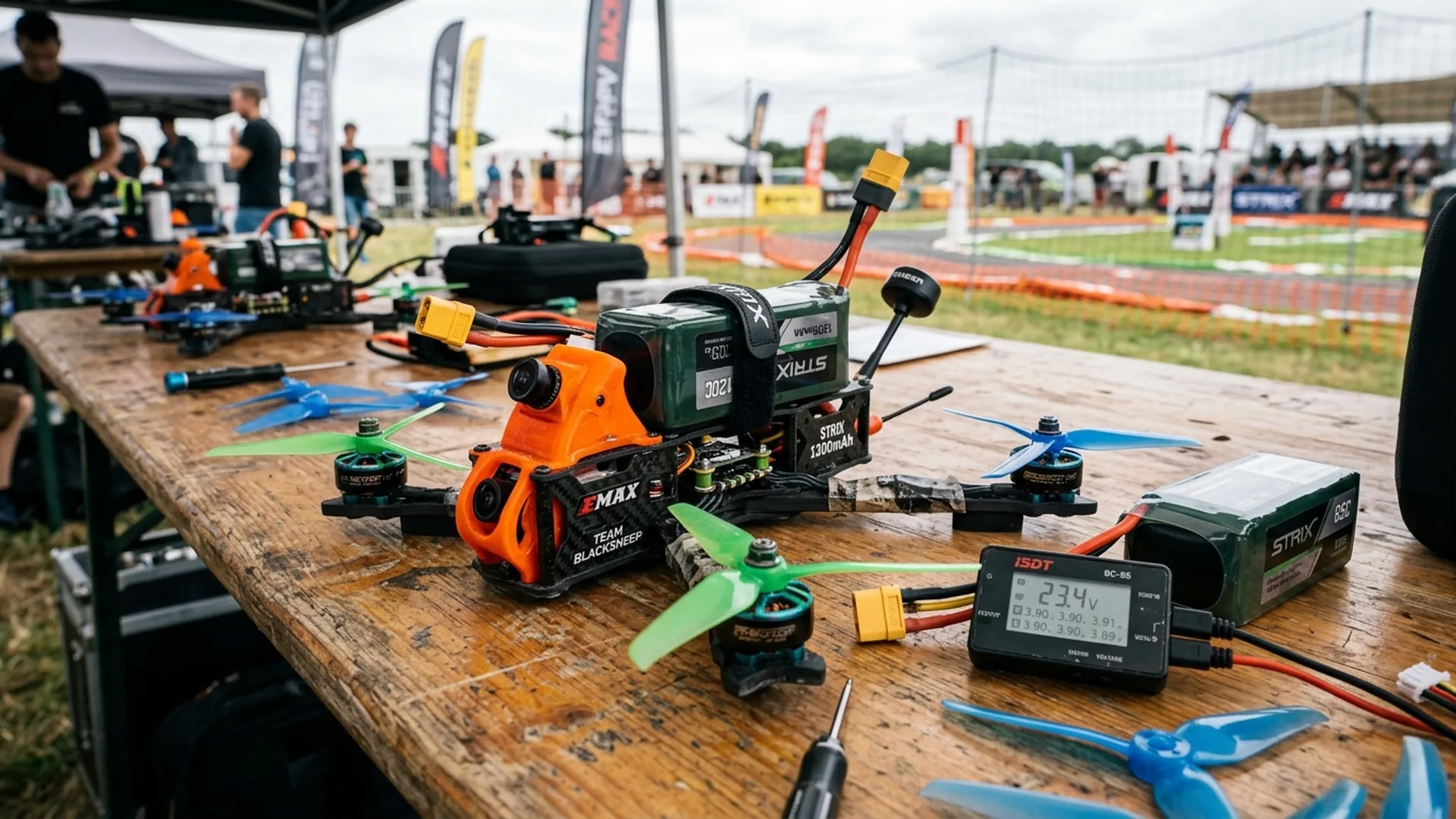
In the arena of competitive drone motorsport and high-speed aerial cinematography, an uncompromising law of physics dictates the game: every additional kilometer per hour demands exponentially more electrical power. While standard cinema drones or enterprise UAVs comfortably cruise for 25 to 40 minutes, an official heat in international FPV (First Person View) racing rarely exceeds 90 to 120 seconds. Modern 5-inch and 6-inch racing quads reach straight-line speeds between 180 and 220 km/h (112 to 137 mph), accelerating from 0 to 100 km/h in less than one second.
To produce this sheer level of performance, pilots push lithium-polymer (LiPo) battery packs to their absolute chemical and thermal limits. But why can't racing drones simply carry a larger battery pack to double their flight endurance at top speed? The answer lies in the complex interaction between parasitic drag, extreme current draw in amperes, internal resistance, voltage sag, and All-Up Weight (AUW). In this comprehensive technical analysis, we dissect the electrochemical and aerodynamic equations behind high-speed FPV flight.
The physics of extreme speed: power demand at 220 km/h
The primary governing factor behind short flight times at extreme velocities is aerodynamic drag ($F_d$). In fluid dynamics, aerodynamic drag scales quadratically with velocity:
F_d = ½ · ρ · v² · C_d · A
However, the mechanical power ($P = F_d \cdot v$) required to push a drone forward against that drag scales with the cube of velocity ($v^3$). An FPV racing quad accelerating from 110 km/u to 220 km/u doubles its forward speed, but requires theoretical power outputs almost eight times higher to overcome air resistance.
In real-world terms, four high-performance brushless motors engineered by industry leaders such as T-Motor draw roughly 25 to 35 amps at 22.2V (around 600 to 750 watts) during moderate cruise flights. As soon as the pilot opens the throttle wide open and hits 220 km/h, the combined current surging through the 4-in-1 Electronic Speed Controller (ESC) explodes to between 160 and 220+ amperes. Total power consumption peaks at 3,500 to 4,800 watts on a drone platform weighing under 650 grams including battery.
LiPo chemistry under extreme strain: C-ratings, internal resistance, and voltage sag
To deliver continuous bursts exceeding 200 amps without immediate cell failure, FPV pilots rely on high-discharge 6S LiPo or LiHV (Lithium High Voltage, 4.35V/cell) batteries. These packs carry continuous discharge specifications of 100C to 150C.
Under such violent discharge rates, an inevitable electrochemical limitation emerges: voltage sag. Every lithium cell exhibits an inherent Internal Resistance (IR), typically between 1.5 and 4 milliohms (Ω) per cell in healthy, preheated packs. Under Ohm's law ($V_{drop} = I \cdot R_{int}$), pulling 180A across a 6-cell pack causes a massive instantaneous voltage drop:
- Rest Voltage (Fully Charged 6S): 25.2V (4.20V per cell).
- Operating Voltage at 220 km/h Full Throttle: Abruptly collapses to 17.5V - 18.5V (barely 2.9V - 3.1V per cell under load).
- Thermal Dissipation: Internal resistance converts a large fraction of the battery's energy into direct heat ($P_{loss} = I^2 \cdot R$), causing packs to reach scorching temperatures of 60°C to 75°C (140°F - 167°F) after a 90-second heat.
When voltage sags severely during full-throttle runs, flight controller firmware such as Betaflight triggers low-voltage warnings. Pilots must monitor their On-Screen Display (OSD) telemetry in real time to prevent permanent cell degradation, pack swelling, or sudden electrical brown-outs.
The law of diminishing returns: capacity vs All-Up Weight (AUW)
A common assumption is that mounting a 2200 mAh or 3000 mAh pack instead of standard 1300 mAh - 1500 mAh packs would solve the flight duration challenge. In multirotor physics, however, increasing battery capacity quickly runs into diminishing returns:
A premium 6S 1300 mAh LiPo weighs roughly 225 grams, whereas a 6S 2200 mAh pack weighs around 360 grams. Adding 135 grams raises the drone's All-Up Weight from 580g to 715g—a 23% mass penalty that degrades every performance metric:
- Increased Induced Drag & Baseline Draw: The rotors must generate substantially higher continuous thrust simply to keep the heavier airframe in the air, elevating baseline current draw across all flight regimes.
- Loss of Cornering Agility: Greater rotational inertia makes the drone sluggish in hairpin turns and slalom gates, forcing earlier braking points and sluggish corner exits.
- Marginal Flight Time Gains: Because the heavier quad continuously pulls higher amperage to sustain race speed, the 70% capacity boost yields barely 30 to 45 extra seconds of racing endurance while completely ruining handling dynamics.
Technical benchmark: 6S LiPo capacity vs speed, current draw, and flight time
The following empirical telemetry dataset illustrates the trade-offs on a competitive 5-inch FPV racing quad (2207.5 1950KV motors, 5.1x4.6 tri-blade props) tested across various 6S battery capacities under full race conditions:
| Battery Configuration | Battery / AUW Weight | Average Current Draw | Top Speed | Effective Race Flight Time |
|---|---|---|---|---|
| 6S 1100 mAh (150C) | 190 g / 545 g | 62 A (Peak 195 A) | 224 km/h | 1 min 15 sec |
| 6S 1300 mAh (130C) - Race Standard | 225 g / 580 g | 66 A (Peak 210 A) | 220 km/h | 1 min 45 sec |
| 6S 1500 mAh (120C) | 255 g / 610 g | 70 A (Peak 205 A) | 214 km/h | 2 min 10 sec |
| 6S 1800 mAh (100C) | 305 g / 660 g | 78 A (Peak 190 A) | 202 km/h | 2 min 40 sec |
| 6S 2200 mAh (80C) - Chase / Cinelifter | 365 g / 720 g | 85 A (Peak 175 A) | 188 km/h | 3 min 15 sec |
Flight management strategies: throttle control, prop pitch, and motor KV
In elite drone racing championships, races are won not merely through pure stick reflexes, but through meticulous energy management. Pilots operating at full throttle continuously risk draining their battery before the final lap, encountering debilitating voltage sag right before the finish gate.
Experienced pilots implement precise technical adjustments to optimize every milliampere-hour:
- Propeller Pitch Tuning: On tight, technical tracks with frequent deceleration and directional changes, pilots choose lower pitch propellers (such as 5.1x3.6 or 5.1x3.8) to reduce peak current spikes during punch-outs. On fast circuits with long straights, aggressive 5.1x4.6 or 5.1x4.8 props are deployed to unlock the 220 km/h velocity ceiling.
- Motor KV and Throttle Scaling: Pairing motors (typically 1950KV on 6S architectures) with digital throttle curves prevents running motors in the inefficient saturation zone of their thrust curve.
- Battery Pre-Heating: Before lining up on the starting grid, LiPo packs are kept in temperature-controlled warming cases at 38°C to 42°C (100°F - 108°F). Pre-heating lowers the electrolyte viscosity and internal resistance, reducing voltage sag under load and boosting power efficiency by 8% to 12%.
From competitive racing to cinema chases and motorsport tracking
The engineering breakthroughs achieved in FPV racing have revolutionized commercial filmmaking and live sports coverage. When capturing GT3 supercars, rally vehicles, or extreme action sports, conventional camera drones lack the raw speed and agility to keep pace.
For high-speed motorsport drone cinematography and precision FPV fly-throughs, professional FPV drone pilots deploy modified 6-inch to 8-inch high-speed cinema rigs. These custom quads carry cinema payloads like the RED Komodo or Sony FX3, utilizing aerodynamic fairings and enlarged 6S/8S power architectures to sustain 180 km/h chase speeds with 4 to 6 minutes of productive filming time.
Unlike pure racing where every gram is shed, commercial productions prioritize airframe rigidity, radio link redundancy, and cinematic image stability, complementing our fleet of high-end cinema drones used in major international film productions.
European race championships and EASA safety compliance
Across Europe, sanctioned drone racing events operate under the governance of the Fédération Aéronautique Internationale (FAI) through the FAI World Drone Racing Cup and national aeromodelling federations. Because racing drones travel at highway speeds, strict organizational safety parameters are enforced.
Under the European Union Aviation Safety Agency (EASA) framework, competitive racing events typically take place within approved model aircraft club grounds (Article 16 of Regulation (EU) 2019/947) or under Specific category operational authorisations with full containment netting.
For individual pilots training in the Open category (A1/A3), having a dedicated visual observer (spotter) stationed alongside the pilot is a strict legal requirement: because the pilot is wearing immersive FPV goggles without direct line of sight (VLOS), the spotter must maintain continuous visual awareness of surrounding airspace and ground risks. Checking current Dutch drone regulations and no-fly zones ensures safe and compliant operations outside dedicated track facilities.
The future of energy density and aerodynamic efficiency
The perpetual trade-off between speed and flight duration remains the primary catalyst for innovation across the FPV sector. While traditional LiPo chemistries are approaching their theoretical gravimetric limits (around 180 to 220 Wh/kg), battery manufacturers and racing engineering teams are actively testing semi-solid-state lithium batteries and graphene-doped electrodes. These next-generation cells promise significantly reduced internal resistance and up to 30% higher energy density at identical pack weights.
Concurrently, aerodynamic refinement is transforming airframe design: streamlined carbon fiber monocoque fuselages and integrated motor nacelles reduce parasitic drag by 15% to 20% at 220 km/h. By achieving extreme velocities with lower sustained amperage, the next era of high-speed FPV promises longer racing heats and even more spectacular broadcast capabilities.
Frequently asked questions about FPV racing batteries and flight time
Why do FPV racing drones only fly for 90 seconds to 2 minutes at top speed?
At velocities above 200 km/h, aerodynamic drag increases exponentially. The four brushless motors combined draw 150 to over 220 amperes at full throttle. A standard 6S LiPo racing pack of 1300 mAh to 1500 mAh exhausts its usable capacity in under two minutes under such heavy sustained loads.
Why don't FPV racing pilots install larger batteries for extended flight times?
A heavier battery increases the all-up weight (AUW), which adds rotational inertia and worsens high-speed cornering and braking performance. Furthermore, the motors must work harder continuously to carry the extra mass, causing the theoretical flight time gains at race speed to diminish almost entirely.
What is voltage sag and how does it affect FPV racing performance?
Voltage sag is the temporary drop in battery terminal voltage caused by the internal resistance (IR) of the LiPo cells under massive current draws. Under full throttle, a 6S pack (nominal 22.2V to 25.2V) can abruptly dip below 18V, leading to immediate thrust loss and early low-voltage alerts.
What regulations govern high-speed FPV racing drone flights in Europe?
Under the EASA regulatory framework, FPV flights fall under Open category (A1/A3) or Specific category operations. Because the pilot wears FPV goggles and lacks direct visual line of sight, having a qualified visual observer (spotter) alongside the pilot is legally mandatory at all times.