 NL
NL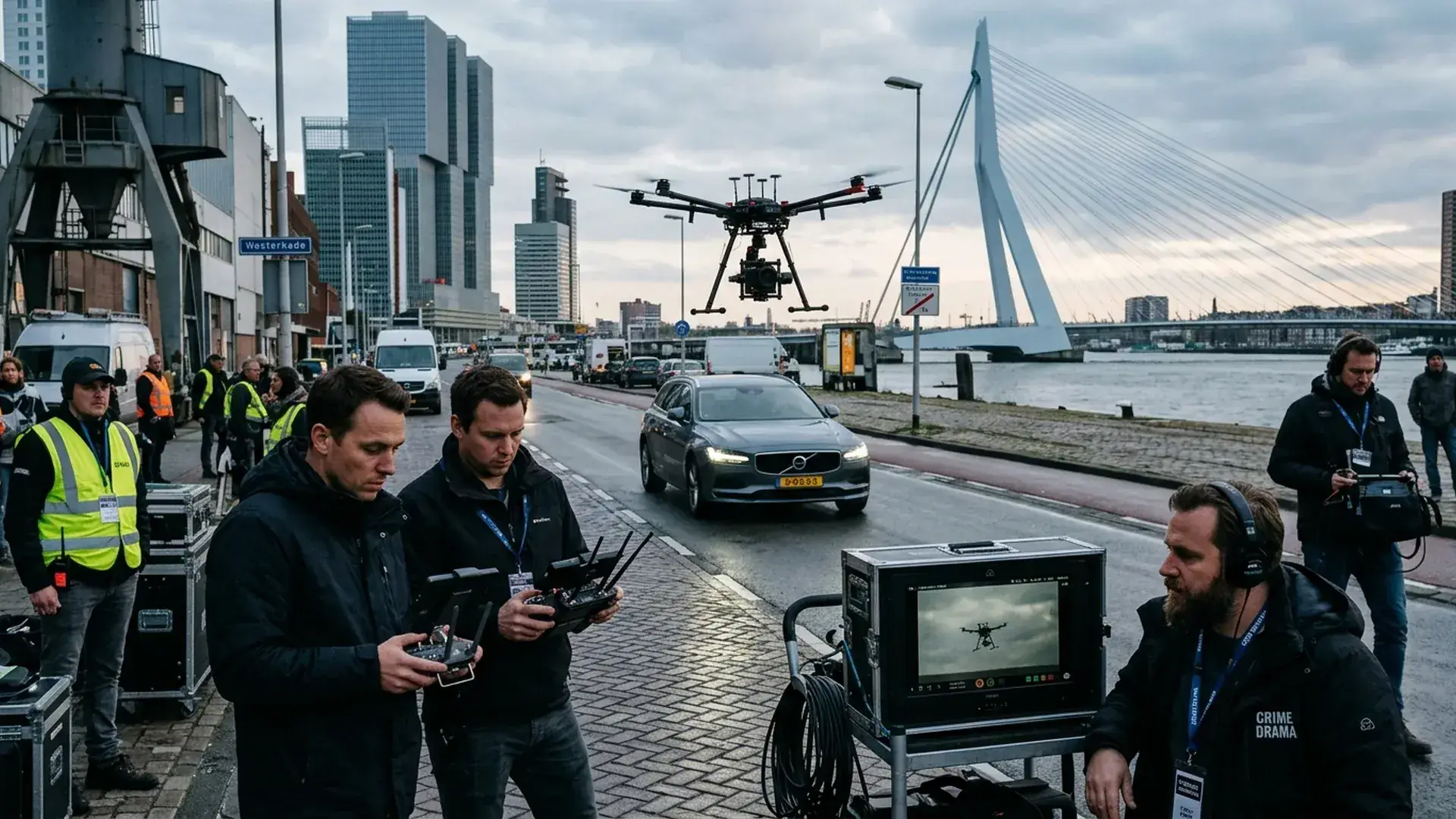
In contemporary European television drama and high-end crime series, visual storytelling has undergone a revolutionary shift. Where aerial cinematography once served primarily as static establishing wide shots to set geographic context, modern drone cinematography has become an essential narrative engine. Acclaimed police procedurals and crime dramas like Flikken Rotterdam, Flikken Maastricht, and international co-productions demonstrate how cinema drones immerse audiences directly into the heartbeat of urban action.
From high-speed vehicle pursuits across the quays of the Nieuwe Maas to continuous sequence shots where the camera swoops down from a hundred meters in the sky to eye level with lead detectives, the traditional boundary between cranes, helicopters, and ground cameras has evaporated. This visual evolution demands elite cinema operators who master not only razor-sharp flight precision but also the intricate dramatic language of Directors and Directors of Photography (DPs).
From static overhead vistas to dynamic narrative movement
Conventional helicopter footage during the analog broadcast era suffered from significant narrative limitations. Rotor wash, high acoustic noise, and strict altitude baselines forced cameras to stay far removed from the emotional core of the scene. With the maturation of state-of-the-art cinema drones such as the DJI Inspire 3, filmmakers can now execute fluid camera moves that were physically unattainable with classical rigs.
In an architecturally dramatic city like Rotterdam, with landmarks like the Erasmus Bridge, Wilhelmina Pier, and deep maritime shipping ports, the cinema drone operates as an airborne dolly with unlimited track length. The gimbal can glide inches away from modernist glass high-rises, accelerate effortlessly behind a fleeing suspect along the historic Westerkade, and settle smoothly into a tight medium shot outside an interrogation venue. This unbroken motion sustains suspense without requiring hard cuts, creating a captivating and fluid visual rhythm.
Watch below how Drone Department executed dynamic aerials and cinema drone sequences for the Dutch crime series Flikken Rotterdam:
Camera matching and color science on professional film sets
A critical requirement for broadcast drama is visual consistency across all scene coverage. Ground units routinely shoot on premium digital cinema cameras, including the ARRI Alexa Mini LF, RED Digital Cinema V-Raptor, and Sony VENICE 2. If an aerial shot demonstrates compressed dynamic range, harsh digital sharpening, or inconsistent color science, it shatters the viewer's immersion.
The integration of the Zenmuse X9-8K Air gimbal camera has eliminated this technical hurdle. Featuring a full-frame 8K sensor with Dual Native ISO (ISO 800 and ISO 4000), 14.7+ stops of dynamic range, and internal Apple ProRes RAW / CinemaDNG recording, aerial footage grades seamlessly into high-end color finishing pipelines. Interchangeable DL-mount prime lenses (18mm, 24mm, 35mm, 50mm, and 75mm) allow DPs to match depth of field, perspective, and optical distortion with primary ground packages.
| Camera Platform | Sensor & Resolution | Primary Production Role | Dynamic Range |
|---|---|---|---|
| DJI Inspire 3 (X9-8K Air) | Full-Frame 8K / 75fps | Narrative moves, tracking shots, seamless dolly lines | 14.7+ Stops |
| Custom Cinema FPV | RED Komodo-X 6K / BMPCC | High-speed chases, tight vehicle passes, fly-throughs | 16.5+ Stops |
| Heavy-Lifter Gimbal Rig | ARRI Alexa Mini LF / Sony VENICE | Matched A-camera builds, anamorphic glass | 15.0+ Stops |
Dual-operator coordination and real-time set communication
Executing intricate narrative shots demands flawless synchronization between creative and technical crew members. Premium drama sets rely on a dual-operator system where flight operations and camera framing are managed independently. The certified pilot-in-command concentrates fully on flight dynamics, navigation, and obstacle clearance, while the camera operator controls 360-degree pan, tilt, roll, and wireless focus using dedicated DJI Master Wheels or high-bright remote monitors.
During complex action & motorsport sequences or high-speed police chases, the flight team, director, and First Assistant Director (1st AD) stay connected via wireless full-duplex intercom headsets. This allows the director to cue dynamic camera pans in real time ("track the lead patrol car through the intersection, now tilt up toward the rooftop sniper"), while the pilot maintains full situational awareness against power lines, street furniture, and micro-weather patterns.
Regulatory airspace management in urban and port environments
Operating professional drone rigs in a busy European metropolis involves stringent aviation governance. Rotterdam presents a uniquely complex airspace structure: substantial sections of the city and industrial harbor lie within the Control Zone (CTR) of Rotterdam The Hague Airport, maritime jurisdictions managed by the Port of Rotterdam Authority, and dense public spaces governed by the Municipality of Rotterdam.
Under the European Union Aviation Safety Agency (EASA) framework, television aerial shoots must be conducted within the Specific Category. Key operational requirements include:
- Standard Scenarios (STS-01) or PDRA/SORA authorizations: Operating over controlled ground areas in urban centers requires comprehensive risk mitigations and an approved Operations Manual issued by civil aviation authorities.
- Air Traffic Control coordination with LVNL: Two-way radio clearance, flight plan submissions, and digital geozone approvals through official national drone airspace maps.
- Street closures and safety perimeters: Working alongside local police, certified traffic marshals, and municipal film offices to maintain sterile drop zones beneath the flight path.
- Night flight authorizations: Specialized operational safety procedures for filming outside official daylight hours, including high-visibility anti-collision strobe arrays and maritime port liaison.
The emergence of cinema FPV for high-speed action and fly-throughs
Alongside stabilized camera ships, specialized custom Cinema FPV drones are redefining the choreography of modern television action. When a script calls for an intense foot chase weaving through narrow warehouse alleys or passing directly through vehicle cabins, compact cinewhoop platforms provide agility that larger drones cannot match. These methods also form the core of immersive indoor FPV fly-throughs.
Harnessing gyro-stabilization pipelines like Gyroflow and cinema-grade payloads, FPV pilots reach speeds exceeding 140 km/h while delivering buttery-smooth, cinematic motion. This gives directors the ability to put the camera in the exact physical perspective of a pursuing officer or fleeing vehicle, generating visceral tension for broadcast viewers.
The evolving craft of European broadcast cinematography
The convergence of cutting-edge drone hardware, full-frame cinema sensors, and rigorous European aviation compliance has elevated television storytelling to cinematic heights. Productions like Flikken Rotterdam illustrate that drones are no longer merely technical novelty tools, but integral narrative instruments that establish tension, control pacing, and deeply embed characters into their architectural surroundings.
For television producers and directors, the cornerstone of success is early pre-production collaboration with the drone crew. By designing flight trajectories, lens choices, and permit roadmaps during the storyboard phase, the most ambitious creative visions can be executed safely, efficiently, and with maximum dramatic impact on screen.
Frequently asked questions about drones in TV series
Why do TV drama productions choose cinema drones over helicopters?
Cinema drones can operate extremely low to the ground, navigate tight urban corridors, and descend smoothly to eye level with actors at a fraction of the operational cost and carbon footprint of conventional helicopters.
What camera systems are used for television series like Flikken Rotterdam?
High-end television productions predominantly rely on the DJI Inspire 3 with Zenmuse X9-8K Air, equipped with full-frame prime lenses and Apple ProRes RAW or CinemaDNG recording for flawless color matching with ground cameras like ARRI Alexa and Sony VENICE.
What flight permits are required for drone filming in port cities like Rotterdam?
Filming in populated urban areas and maritime ports falls under the EASA Specific Category with operational authorizations (such as STS-01 or PDRA SORA), alongside clearance from the Port of Rotterdam Authority, Air Traffic Control (LVNL) in the Rotterdam CTR, and local municipal authorities.
What is the benefit of a dual-operator workflow on a film set?
In a dual-operator setup, the certified pilot-in-command focuses entirely on flight path safety and precision piloting, while the specialized gimbal camera operator and Director of Photography (DP) control 360-degree pan, tilt, zoom, and wireless focus in real time.