 NL
NL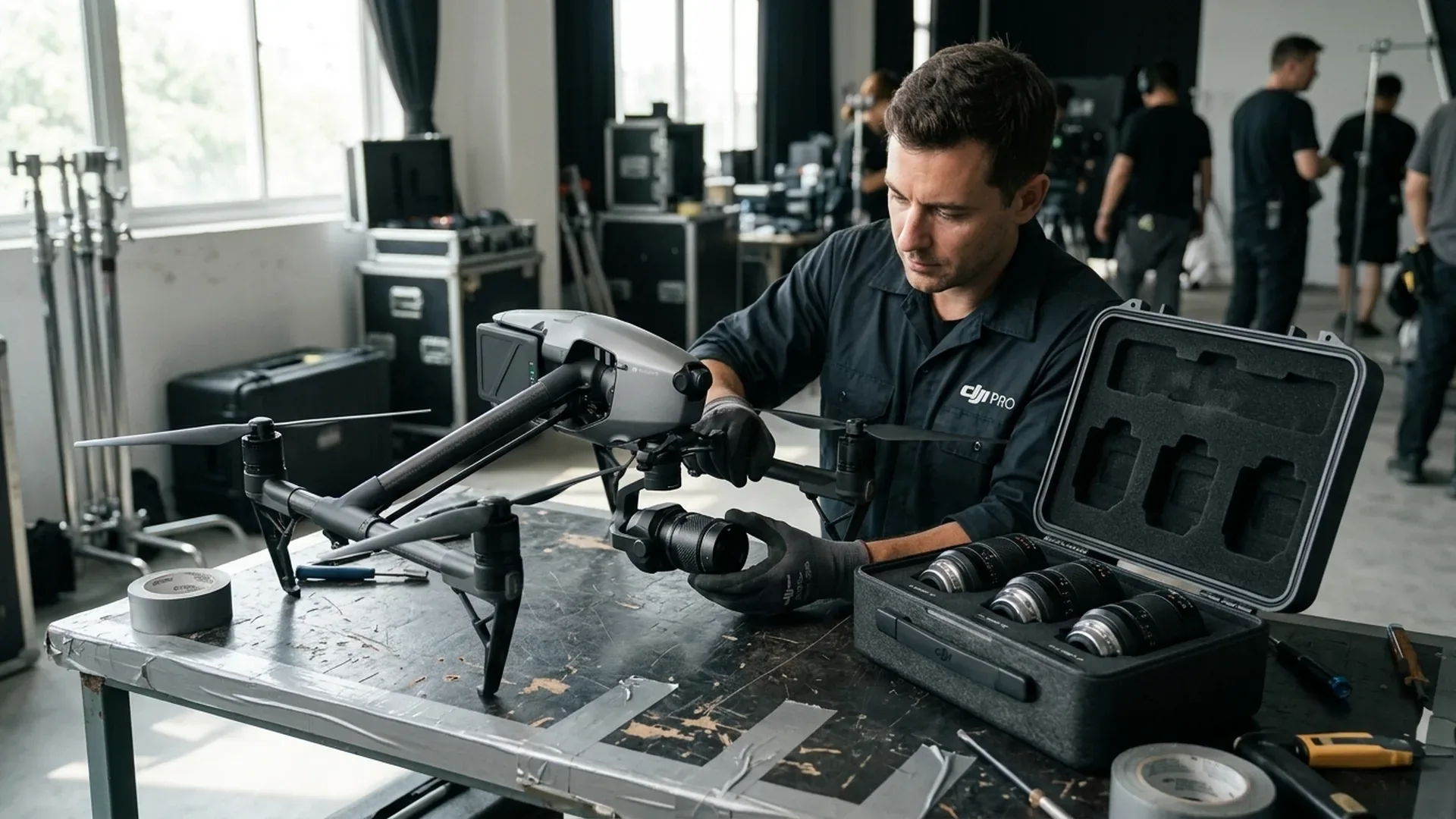
Aerial cinematography has matured from simple wide-angle establishing perspectives into a sophisticated visual storytelling medium. While standard consumer drones remain restricted to fixed wide lenses, high-end feature films, high-concept commercials, and premium drama series demand absolute optical versatility. The arrival of full-frame aerial cinema platforms such as the DJI Ronin 4D and Inspire 3 X9-8K Air ecosystem featuring the DL-mount system has redefined how directors and Directors of Photography (DPs) orchestrate shots from the air.
Changing focal lengths aloft is far more than simply framing closer or further away. Every prime lens (from ultra-wide 18mm to compressed 75mm telephoto) fundamentally alters perspective, parallax displacement, spatial depth, perceived flight speed, and depth of field. To extract the full narrative potential from modern cinema drones, filmmakers and operators must master the unique visual characteristics and technical disciplines associated with each focal length.
Optical physics aloft: perspective, parallax, and perceived flight velocity
When a camera tracks across a physical set on a dolly or jib crane, the relationship between camera-to-subject distance and focal length establishes the spatial depth of the shot. In three-dimensional airspace, these fundamental optical principles are magnified substantially. A cinema drone travels freely along X, Y, and Z axes, frequently at operational speeds ranging from 30 to over 90 kilometers per hour.
Through an ultra-wide prime such as an 18mm or 24mm, foreground elements rush past the lens at blistering apparent speeds while the distant horizon remains relatively stable. This dynamic creates an exhilarating sensation of kinetic motion, expansive scale, and spatial immersion. Conversely, switching to a 75mm telephoto prime produces dramatic background compression. Distant mountain ranges or city skylines appear pulled directly behind subjects, and foreground-background elements glide past one another in a smooth, cinematic parallax cadence. This optical compression empowers filmmakers to isolate characters within complex environments and create striking juxtapositions impossible with conventional wide drone optics.
18mm Ultra-Wide: grand architectural scale and high-speed proximity
An 18mm F2.8 lens on a full-frame sensor delivers a generous diagonal field of view of approximately 100 degrees. In cinematic production, this ultra-wide focal length is chosen when the surrounding geography is a central character in the narrative. Expansive mountain passes, historic European castle estates, sprawling industrial complexes, and vast coastal vistas benefit immensely from this sweeping optical rendering.
A primary operational benefit of the 18mm prime is its expansive hyperfocal depth. Even when filming wide open, virtually the entire image plane remains razor sharp from a few feet in front of the drone all the way to infinity. This optical depth makes the 18mm prime the premier choice for close proximity fly-bys skimming rock faces, structural arches, and dense forest canopies. Because optical edges are slightly stretched, forward flight at 50 km/h delivers the visceral sensation of a high-speed dive. However, framing with an 18mm requires exceptional precision from the cinema drone operator team: because the field of view is so broad, landing gear, propellers, and horizon tilt must be actively managed to eliminate unwanted edge artifacts.
24mm Wide: the universal industry standard for establishing shots
On European commercial and film sets, the 24mm F2.8 is widely regarded as the most versatile workhorse prime. Offering an 84-degree diagonal field of view on full-frame sensors, the 24mm delivers a generous environmental overview while maintaining rectilinear geometry and natural vertical lines. Structural lines in architectural monuments remain straight and realistic, preventing the exaggerated barrel distortion typical of wider optics.
The 24mm shines across classical establishing scenes, dynamic vehicle tracking sequences, and narrative sequences where subjects must interact organically within their surroundings. During action and motorsports filming, the 24mm provides an ideal balance: it allows the pilot to maintain a safe standoff distance of several meters while capturing crisp, dynamic vehicle framing. Furthermore, the 24mm prime is significantly less vulnerable to crosswind buffeting than longer telephoto lenses, providing rock-solid 3-axis stabilization in challenging offshore and alpine conditions.
35mm Moderate Wide: natural human perspective and cinematic intimacy
The 35mm F2.8 lens delivers the quintessence of cinematic realism. With a diagonal field of view of approximately 63 degrees, it closely mirrors natural human visual perception. While a 24mm subtly expands the perceived distance between objects, a 35mm maintains genuine spatial proportions and physical scale.
When an aerial cinema platform flies low to the deck or tracks alongside running actors, boats, or horseback riders on a 35mm lens, the resulting shot feels intimate and organic. The footage ceases to look like a detached, high-altitude drone overview and instead mirrors the kinetic grace of a flying Steadicam or 50-foot Technocrane arm. Backgrounds begin to dissolve into smooth, creamy bokeh, cleanly separating key talent from busy backgrounds. This organic rendering makes the 35mm the preferred choice for directors seeking seamless editorial transitions between aerial plates and ground coverage shot on ARRI or RED cinema systems.
75mm Telephoto: intense background compression and set safety
The engineering of lightweight, balanced 75mm F1.8 and F2.8 telephoto primes designed specifically for aerial gimbals has fundamentally expanded creative horizons. Delivering a tight 32-degree field of view on full-frame sensors, the 75mm creates dramatic optical compression. A mountain ridge situated ten kilometers behind a historic cathedral appears immediately adjacent to the spires, creating an unforgettable sense of visual density.
Beyond artistic expression, telephoto primes solve critical operational and safety challenges on modern film sets. Under the regulatory framework established by the European Union Aviation Safety Agency (EASA), drone operations must maintain strict safety buffers from non-involved personnel, active traffic corridors, and protected heritage structures. With a 75mm prime, an aerial crew can maintain an operational standoff distance of 50 to 100 meters while capturing a tight, compelling medium close-up of actors or moving vehicles. This capability allows high-end aerial production in congested urban hubs where close-proximity flight is legally or physically impossible.
Operating a 75mm telephoto prime aloft introduces elevated operational demands. Every micro-vibration, motor resonance, or subtle wind gust is magnified through the telephoto optics. Flawless execution requires specialized gimbal isolation dampening. Focus can be tracked reliably via onboard autofocus systems, managed directly by the camera operator from the ground station, or handled by a dedicated focus puller (1st AC) using a wireless follow-focus controller (such as the DJI Three-Channel Follow Focus or High-Bright Remote Monitor) for complex narrative sequences.
Comparative analysis: 18mm, 24mm, 35mm, and 75mm on cinema drones
The following comparative overview outlines the technical characteristics, optical aesthetics, and premier applications of the four core focal lengths in aerial cinematography:
| Focal Length | Field of View (Full-Frame) | Optical Characteristics | Wind & Vibration Sensitivity | Primary Set Application |
|---|---|---|---|---|
| 18mm F2.8 Ultra-Wide | ~100° Diagonal | Deep hyperfocal field, exaggerated speed, expansive perspective | Very Low (masks micro-vibrations) | Landscapes, architectural vistas, close fly-bys |
| 24mm F2.8 Wide | ~84° Diagonal | Natural wide perspective, minimal distortion, reliable framing | Low | Establishing shots, vehicle tracking, commercials |
| 35mm F2.8 Standard | ~63° Diagonal | Human eye perspective, gentle bokeh, subject isolation | Moderate (requires smooth pilot inputs) | Narrative drama, feature films, low-altitude tracking |
| 75mm F1.8 / F2.8 Tele | ~32° Diagonal | Intense compression, strong parallax separation, flat depth | High (dual-operator recommended; focus puller optional) | Standoff safety shots, intimate close-ups, parallax tracking |
On-set workflows: balancing, calibration, and optical filtration
Executing lens changes on an aerial cinema platform demands rigorous protocols far beyond standard ground camera operations. Because the camera package is suspended on an ultra-sensitive 3-axis brushless gimbal, any variance in glass mass immediately shifts the system's center of gravity.
Modern aerial camera systems utilize precision counterweight balancing rings engineered for each specific focal length. When swapping from a compact 24mm prime to a longer 75mm lens, the camera assistant (1st AC) or drone technician must mount the designated counterweight and initiate an automated gimbal balance calibration on the ground controller. Neglecting this calibration can lead to brushless motor overheating and introduce high-frequency jitter into pristine 8K RAW cinema files.
Optical filtration is equally paramount. To preserve the cinematic 180-degree shutter rule (1/50s shutter speed at 25fps) under intense daylight conditions, heavy neutral density filtration is mandatory. Modern aircraft in our fleet of professional high-end cinema drones incorporate motorized internal 9-stop ND systems (ND2 to ND512), allowing instant exposure adjustment without altering external lens weight or disrupting fine gimbal balance.
European regulatory compliance and operational safety with telephoto glass
Employing interchangeable focal lengths offers substantial legal and operational flexibility within European airspace frameworks. Under the EASA Specific Category and corresponding SORA risk assessments, aerial filming near infrastructure, ports, and large crew environments requires strict ground risk mitigation.
By deploying 35mm or 75mm focal lengths, production teams can position the aircraft within a cordoned, secure operating volume while delivering the visual intimacy of a close-quarters shot. Seasoned, certified drone pilots integrate this optical capability with centimeter-precise RTK (Real-Time Kinematic) positioning to execute repeatable, complex flight paths with unmatched fidelity and safety.
Selecting the ideal focal length as a creative signature in aerial filmmaking
The transition to interchangeable full-frame prime lenses signifies the complete maturation of drone cinematography. Aerial shots are no longer constrained to generic wide angles; directors and DPs now possess the same expressive optical canvas in the sky as on ground sets.
Whether harnessing the grand geometry of an 18mm over dramatic coastlines, the proven storytelling versatility of a 24mm in a national commercial, the intimate human realism of a 35mm in feature drama, or the dramatic spatial compression of a 75mm telephoto prime, selecting the right lens elevates aerial filmmaking into pure cinematic art.
Frequently asked questions about interchangeable lenses on cinema drones
Why do directors and DPs prefer interchangeable prime lenses on cinema drones?
Interchangeable prime lenses deliver unmatched optical sharpness, organic bokeh, and color consistency that matches ground cinema cameras seamlessly. Furthermore, focal length selection directly shapes camera motion dynamics, depth of field, and background compression in three-dimensional airspace.
What is the key flight dynamic difference between an 18mm ultra-wide and a 75mm telephoto lens?
An 18mm lens exaggerates close foreground movement and naturally masks minor gimbal vibrations, allowing high-speed dynamic tracking. A 75mm lens significantly compresses the background and brings distant subjects closer, but requires smooth flight paths, millimeter-accurate gimbal control, and dedicated focus pulling.
Does the gimbal need rebalancing and calibration after swapping lenses?
Yes, each prime lens has a unique weight and center of gravity. Systems like the DJI Zenmuse X9-8K Air utilize dedicated counterweights and locking rings, followed by an automated or manual gimbal calibration to prevent brushless motor strain and high-frequency vibrations.
How do EASA safety buffers relate to using telephoto lenses on drone sets?
Under European EASA regulations and Specific category SORA frameworks, strict minimum standoff distances apply to uninvolved personnel and critical assets. A 75mm telephoto lens enables drone crews to capture intimate, frame-filling close-ups while maintaining full regulatory compliance safely outside the ground risk buffer.