 NL
NL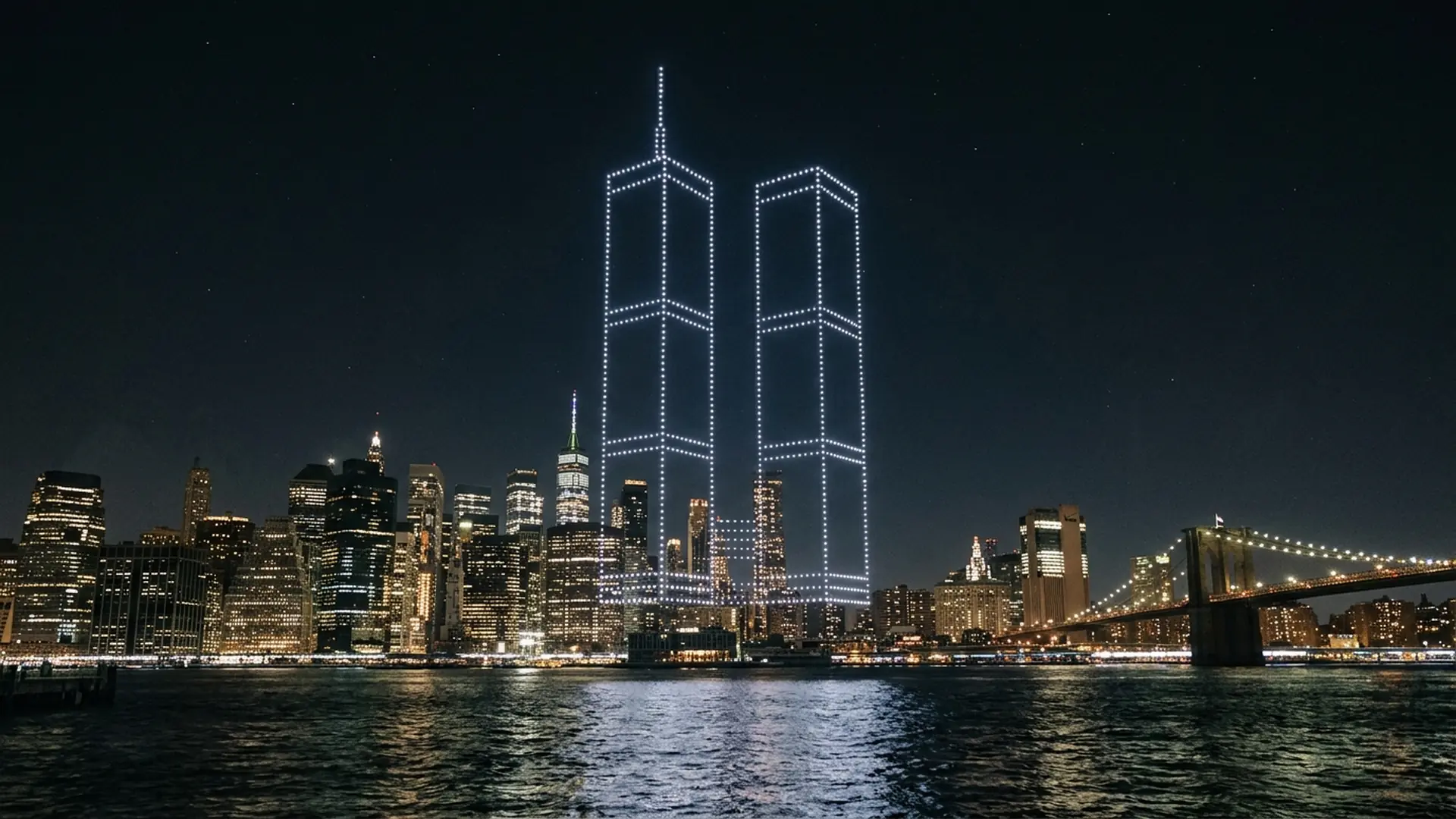
On Wednesday evening, September 9, 2026, the night sky over New York Harbor became the stage for one of the most poignant and technologically ambitious aerial art installations in modern history. Ahead of the milestone 25th anniversary of the September 11 terrorist attacks, exactly 2,977 illuminated drones ascended in unison above the harbor waters. Each individual airborne light represented a single life lost on September 11, 2001, forming a breathing constellation of remembrance before coalescing into the full architectural scale of the original World Trade Center Twin Towers in light.
Titled "2,977 Lights Over New York Harbor", the commemorative artwork was unveiled as a free public act of unity and reflection, offered as a gift to the city of New York and to all whose lives were irrevocably touched by that fateful morning. The installation is a sponsored project of the New York Foundation for the Arts (NYFA), funded entirely through private philanthropy. It represents an unprecedented fusion of civic memorialization, architectural history, and cutting-edge autonomous swarm aviation.
Watch the official video of 2,977 Lights Over New York Harbor
The official video footage below documents the solemn ascent as nearly three thousand individual drones swirl upward from the water into a soaring double-helix formation before aligning into the majestic wireframe silhouettes of the Twin Towers across the New York skyline:
The architectural helix: reviving the World Cultural Center concept
For more than two decades, New York's primary night sky memorial has been the celebrated "Tribute in Light", projecting vertical shafts of illumination into the stratosphere. While 2,977 Lights Over New York Harbor was conceived in respectful dialogue with that installation, it introduced a dynamic spatial narrative by harnessing the sculptural versatility of autonomous drone formations.
Rather than rising as rigid columns, the 2,977 lights first gathered in a spiraling double-helix. The helix intentionally recalls the THINK team's World Cultural Center, the unbuilt 2002 proposal for the World Trade Center site. That master plan envisioned two soaring latticework towers rising around the original footprints without touching them, carrying public cultural space high into the sky.
By translating that civic vision into a temporary monument of light, the creative team returned the proposal to the skies of Lower Manhattan, floating gracefully above the waters of New York Harbor.
A global collaboration: Studio Drift, Sky Elements, and 9/11 families
The realization of an aerial production of this magnitude demanded an exceptional alignment between artistic sensitivity, aviation engineering, and civic stewardship. The project was led by creative director and executive producer Addison Mehr, working alongside designer Yan Paul Dubbelman and production partner Sky Elements Drone Shows, headed by CEO Rick Boss. Sky Elements is renowned across North America for executing record-setting commercial drone spectacles and complex public events.
A vital artistic force behind the project was the Amsterdam-based artist duo Studio Drift, led by Ralph Nauta and Lonneke Gordijn. Revered globally as the originators of choreographic drone light art, Studio Drift brought their profound experience with bio-inspired swarm dynamics and contemporary light sculpture to the production. Having pioneered historic public installations such as "Franchise Freedom" and Hamburg's "Breaking Waves", their involvement ensured that the movement of the drones felt contemplative, organic, and deeply human rather than mechanical. Renowned architects Shigeru Ban and Dean Maltz contributed architectural consultancy to ensure structural verisimilitude in the towers' celestial proportions.
Major philanthropic backing was provided by The Cantor Fitzgerald Relief Fund and individual 9/11 family members, with critical additional funding from The Blavatnik Family Foundation and Pershing Square Philanthropies. Permitting, inter-agency federal coordination, and rigorous harbor safety operations were spearheaded by event production specialist IDEKO, under the leadership of CEO Evan Korn.
Voices of responders and survivors: keeping memory alive
Throughout its development, the installation was guided by a dedicated advisory collective representing first responders, survivors, and bereaved family members. While recognizing that no single group can articulate the full spectrum of grief, their shared guidance ensured that every phase of the artwork honored the gravity of the occasion.
Tim Brown, an FDNY first responder during both the 1993 World Trade Center bombing and the 2001 collapse, explained that he helped shape 2,977 Lights to pay homage to the 343 firefighters who made the ultimate sacrifice, noting that three specific lights in the formation flew in direct remembrance of his fallen colleagues Chris Blackwell (Rescue 3), Terry Hatton (Rescue 1), and Michael Lynch (Ladder 4).
Terry Strada, national president of 9/11 Families United and widow of Tom Strada, expressed hope that illuminating the skyline would remind the world not only of what was lost, but of who the nation became on September 12: a society bound by compassion, mutual solidarity, and collective resilience. Brenda Berkman, a pioneering retired FDNY captain and contemporary printmaker, underscored the educational responsibility of the project: twenty-five years later, more than 100 million Americans possess no living memory of September 11. Public art offers a vital cultural vessel to convey emotion, historical context, and communal truth across generational divides.
The aerial choreography was paired with a musical score chosen specifically for collective introspection. The soundscape incorporated orchestral masterworks by Philip Glass, John Adams' Pulitzer Prize-winning tribute "On the Transmigration of Souls", and Max Richter's celebrated composition "On the Nature of Daylight" from The Blue Notebooks.
Aviation safety and the logistical mastery of 2,977 drones
For aviation authorities, airspace regulators, and commercial drone professionals, the execution of 2,977 Lights Over New York Harbor represents a pinnacle of contemporary swarm logistics. Operating nearly three thousand unmanned aircraft simultaneously within one of the most heavily congested airspace sectors in the world is a remarkable technical feat.
New York Harbor borders intensive air traffic corridors serving Newark Liberty International Airport (EWR), John F. Kennedy International Airport (JFK), and LaGuardia Airport (LGA), alongside routine low-altitude NYPD aviation patrols and commercial sightseeing helicopters. To secure the flight envelope, the Federal Aviation Administration (FAA) issued specialized airspace waivers under a Certificate of Authorization (COA) and enacted a rigorous Temporary Flight Restriction (TFR / NOTAM). On the water below, IDEKO coordinated closely with the United States Coast Guard and local law enforcement to enforce maritime exclusion buffers, ensuring no unauthorized vessels entered the drop-zone perimeter.
The mission-critical engineering parameters that made this performance possible include:
- Centimeter-grade multi-band RTK GPS: High-precision Real-Time Kinematic satellite telemetry keeps every drone locked to its exact coordinate in three-dimensional space, counteracting harbor wind shear and maritime humidity.
- RF spectrum coordination: Synchronizing data telemetry across 2,977 individual transmitters in a densely populated metropolitan frequency environment requires multi-channel frequency hopping and isolated wireless control links.
- Dynamic automated geofencing: Comprehensive containment barriers immediately trigger fail-safe return-to-home or gentle vertical descents if any aircraft breaches its pre-assigned spatial envelope.
- 3D digital pre-flight simulation: Swarm flight paths, battery consumption curves, and spatial clearances were modeled through millions of digital iterations before physical hardware was deployed on the launch barges.
In Europe, equivalent large-scale night displays are governed by the risk-based framework of the European Union Aviation Safety Agency (EASA). Such operations operate within the Specific category and demand comprehensive Specific Operations Risk Assessments (SORA) approved by national aviation authorities. For detailed insight into how commercial crews handle complex night shoots and safety protocols, review our comprehensive analysis on filming drone shows, safety protocols, and aviation licenses.
Comparative analysis: searchlight beams versus 3D drone memorials
The advent of programmable drone fleets offers civic planners and memorial foundations transformative storytelling capabilities. The table below illustrates the structural and operational differences between traditional searchlight installations and modern sculptural drone light shows:
| Operational Dimension | Traditional Tribute in Light | 2,977 Lights Drone Installation |
|---|---|---|
| Illumination Technology | 88 high-intensity xenon searchlights (7,000 W each) | 2,977 individually addressable RGBW LED drones |
| Spatial Representation | Two continuous vertical beams piercing the sky | True 3D volumetric wireframe recreation at full scale |
| Choreographic Dynamics | Static light column through the night | Evolving narrative from ascending helix into twin towers |
| Ecological & Avian Impact | Can disorient migrating birds; requires radar shutdowns | Zero bird-attracting skyward glare; focused LED luminaires |
| Energy Footprint | Extensive fuel and continuous generator power | Rechargeable lithium-polymer cells with minimal footprint |
| Airspace Permitting | FAA tower notifications for high-intensity beams | FAA COA, TFR airspace closure, and Coast Guard safety zone |
Whether producing historic public commemorations or large-scale brand spectacles, modern aerial productions rely on the synergy between synchronized light fleets and camera aircraft. Organizations planning major events can explore our specialized drone show production services, which are frequently combined with cinema drones and certified drone pilots to capture breathtaking aerial cinematography.
Light as an enduring monument for future generations
The ascent of 2,977 lights over New York Harbor represents a transformative moment in the history of public monuments. For centuries, societies commemorated profound historical turning points through immovable monoliths of bronze, marble, and granite. Yet the temporary nature of this aerial installation achieved an emotional resonance that permanent stone often struggles to evoke.
By translating unfathomable statistics into individual, breathing lights, the artwork restored personal intimacy to collective memory. Each glowing point in the harbor sky stood as a distinct human soul: a parent, a child, a spouse, or an unhesitating first responder. As those discrete lights converged to re-form the skyline of memory, they offered a profound reminder that true resilience resides not in the physical permanence of buildings, but in the enduring spirit and unity of the people who remember them.
Frequently asked questions about the 2,977 Lights installation
What does the number of 2,977 drones represent?
Each drone in the swarm represented exactly one of the 2,977 innocent lives lost during the terrorist attacks of September 11, 2001, in New York City, Shanksville, and the Pentagon.
Who produced and designed the 2,977 Lights aerial installation?
The project was created by executive producer Addison Mehr and Sky Elements Drone Shows, in close collaboration with Dutch artist studio Studio Drift as artistic advisor, designer Yan Paul Dubbelman, architects Shigeru Ban and Dean Maltz, and event agency IDEKO for permitting and security.
How does this drone installation differ from the Tribute in Light?
The iconic Tribute in Light projects two vertical beams of searchlight beams from the ground into the stratosphere. In contrast, 2,977 Lights Over New York Harbor deployed an active 3D swarm of autonomous drones that outlined the full three-dimensional wireframe architectural form of the Twin Towers at real scale.
What aviation approvals are required for a drone swarm of this scale?
In the United States, operations of this magnitude require formal FAA waivers, a Certificate of Authorization (COA), Temporary Flight Restrictions (TFR), and coordinated maritime safety perimeters with the U.S. Coast Guard. In Europe, equivalent operations fall under EASA Specific category authorizations through rigorous SORA assessments.