 NL
NL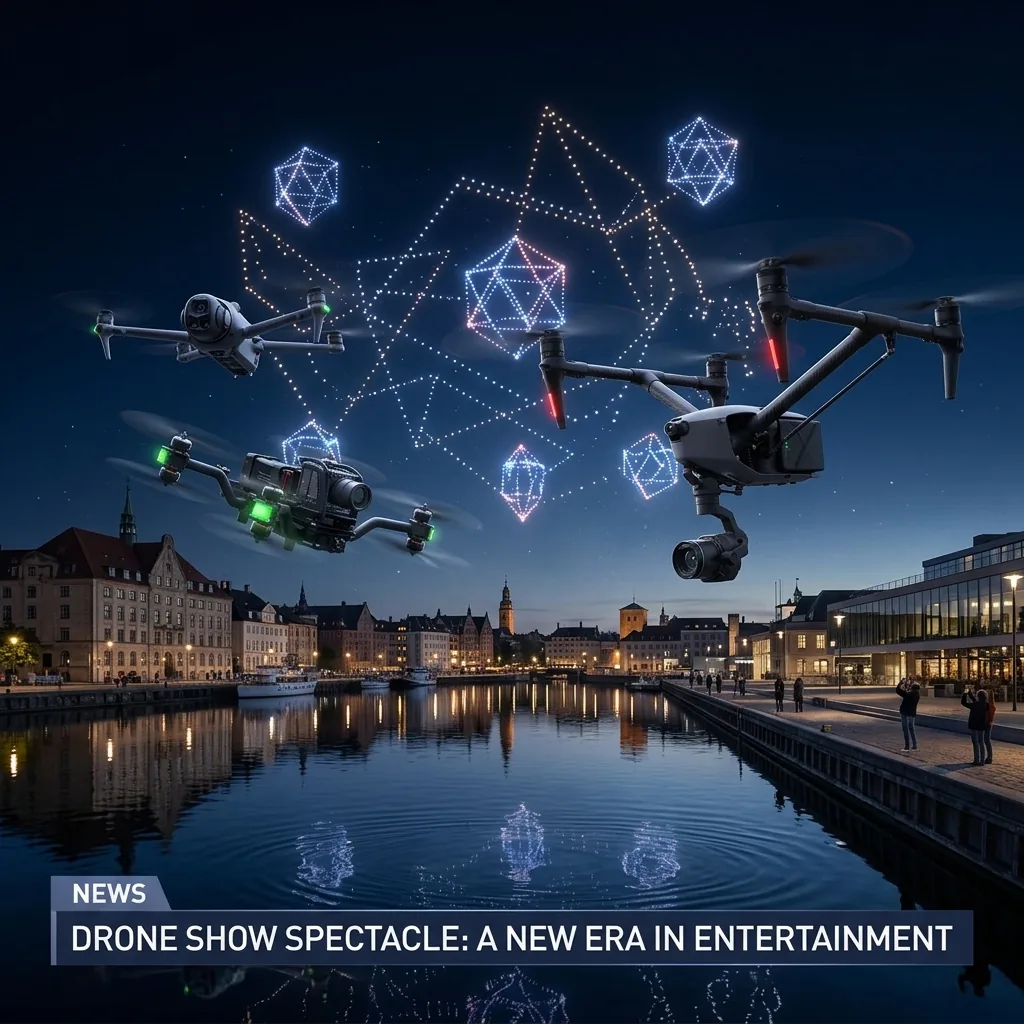
Capturing a drone light show is one of the most complex, yet rewarding tasks in modern aerial videography. While hundreds or even thousands of illuminated drones draw patterns across the night sky in perfect choreography, the filming crew must operate in the air with utmost precision under strict safety standards. At Drone Department, we have built unparalleled expertise in this specialized field over the years. Filming such a large-scale spectacle requires far more than just sending a camera drone into the air; it demands correct licensing, advanced equipment, and a rock-solid safety protocol.
In this article, we share our extensive experience capturing complex light shows. We look at the tight regulations governing these flights, the technical and operational challenges such as signal interference, the specific camera drones we deploy, and how we digitally rehearse every show using 3D simulations. Through this structured approach, we guarantee breathtaking cinematic shots without ever compromising the safety of the event, the audience, or the show drones themselves.
Our Experience with Over 40 Drone Shows in 10+ Countries
The reliability and high standard of our operations are proven by our track record. Drone Department has successfully captured more than 40 major drone shows in over 10 different countries. From the vast coastlines of the Middle East and dynamic cities in North America to complex airspaces over European capitals, our crew has flown under almost every imaginable environmental condition. This global experience allows us to anticipate local variables quickly and coordinate efficiently with international authorities.
Every country brings its own unique challenges, including shifting maritime wind patterns, temperature drops, and strict local flight restrictions. Through years of close collaboration with leading drone show developers and event organizers, we understand ground and aerial dynamics intimately. Our camera operators and pilots work in tandem with on-site technical teams to map out the perfect angles, resulting in high-end video productions that translate the scale and magic of the show seamlessly to the screen.
Throughout these productions, we have worked closely with some of the most prominent drone show providers and creative studios in the world. A selection of the drone show companies we have successfully collaborated with includes:
- Drone Stories: Renowned for their narrative-driven and artistic outdoor light shows.
- Nova Sky Stories: Global leaders in large-scale drone entertainment and choreography.
- Allumee: Our strategic partner for innovative, eco-friendly light shows in Europe.
- Sky Elements: Record-breaking drone show producer from the United States known for massive formations.
- Drift: The famous artist studio (Studio Drift) combining technology and art in iconic installations like "Breaking Waves."
Watch Our Drone Show Video Production Playlist
To see the quality and dynamic range of our work firsthand, we have compiled a playlist of our most iconic drone show video productions. In these clips, you will find our footage from the Monaco F1 Grand Prix drone show, where we used a blend of Inspire 3 and custom FPV drones to capture the massive formations dancing above the harbor. Click the player below to view the full queue of videos and experience the harmony of aerial cameras and light art.
Our playlist features the following spectacular productions which you can watch directly (click on a video to play it above):
- F1 Monaco biggest EU Droneshow 2026
- Cannes Lions Drone Show 2026
- DRIFT “Breaking Waves” Elbphilharmonie
- International Ukraine Recovery Conference URC 2022 in Lugano
- Drone Show - AL ULA Saudi Arabia
Our films demonstrate not only the beauty of the light formations but the extreme precision with which our pilots fly in challenging marine and urban conditions. Each clip represents the culmination of our SORA-compliant preparation, 3D simulation testing, and expert post-production.
Regulations and Licensing for Flying Near Drone Light Shows
Filming in close proximity to an active drone light show carries significant legal responsibilities. Because show drones fly in dense clusters and events attract large crowds, these flights fall under the strict "Specific" category of European regulations set by the EASA. Standard flight certificates in the Open category (such as A1/A3 or A2) are completely inadequate. An operational authorization is always required, issued by national aviation authorities (like the Dutch ILT or equivalent agencies in other European countries).
To secure these approvals, we must submit a detailed Risk Assessment for every operation using the SORA (Specific Operations Risk Assessment) methodology, or fly under Pre-Defined Risk Assessments (PDRA). This documentation outlines the technical specifications of our equipment, the flight zones, emergency protocols, and safety mitigations to minimize any hazards. Thanks to our certified operator status, our drone pilots hold the qualifications necessary to legally and safely fly in these challenging conditions.
Furthermore, filming a drone show introduces a critical timing constraint: these shows take place almost exclusively after sunset, meaning we are flying outside the Uniform Daylight Period (UDP). Night flying is highly regulated under EASA guidelines and requires specific authorization in our operational permit. Check out our guide on night flights on film sets outside the UDP to learn more about the regulatory requirements. One of the primary technical requirements for night flight is that our camera drones must be equipped with a highly visible green flashing light (commonly referred to as a 'green blinker'). This green flashing light is a mandatory safety feature designed to make the drone instantly identifiable to other airspace users, such as emergency services helicopters, ensuring clear separation and awareness at all times.
Safety First: Signal Interference and Operational Protocols
One of the most significant and underappreciated risks when filming drone shows is radio frequency (RF) interference. Drone shows rely on hundreds of synchronized radio signals sent from a central system to coordinate the position and lighting of each unit in real time. If a filming drone flies nearby and broadcasts control or video telemetry signals on the same frequency bands (typically 2.4 GHz and 5.8 GHz), it can cause fatal disruptions. This can force show drones to lose telemetry and trigger automatic fail-safes, such as emergency landings or return-to-home protocols.
To avoid this, we work closely with the drone show's radio engineering team. Prior to takeoff, we execute a thorough spectrum analysis to map out local frequency occupancy. Our key safety protocols include:
- Strict Channel Separation: We manually lock our filming drones to specific, pre-tested channels that are physically isolated from the frequencies used by the show grid.
- Direct Radio Link with the Air Boss: Our pilots maintain a continuous, direct radio connection with the drone show director (the Air Boss) on the ground. If any anomaly arises, we can abort or adjust the flight instantly.
Advanced Camera Gear: Inspire 3, Mavic 4 Pro, and Custom FPV
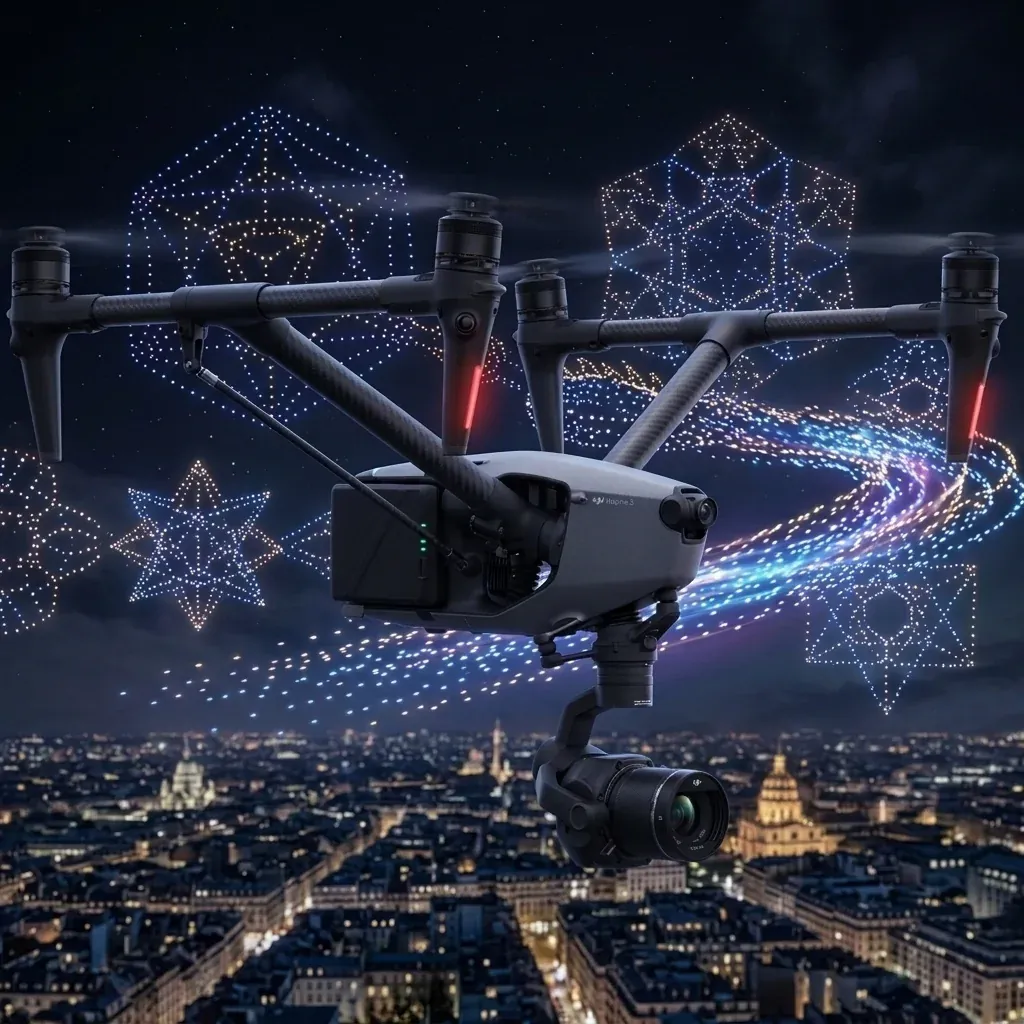
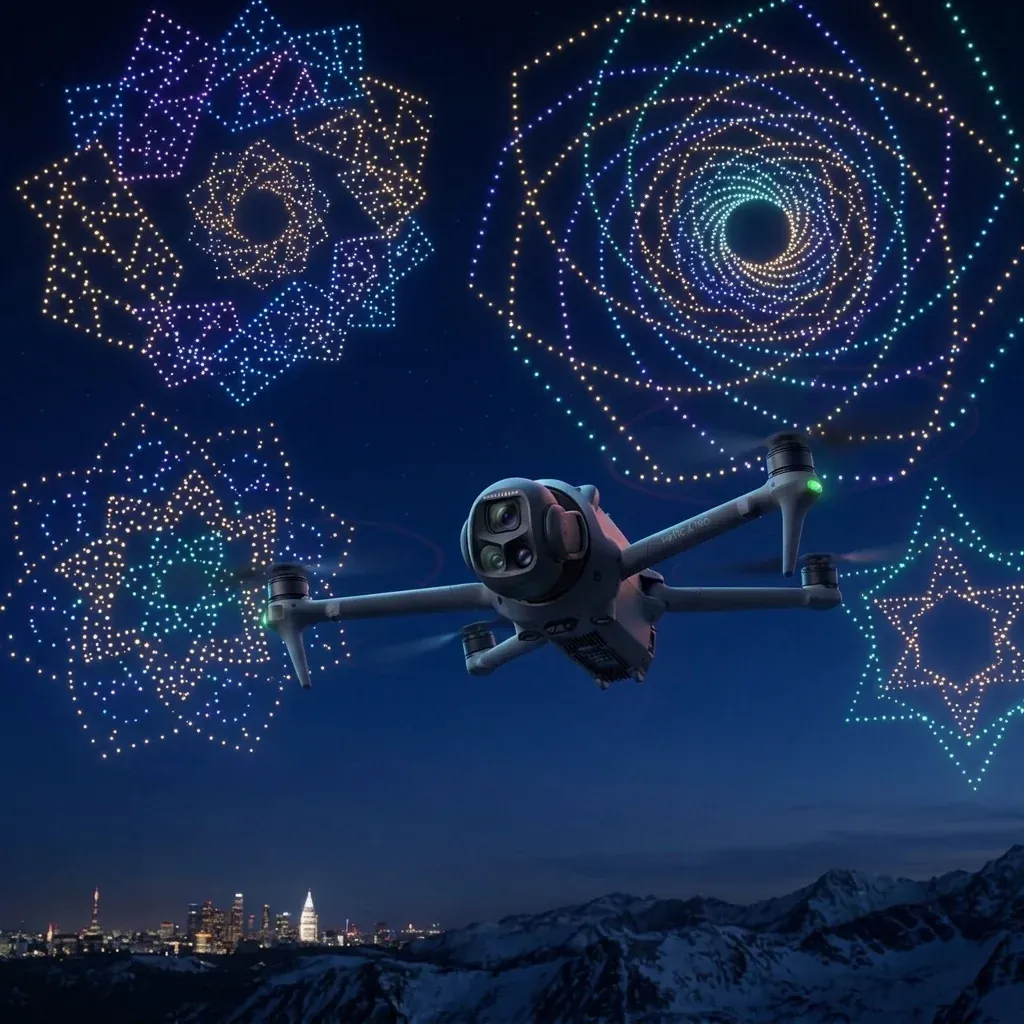
Capturing the dynamics and rich colors of a drone show at night requires elite camera gear. We deploy a diverse fleet of drones, each selected for the specific shots we want to capture. For stable, cinematic wide shots and smooth parallax movements, we use our heavy-lift platforms, primarily the DJI Inspire 3 equipped with the full-frame X9-8K camera. This drone allows us to shoot in RAW formats, preserving the details in both the pitch-black sky and the intense LEDs of the show. We also utilize the DJI Mavic 4 Pro (and equivalent compact platforms) for flexible, quick-to-launch backup perspectives.
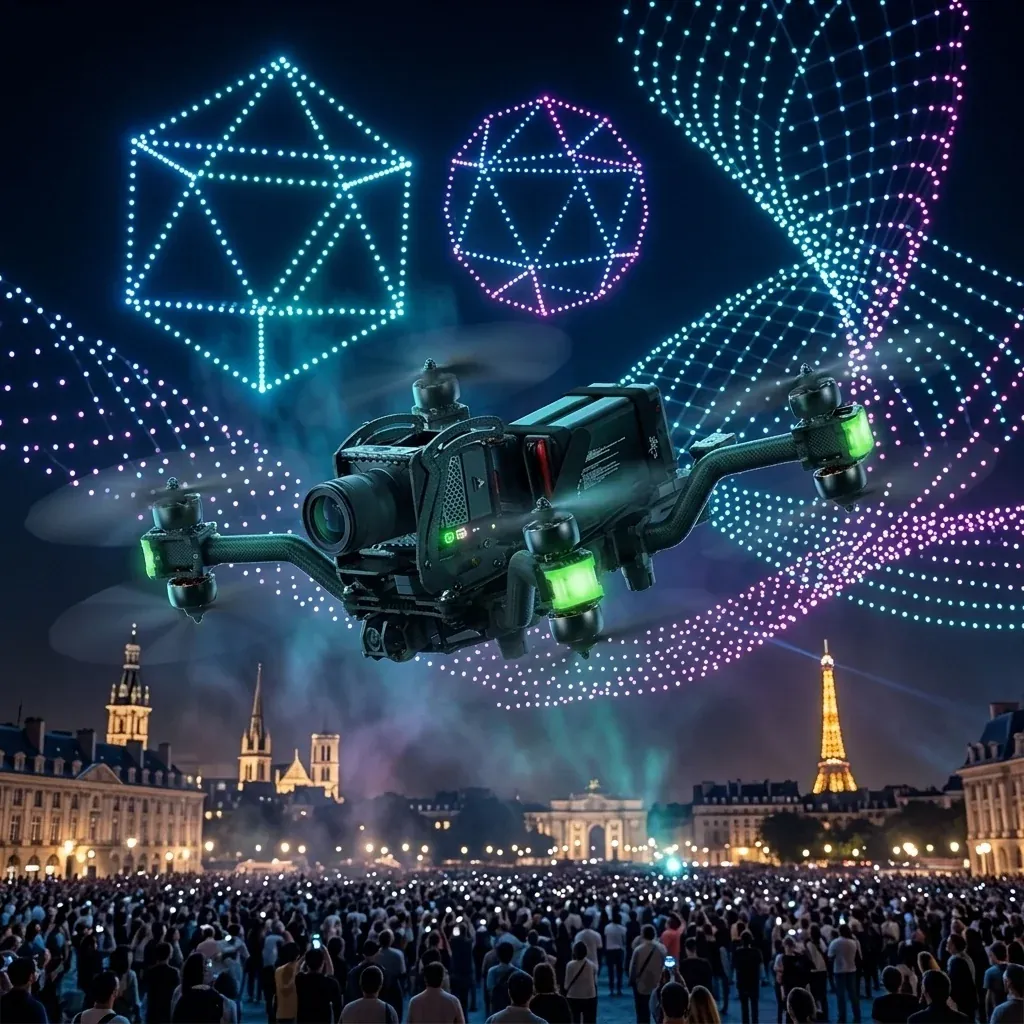
For high-octane, immersive shots that put the viewer in the middle of the action, we rely on custom FPV (First Person View) drones. These custom-built quadcopters carry camera packages equivalent to the Sony FX30. This setup provides the ideal balance of payload weight and cinematic color science, allowing the FPV drones to dive along the perimeter of show formations at high speeds and capture angles that are impossible with traditional platforms. Combining stable cinema drones with agile FPV racers yields a dynamic, well-rounded final edit.
| Drone Type | Primary Role | Camera Specs | Key Advantages |
|---|---|---|---|
| DJI Inspire 3 | Cinematic master shots and pans | Full-frame 8K Zenmuse X9 | Dual-operator control, extreme dynamic range in low light |
| DJI Mavic 4 Pro | Quick-response detail shots | Hasselblad CMOS camera | Long battery life, rapid deployment, reliable obstacle avoidance |
| Custom Cine FPV | Immersive fly-by's and high-speed action | Sony FX30 (or equivalent) | Extreme agility, unique angles, high velocity |
3D Pre-Visualization and Rehearsal Workflow
When filming a show that is only performed once or twice live, and where drone battery life is limited, there is zero margin for error. We prepare every flight path in detail using a 3D pre-visualization process. The drone show design team provides us with the 3D telemetry coordinates and formation animations ahead of the event. We import these models into 3D environments (such as Cinema 4D or Unreal Engine) where we simulate our own camera paths and lens fields-of-view.
This digital rehearsal shows us exactly at which second a formation (like a logo, globe, or symbol) will take shape and which angle best highlights it. We pre-plan our flight trajectories, verifying that they clear all ground obstacles and maintain safety buffers. Consequently, when the live show begins, our crew knows exactly where to be and when to capture, maximizing our shoot efficiency and the visual production value of the final film.
The Team Behind the Scenes: Ground Cameras, B-Roll, and Post-Production
A breathtaking drone show video requires more than just spectacular aerial captures. To tell the full story and convey the experience on the ground, we work with a highly specialized production team. This crew includes professional ground-based camera operators stationed at multiple strategic locations surrounding the show. They capture the reactions of the crowd and record essential B-roll footage of the preparations, launch areas, and overall event atmosphere. In this process, we work closely with our trusted video producer XinixFilms, who coordinates the direction and overall logistics of the ground captures to ensure a seamless narrative.
All these separate media streams, from the 8K cinema master shots and dynamic FPV sweeps to the ground-level angles, are brought together in post-production. We collaborate with expert video editors and color graders who possess extensive experience in handling these unique nighttime events. They know exactly how to balance the extreme contrast between the dark sky and the bright LED show elements, ensuring the colors pop and the final edit perfectly delivers the magic of the live display.
Looking for professional drone show video production?
Are you organizing a large-scale event with a drone show and looking to ensure it is captured at a professional cinema level? Drone Department specializes in the complete video production of drone shows. From detailed pre-visualization and flight authorization management for our camera drones to the final aerial capture and post-production, our team covers it all. Visit our dedicated service page to explore how we can help bring your vision to life: drone show video production with Drone Department.
Harmonizing Aerial Cameras and Light Art
Successfully filming drone light shows relies on three pillars: absolute regulatory compliance with the correct EASA licenses, unwavering attention to RF safety to prevent interference, and selecting the optimal camera equipment. By relying on our experience of over 40 shows in multiple countries and our rigid 3D simulation workflows, Drone Department unites these requirements into stunning high-end films. The synchronization of pre-programmed light displays and the organic, hand-flown cinema paths of our drones creates a visual experience that elevates any event.
Frequently Asked Questions (FAQ)
What licenses are required to film near drone shows?
Because these flights occur near large crowds and active show swarms, standard Open category permits are not sufficient. Operators must hold specific operational authorizations (such as a SORA or applicable PDRA approvals) granted by the national aviation agency (like the ILT in the Netherlands).
Is flying outside the UDP (at night) allowed for filming a drone show?
Yes, but it is strictly regulated and requires a night flight approval within our operational authorization (Specific category). Additionally, in compliance with EASA regulations, the camera drone must be equipped with a green flashing beacon (green blinker) for night visibility.
How do you prevent the filming drone from interfering with the show?
We do this through strict RF coordination. We perform on-site spectrum analysis and configure our command and video links to frequencies far from the channels used by the show. We also maintain live contact with the show's Air Boss to execute immediate safety commands if needed.
Why do you use FPV drones in addition to standard cinema drones?
Cinema drones like the DJI Inspire 3 provide stable, majestic master shots and smooth pans. Agile FPV drones, carrying setups equivalent to the Sony FX30, allow us to capture fast-moving, high-speed fly-by's that weave near the display borders, creating immersive angles that bring viewers close to the lights.
How does the 3D simulation help before the shoot?
The 3D pre-visualization lets us plan flight paths based on the actual telemetry of the display. Since live shows are short (usually 10 to 15 minutes), pre-planning guarantees our pilots know exactly where to fly and when to shoot, ensuring we capture all key shapes without wasting flight battery life.