 NL
NL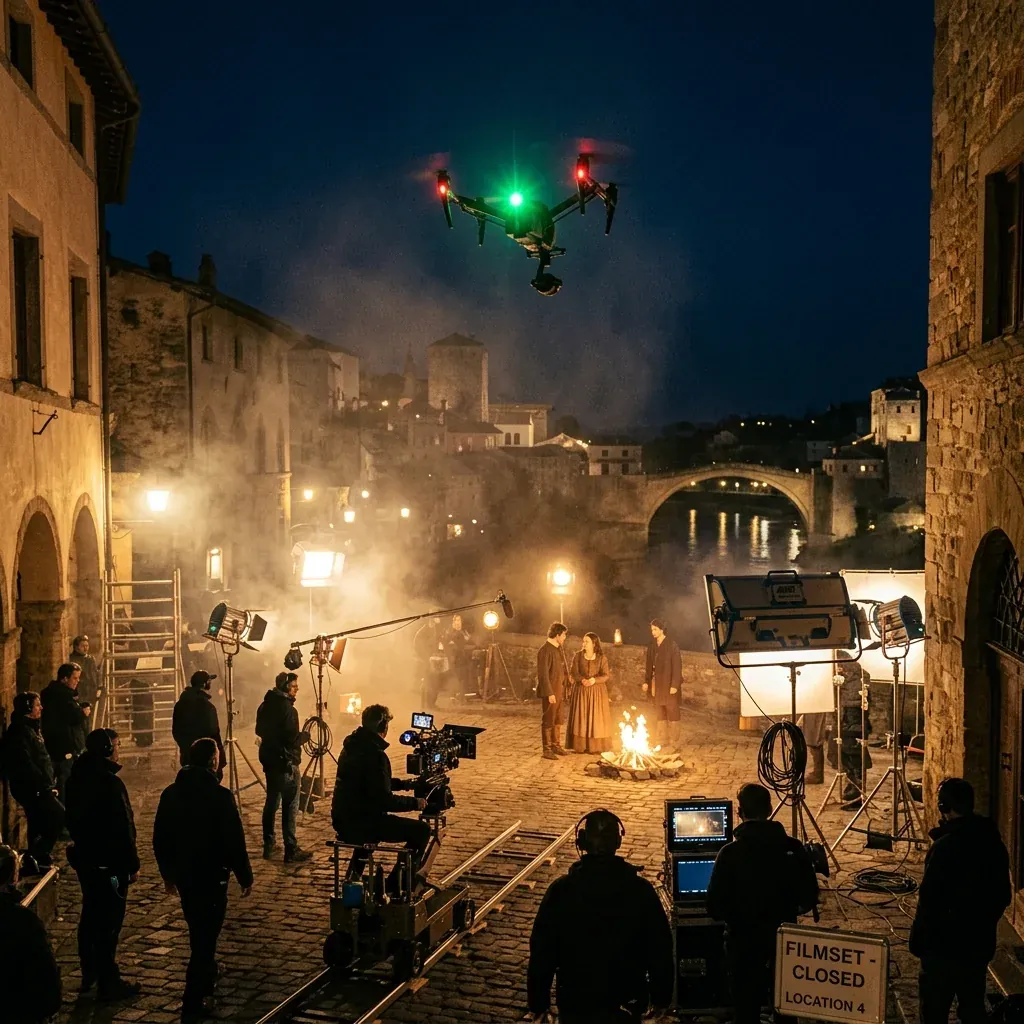
Night scenes represent a vital component of modern film and television productions. Capturing dramatic nocturnal car chases, atmospheric cityscapes lit by artificial lights, or mysterious forest sequences often demands the use of drones to achieve high-quality, dynamic aerial perspectives. However, flying after dark introduces unique operational and regulatory complexities. Under the European aviation framework, drone flights outside the designated Uniform Daylight Period (UDP) are strictly controlled to maintain safety and prevent collisions with other aircraft in the night sky.
For professional film production crews, it is vital to understand the regulatory pathways and technical rules that apply to night operations. Fortunately, when partnering with Drone Department, production teams can skip the typical administrative delays. We hold a structural, long-term UDP waiver (ontheffing) within our operational authorization portfolio. This allows us to plan and execute night shoots on closed film sets quickly and legally, providing production managers with unmatched flexibility and peace of mind.
What is the uniform daylight period?
The Uniform Daylight Period is a standard regulatory window defined by civil aviation authorities during which VFR (Visual Flight Rules) flights can be operated without additional night qualifications. In the Netherlands, this window is defined by the ILT (Human Environment and Transport Inspectorate) and generally runs from fifteen minutes before sunrise to fifteen minutes after sunset. Outside of these hours, all aviation operations are classified as night flights.
For drone flights in the Open category, flying at night is heavily restricted or prohibited depending on the specific subcategory. For complex enterprise or film set operations that utilize heavier camera rigs, the flights must be conducted in the Specific category. Within the Specific category, any flight outside the UDP requires an operational authorization backed by a structured risk assessment that addresses the increased hazards of nighttime operations.
The regulatory pathways: PDRA versus SORA
To obtain approval for night flights within the Specific category, operators working under EASA guidelines must follow one of two regulatory processes. The first is a Pre-Defined Risk Assessment (PDRA). EASA has established standard PDRAs, such as PDRA-G01 for flights within visual line of sight in uncontrolled airspace, which allow night operations provided the operator complies with all listed mitigation strategies.
When film productions require flight patterns that exceed standard PDRA limits, operators must conduct a full Specific Operations Risk Assessment (SORA). A SORA forces the operator to document how they will mitigate night-specific risks, such as reduced visual range and pilot spatial disorientation. This is a highly detailed safety analysis, as illustrated by the complex guidelines described in our article on the new SORA 2.5 containment levels.
Technical requirements for night flights
Drones operating outside the UDP must be retrofitted or designed with specific hardware components to ensure they are visible to other aircraft and easily controlled by the pilot in low-light conditions:
- Green collision avoidance lighting: EASA regulations mandate that drones flying at night carry at least one high-intensity, flashing green strobe light. This light must be visible from the air and the ground, enabling manned helicopter pilots and low-flying aircraft to differentiate the drone from ground lights or stars.
- Navigation LEDs: The drone must feature standard aviation navigation lights (e.g. red on the left, green on the right, white on the tail) to assist the remote pilot in maintaining visual orientation and heading at a distance.
- Low-light FPV camera systems: To navigate safely near set structures, pilots rely on highly sensitive First Person View (FPV) cameras. Modern cinema drones, such as the DJI Inspire 3, feature onboard low-light FPV cameras that deliver clear situational feeds to the pilot, even in deep shadows.
- Telemetry monitors: The ground control station must output precise altitude, speed, and positioning data to ensure the pilot does not experience visual illusions or spatial disorientation due to lack of ground reference points.
Safety measures on a closed film set
Beyond the technical modifications on the aircraft, operational discipline on the ground is critical for night shoots. Because visibility is limited, securing the area is paramount. A set-based night operation requires several key safety protocols:
The entire flight zone must be physically isolated, with active marshals patrolling the perimeter to ensure no unauthorized crew members or spectators enter the flight path. The takeoff and landing area (FATO) must be brightly illuminated to give the pilot clear vison of the ground area during critical flight phases. Before the drone takes off, a mandatory crew briefing is conducted with the director, actors, and safety coordinators to establish flight paths, hazard zones, and emergency recovery plans.
During the flight, Visual Observers (VOs) are stationed around the set in direct radio contact with the pilot. Their sole responsibility is to scan the sky and surrounding area for unexpected hazards, such as low-flying emergency helicopters or drifting gear, which the pilot might not see through the camera feed. These steps align with the rigorous safety standards we maintain across all of our projects, as highlighted on our pages regarding our certified drone pilots and our expert cinema drone operator services.
Comparison: daytime versus nighttime drone operations
Operating a drone during the UDP (daytime) versus outside the UDP (nighttime) on a film set involves different sets of requirements. The table below compares the key legal, technical, and operational differences:
| Operational Aspect | Daytime Operations (Within UDP) | Nighttime Operations (Outside UDP) |
|---|---|---|
| Regulatory Approval | Standard operational authorization or declaration | Explicit UDP waiver/authorization required |
| Drone Lighting | Optional standard positioning lights | High-intensity flashing green strobe (3 NM visibility) mandatory |
| Pilot Navigation | Direct visual line of sight (VLOS) with the aircraft | VLOS supported by low-light FPV camera feeds and telemetry |
| Ground Management | Standard safety perimeters and crew briefings | Illuminated FATO, increased perimeter marshals and VOs |
| Disorientation Risk | Low (abundant visual references) | High (requires instrument monitoring and night flight training) |
The advantage of a structural UDP waiver
In film production, scheduling changes occur frequently. Waiting weeks for a project-specific night flight permit from civil aviation regulators is often not feasible for fast-moving shoots. A drone team that needs to apply for a permit for every night shoot restricts the creative options of the production crew.
Because Drone Department holds a pre-approved, long-term UDP waiver, we can bypass these administrative delays entirely. Our pilots are certified for night operations, and our fleet of high-end cinema aircraft is pre-equipped with EASA-compliant strobe lights and FPV systems. This allows us to plan and execute complex night flights on closed sets within 24 hours. This agility makes us a preferred partner for international and domestic productions seeking high-end visuals without regulatory delays, integrating seamlessly with advanced setups like our Inspire 3 dual-operator workflow.
A framework for safe night cinema
Drone night flights require a balanced combination of modern hardware and strict operational safety protocols. By addressing risks through strobe lights, perimeter controls, and trained observers, crews can capture breathtaking nighttime perspectives safely. With structural authorizations in place, night shoots are not a regulatory gamble but a powerful tool to elevate the visual quality of any cinematic project.
Frequently asked questions about drone night flights
What is the UDP and when does a night flight start?
The Uniform Daylight Period (UDP) is the time between fifteen minutes before sunrise and fifteen minutes after sunset. Any drone flight operated outside this window is legally a night flight.
Does Drone Department have permission for night flights?
Yes, Drone Department holds a pre-approved, long-term UDP waiver as part of our specific category operating license, allowing us to plan night flights on closed sets immediately.
What lights are required on a drone at night?
EASA regulations require a green flashing collision avoidance strobe light visible from the air and ground, in addition to standard navigation LEDs.
Is a closed set required for nighttime drone flights?
Yes, a controlled and closed ground area is a fundamental requirement under SORA and PDRA frameworks to ensure safety and prevent un-involved persons from entering the flight path.