 NL
NL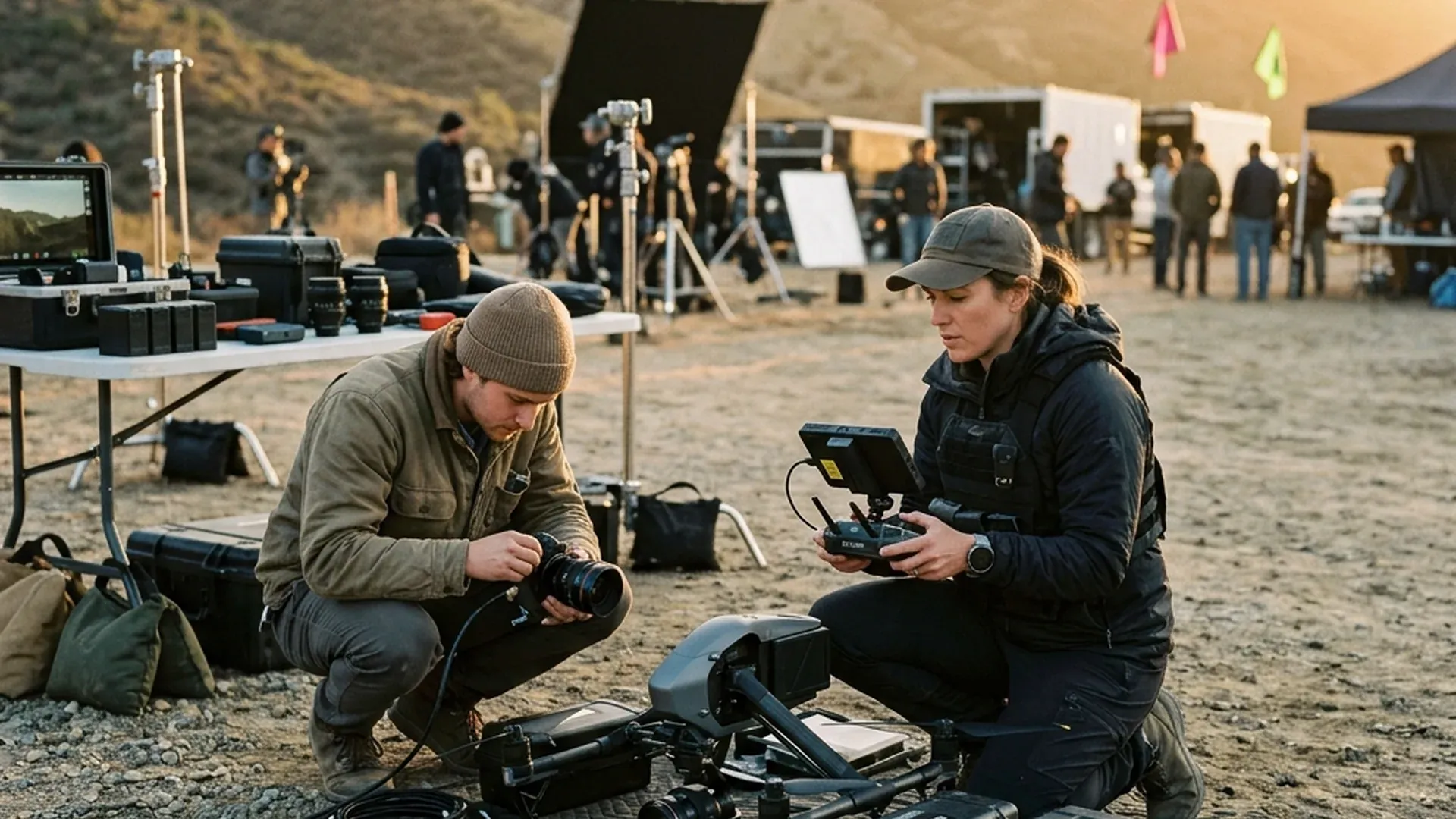
Aerial cinematography across European feature films, commercial productions, and high-end television has undergone a remarkable transformation over recent years. Where early camera drones were primarily used for establishing wide landscape perspectives, contemporary directors and Directors of Photography (DPs) demand mathematical visual precision. Achieving flawless geometric compositions, perfectly balanced top-down angles, and fluid orbital camera trajectories requires advanced technical control and visual framing principles.
By leveraging high-end professional cinema drones such as the DJI Inspire 3 alongside heavy-lift rigs equipped with ARRI or RED cinema cameras, aerial teams produce imagery matching traditional crane or dolly moves. In this article, we outline core principles of symmetry, framing, and camera control for executing flawless top-down perspectives and complex orbital flight paths.
The Power of Symmetry and the 'God's Eye' Top-Down Perspective
The 90-degree top-down angle, often referenced as the 'god's eye shot', translates three-dimensional environments into striking two-dimensional graphic compositions. By orienting the camera perpendicular to the ground plane, the horizon is eliminated, leaving natural textures, architectural lines, and geometric patterns as the primary focal elements.
For a top-down frame to resonate visually, absolute geometric symmetry is critical. Deviations as subtle as one or two degrees in gimbal tilt or roll break visual equilibrium and clutter the frame. Flight crews utilize real-time grid overlays, electronic horizon meters, and centimeter-accurate RTK (Real-Time Kinematic) positioning to lock the aircraft precisely along the vertical axis.
Principles for Executing Flawless Orbital Camera Moves
An orbital trajectory around a central subject is among the most dynamic techniques for creating visual parallax and spatial depth. As the focal subject remains locked in the exact center of the frame, the background slides past smoothly, delivering an immersive 3D impression that connects viewers to the scene.
The secret to an unblemished orbit lies in maintaining a synchronized ratio between aircraft groundspeed and gimbal panning rates. When operated by a single pilot, holding a constant radius and angular speed manually is extremely demanding. High-end feature films and commercial productions rely on dual-operator cinema flight crews, allowing the pilot to handle aircraft flight lines while the camera operator controls framing, focus, and tilt.
| Shot Type | Angle & Focal Length | Key Technical Settings | Film & Commercial Application |
|---|---|---|---|
| Symmetrical Top-Down | 90° Vertical / 24mm - 35mm | RTK Lock, Grid Overlay, 90° Gimbal Lock | Architecture, graphic patterns, opening titles |
| Parallax Orbit | 30° - 45° Tilt / 50mm - 75mm | Dual-Operator Mode, Waypoint Tracking, Smooth Yaw | Character reveals, car tracking, action scenes |
| Spiral Ascending Orbit | Variable Tilt / 35mm - 50mm | Continuous Altitude Gain, Constant Angular Rate | Establishing reveals, dramatic location escalation |
Role of Focal Length and Lens Selection in Aerial Framing
Focal length selection dictates visual compression and perspective relationships within the frame. Wide lenses (such as 18mm or 24mm) enhance environmental scale, but may introduce optical barrel distortion along frame edges, altering straight architectural lines and compromising symmetry.
When operating advanced cinema platforms as detailed in our guide on DJI Inspire 3 workflows, cinematographers increasingly select longer focal lengths (50mm or 75mm full-frame equivalent). Telephoto focal lengths compress background elements, accentuating parallax motion during orbits and bringing background details closer to the foreground subject.
Environmental Factors and Wind Compensation in Precision Composition
Environmental conditions such as gusting winds and thermal updrafts present challenges even for stabilized platforms. During high-altitude top-down shots, side winds force the drone to lean into the wind (pitch/roll drift compensation) to hold position. If the gimbal is not independently stabilized from the airframe, the camera angle tilts off perpendicular.
Professional aerial crews utilize 3-axis brushless gimbals offering 360-degree continuous pan and tilt rotation. Decoupling camera orientation from aircraft tilt ensures the frame remains perfectly level regardless of crosswinds or aircraft positioning maneuvers.
Frequently Asked Questions About Framing and Cinema Drone Shots
Here are answers to key questions frequently raised by directors, DPs, and aerial crews regarding visual framing, symmetry, and orbital camera movements.
What is the primary benefit of dual-operator control during orbits?
In a dual-operator configuration, the pilot manages the flight path while the camera operator independently controls camera pan, tilt, and focus. This division of labor guarantees smooth framing, precise subject tracking, and dynamic speed adjustments impossible for a single pilot.
How can lens distortion be eliminated in top-down shots?
Select rectilinear lenses engineered for low optical distortion, and avoid wide fisheye optics. Applying calibrated lens correction profiles during post-production color grading further flattens edge distortion for clean geometric lines.
Why is RTK positioning essential for symmetrical framing?
RTK (Real-Time Kinematic) satellite navigation delivers centimeter-level position hold versus standard GPS meter-level drift. This enables the drone to hover with absolute stability over an exact coordinate for precise top-down symmetry and repeatable flight passes.
Why are longer lenses preferred for aerial orbit moves?
Longer focal lengths (such as 50mm or 75mm) compress spatial depth between foreground subjects and background scenery, producing a pronounced visual parallax effect as the drone orbits the subject.
Visual Mastery Through Mathematical Precision and Creative Control
True mastery in aerial cinematography lies at the intersection of technical precision and artistic vision. Executing flawless top-down framing and smooth orbital moves requires cinema-grade flight platforms, advanced gimbal stabilization, and coordinated dual-operator teamwork. By applying geometric principles of symmetry and framing, aerial cinematographers transform ordinary locations into captivating visual art.