 NL
NL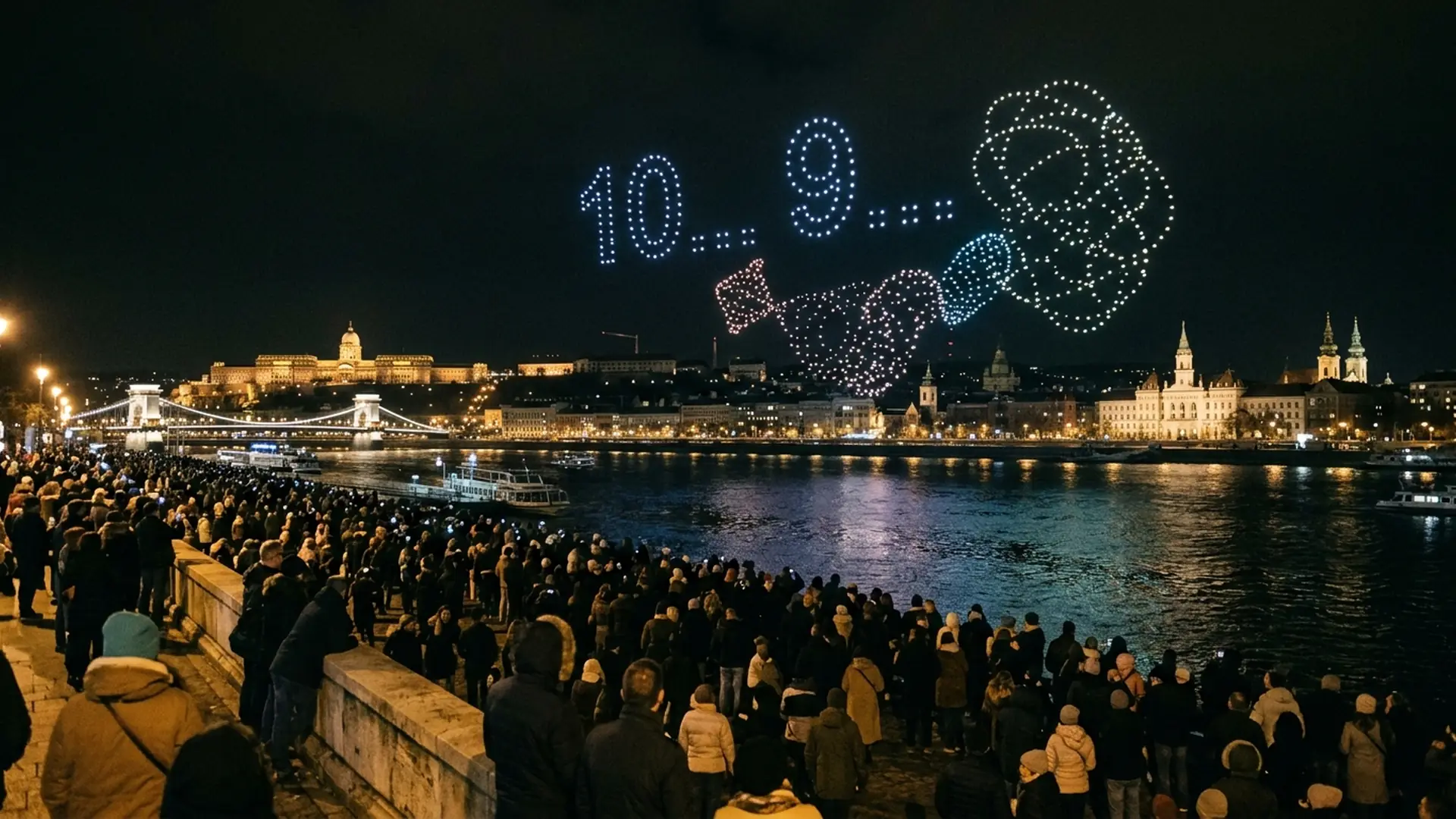
The cultural tradition of ringing in the New Year is experiencing a historic paradigm shift across Europe. As civic authorities and national governments implement comprehensive consumer fireworks bans, municipalities, destination marketing organizations, and large event producers face an immediate strategic dilemma: how can cities deliver an awe-inspiring, communal celebration for tens of thousands of revellers at midnight without the toxic pollution, physical injuries, and civic disruptions inherent to traditional pyrotechnics? The modern answer is lighting up the night sky through synchronized, large-scale drone light shows.
For decades, midnight on December 31 meant blinding plumes of toxic smoke, hazardous particulate spikes, overwhelmed hospital trauma units, and profound distress for domestic pets and wildlife. Today, advanced aviation robotics offers an environmentally conscious and aesthetically breathtaking alternative. Fleets composed of hundreds or thousands of networked aerial drones transform the midnight winter sky into a dynamic three-dimensional digital canvas. From millisecond-synchronized countdown clocks to intricate geometric formations and animated civic iconography, drone light shows unite cutting-edge technology with collective wonder.
At Drone Department, commercial inquiries for turnkey drone light show productions have surged across key European metropolitan regions. Civic leaders are discovering that an orchestrated drone show is far more than a substitute for banned fireworks; it represents an entirely elevated, highly controllable, and infinitely customizable medium. Explore our complete production workflow on our dedicated service page for drone shows, where we integrate concept ideation, 3D animation, regulatory filings, and precision live execution under one roof.
Why public fireworks bans necessitate centralized civic celebrations
Public sentiment regarding consumer pyrotechnics in the Netherlands, Germany, Belgium, and wider Europe has reached a defining tipping point. The confluence of millions in property damage, traumatic eye and burn injuries, violence against first responders, and environmental harm has generated overwhelming support among healthcare professionals, police forces, and civic councils for full consumer fireworks restrictions. More cities each year are outlawing backyard fireworks in favor of safe, centralized public gatherings.
However, ban policies implemented in isolation without providing an engaging public celebration often face public friction. Residents naturally seek to celebrate the transition into the New Year together outdoors. To curb illicit underground pyrotechnics and channel celebratory energy, municipal administrations are investing in centralized midnight gatherings along waterfronts, market squares, and harbor basins. Yet traditional central fireworks displays face mounting hurdles under strict nitrogen deposition limits, particulate matter thresholds, and stringent urban safety zones.
Synchronized drone displays resolve these obstacles completely. They gather large spectator crowds into safely managed zones, cultivate civic pride, and produce stunning visual spectacles primed for viral social media distribution and national broadcast coverage. Our technical teams have documented how drone shows represent a sustainable alternative to fireworks across major public venues, and on New Year's Eve, this technology proves indispensable.
Comparative analysis: consumer pyrotechnics versus drone light shows
To examine the structural advantages of drone light shows for civic organizers, the table below contrasts conventional pyrotechnics against synchronized drone fleets across critical sustainability, safety, and operational metrics:
| Assessment Factor | Consumer Pyrotechnics | Centralized Synchronized Drone Show |
|---|---|---|
| Particulate emissions & heavy metals | Extreme hazardous spike (PM10/PM2.5, copper, strontium, barium pollutants) | 0% direct emissions; completely clean on-site execution powered by rechargeable cells |
| Acoustic pollution & animal welfare | Concussive blasts exceeding 150 dB; severe trauma to pets, livestock, and wild birds | Silent & animal-friendly; whisper-quiet propulsion easily complemented by musical scores |
| Public injuries & emergency strain | Hundreds of traumatic injuries per night (eye clinics, burn wards, emergency rooms) | Zero spectator risk ensured by automated geocaging and secure ground buffers |
| Storytelling & visual customization | Random explosions and scattered bursts devoid of narrative or legible branding | Total creative freedom: 3D animated countdowns, cultural crests, and text greetings |
| Debris & urban cleanup costs | Metric tons of scorched plastic casings, cardboard, and toxic ash in waterways | Zero post-event street refuse; every drone returns safely to dedicated launch pads |
| Live streaming & broadcast clarity | Obscured by thick sulfur smoke within minutes of initiation | Crystal-clear visibility, seamlessly integrated with professional live broadcast and multi-camera coverage |
Precision choreography: from countdown clocks to 3D volumetric art
The defining creative distinction of drone light technology is mathematical precision. While traditional fireworks detonate randomly across the horizon, each drone in a synchronized fleet operates as an autonomous airborne pixel (a voxel in three-dimensional airspace). Outfitted with high-candela RGBW LEDs visible across several kilometers, these specialized aircraft communicate via high-bandwidth datalinks and are guided by dual-band Real-Time Kinematic (RTK) satellite positioning to achieve centimeter-grade positional accuracy.
For New Year's Eve, this enables city authorities to craft meaningful, site-specific narratives. Envision an immense, rotating three-dimensional hourglass hovering over a historic waterway, gradually sifting glowing light particles before morphing into a monumental countdown clock at 23:59:50. As midnight strikes, the sky erupts into an intricate, silent visual firework simulation that transitions into the city skyline, municipal coat of arms, and multilingual celebratory messages.
Furthermore, drone light shows can be locked to musical scores, live symphonies, laser mappings, and kinetic fountain displays via universal timecode synchronization (SMPTE/LTC). Every color shift, velocity change, and geometric morph aligns precisely with musical crescendos, producing a multisensory public masterpiece that captivates audiences and elevates municipal brand visibility worldwide.
Aviation safety, EASA compliance, and winter airspace clearances
Deploying a swarm of hundreds of automated aircraft above or adjacent to dense urban centers requires the highest standards of aviation safety management. Across the European Union, large-scale commercial drone light displays operate strictly within the EASA Specific category. This demands a comprehensive Specific Operations Risk Assessment (SORA), a valid operational authorization from national civil aviation directorates (such as the ILT in the Netherlands or equivalent national authorities), and coordinated clearances with air traffic control organizations.
Airspace planning must commence months prior to December 31. Event organizers can inspect relevant airspace sector structures, controlled airport traffic zones (CTR), and restricted areas using our comprehensive drone airspace map. Leading up to the live show, aviation authorities issue a formal Notice to Airmen (NOTAM) establishing a temporary flight restriction (TFR) around the operational box, protecting the show airspace from uncoordinated air traffic.
On the ground, stringent safety perimeters are established. The launch zone encompasses the Flight Geography and Contingency Volume, enveloped by a calculated Ground Risk Buffer free of unsheltered spectators. In the rare event that an individual drone experiences telemetry degradation or motor abnormality, automated redundancy safeguards instantly isolate the aircraft, directing it to descend safely into the sterile exclusion area without disrupting adjacent flight paths.
Managing winter conditions on December 31
A frequent practical consideration raised by municipal planning committees involves winter weather resilience during late December. European winters often present sub-zero temperatures, dense mist, or brisk coastal winds. Enterprise-grade light show fleets are engineered specifically to navigate harsh operational environments:
- Integrated smart battery heating: Lithium-polymer cells can experience voltage depression in sub-freezing conditions. Specialized show drones incorporate internal pre-heating systems that warm battery cores prior to launch, preserving full discharge rates and stable flight endurance.
- Wind resistance up to 5 to 6 Beaufort: Powerful brushless motors combined with high-frequency inertial measurement sensors allow modern show drones to resist gusts up to 38-45 km/h while holding tight formation tolerances within centimeters.
- Weather-sealed enclosures: Drone hulls boast ingress protection (IP ratings) against light precipitation, falling snow, and heavy condensation, safeguarding sensitive avionics and motor controllers.
Operational discipline remains non-negotiable. In situations involving freezing rain, severe gales, or thick fog reducing visibility below mandatory VFR limits, the Remote Pilot-in-Command retains full authority to hold the launch or execute an alternative window in coordinated consultation with local emergency services.
A new era for public celebrations and civic spectacles
The progression away from hazardous individual fireworks toward synchronized aerial drone art represents a major milestone in urban entertainment. Forward-thinking cities demonstrate that centuries-old holidays can evolve seamlessly into modern, sustainable traditions. By embracing drone light shows, municipalities resolve acute public safety and environmental challenges while presenting their citizens with a spectacular, forward-looking celebration that resonates far beyond the countdown.
Delivering an extraordinary New Year's Eve drone spectacle requires early strategic planning, regulatory flight permits, and bespoke artistic choreography. Are you looking to introduce an unforgettable, eco-friendly New Year's Eve production to your municipality, stadium, or festival? Explore our complete capabilities on the official Drone Department drone shows page to consult with our specialized flight directors and secure your operational slot for the upcoming celebration.
Frequently asked questions about New Year's Eve drone shows
Why are municipalities choosing drone shows over fireworks for New Year's Eve?
Drone light shows generate zero particulate emissions, zero toxic heavy metal residue, and zero concussive blasts that terrify domestic pets and wildlife. They eliminate severe trauma injuries and ease immense pressure on emergency healthcare services while delivering bespoke 3D storytelling.
Can drone light shows operate in winter weather conditions on December 31?
Professional show drones feature internal LiPo battery heating modules and can operate in sustained winds up to 5 or 6 Beaufort and light precipitation. In extreme circumstances such as dense freezing fog or gale-force squalls, automated safety containment protocols trigger a safe hold or rescheduling.
What permits and timelines are required for a civic New Year's Eve drone show in Europe?
Under EASA aviation regulations, commercial drone shows operate in the Specific category. Requirements include an operational risk assessment (SORA), national civil aviation authority approval, airspace coordination (NOTAM), and municipal public assembly permits. An onboarding lead time of 6 to 12 weeks is recommended.
How many drones are needed for an impactful 3D New Year's countdown animation?
Basic 2D letterforms and geometric outlines can be achieved with 100 to 150 drones. For dynamic three-dimensional countdown clocks, city crests, intricate transitions, and immersive aerial choreography, fleet sizes of 300 to 800+ drones are standard for major municipal celebrations.