 NL
NL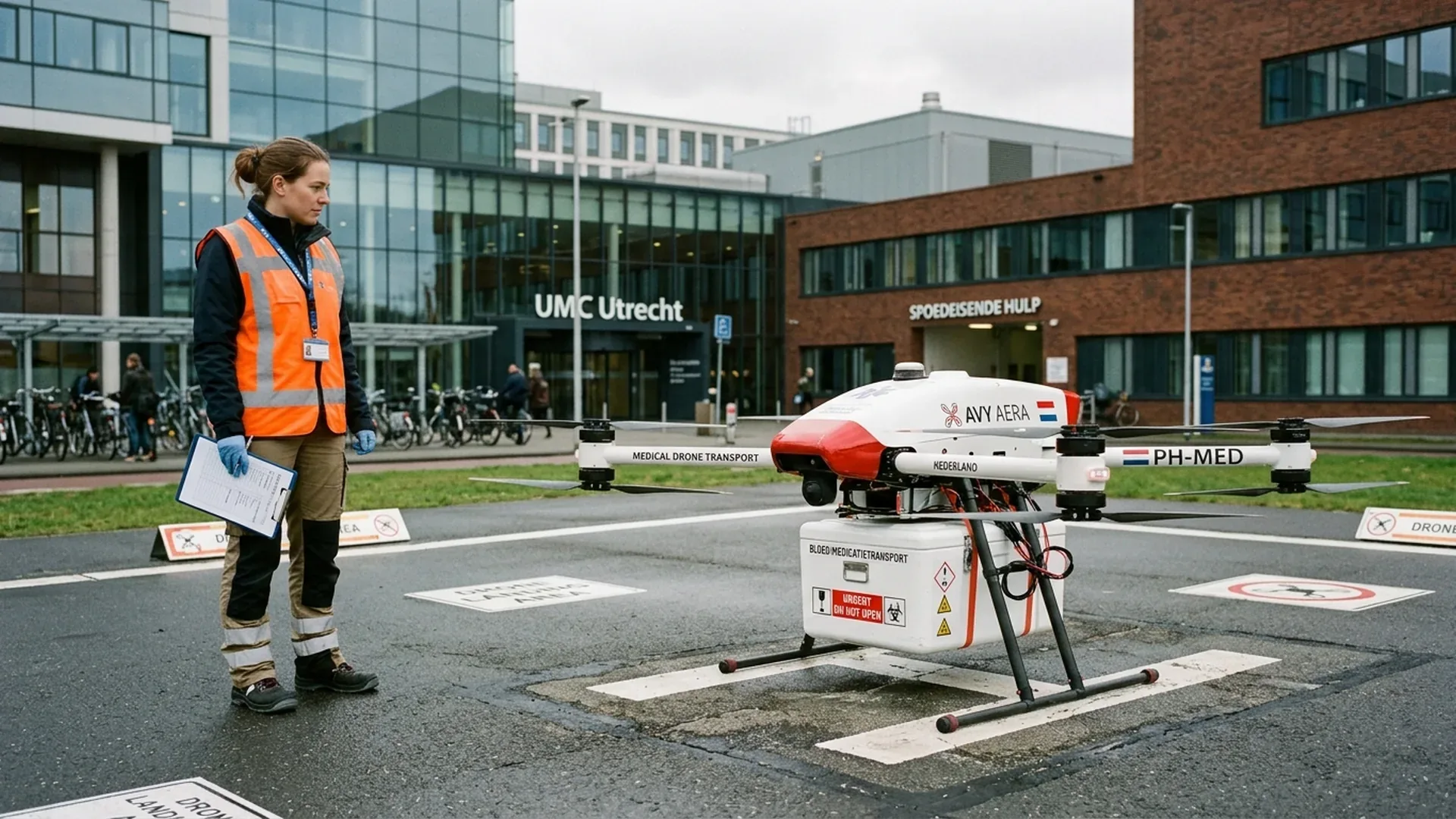
The operational integration of unmanned aircraft systems into healthcare logistics has achieved a major milestone in the Netherlands. Following a full year of intensive trial operations across more than 800 BVLOS (Beyond Visual Line of Sight) flights, ANWB Medical Drone Service and regional hospital network Isala have officially extended their pioneering medical drone corridor between Isala Meppel and Isala Zwolle until mid-2027.
This initiative represents the first long-term hospital-to-hospital drone logistics corridor in the country. By transporting diagnostic blood samples, emergency biopsies, and refrigerated pharmaceutical compounds through dedicated airspace corridors, the project bypasses severe highway bottlenecks along the A28 corridor. The resulting zero-emission aerial transport link delivers predictable, rapid turnaround times that directly enhance regional patient care.
Proven reliability: over 800 autonomous flights through Dutch airspace
Throughout the inaugural operational year, the medical cargo drones maintained a fixed 22-kilometer flight corridor connecting the rooftop landing pad at Isala Meppel with the hospital grounds in Zwolle. Operating completely autonomously at a cruising altitude of 100 meters and a sustained cruise speed of 100 km/h, the aircraft complete the point-to-point transit in exactly 14 minutes. By comparison, road couriers navigating rush-hour traffic and bridge openings frequently require between 25 and 45 minutes.
The initial phase demonstrated exceptional operational consistency, fail-safe BVLOS telemetry, and automated deconfliction within controlled airspace. In close collaboration with Air Traffic Control the Netherlands (LVNL) and national telecom provider KPN, the operations leverage a secure low-latency 5G data link. Real-time telemetry, automated flight plan authorizations, and U-Space airspace parameters are synchronized seamlessly with central air traffic controllers.
Scientific validation: zero degradation in blood samples and medication stability
A primary consideration in medical aviation logistics is ensuring that sample integrity remains pristine during flight. Aerodynamic vibrations, centrifugal forces during acceleration, and barometric shifts at 100 meters altitude must not compromise sensitive laboratory biomarkers or delicate pharmacological properties.
Clinical chemists and laboratory pathologists at Isala conducted rigorous parallel tests across the 800 flight operations. Identical diagnostic blood tubes, tissue biopsies, and chilled medications were dispatched simultaneously via medical drone and conventional climate-controlled road couriers. Comparative laboratory analyses confirmed zero measurable variation in hemolysis rates, enzyme functionality, cellular integrity, or pharmaceutical potency. The specialized insulated transport capsule actively maintains strict temperature control while dampening vibration throughout all phases of flight.
Comparative analysis: medical drone delivery versus conventional road transport
The following performance matrix contrasts the operational parameters and clinical advantages of the dedicated aerial corridor against traditional motor vehicle courier transport:
| Operational Metric | ANWB Medical Drone | Standard Road Courier (Van) | Clinical & Environmental Impact |
|---|---|---|---|
| Corridor Distance | 22 km (direct straight-line corridor) | 28 - 32 km (via highway A28 network) | 25% shorter physical route |
| Average Transit Time | ~14 minutes (fixed) | 25 - 45 minutes (traffic dependent) | Up to 65% faster delivery turnaround |
| Traffic & Bridge Bottlenecks | 0% (unimpeded 3D airspace) | High (rush hour, construction, accidents) | 100% predictable schedule |
| Carbon Emissions | 0 grams (100% electric flight) | Approx. 3.5 - 5.5 kg CO2 per round trip | Sustainable hospital supply chain |
| Payload Condition | Insulated smart pod (lab validated) | Passive vehicle coolbox | Guaranteed biological sample integrity |
Next trial phase to 2027: expanding into oncology and acute pathology
The operational authorization extension to mid-2027 empowers ANWB Medical Drone Service and Isala to substantially broaden clinical applications. While the initial phase validated standard diagnostic blood tubes, the upcoming operational phase targets high-value, time-critical therapeutic workflows.
Key expansion areas include:
- Specialized oncology medications: High-cost cytostatic chemotherapy treatments prepared in the central hospital pharmacy in Zwolle that require rapid, time-sensitive delivery to oncology patients in Meppel.
- Intraoperative urgent biopsies: Frozen section tissue samples extracted during active surgical procedures transported instantly to centralized pathology laboratories for immediate intraoperative evaluation.
- Emergency blood bank products: On-demand point-to-point dispatch of rare blood types and clotting factor concentrates during acute trauma emergencies.
- All-weather and night flight operations: Expanding operational envelopes to higher wind thresholds, precipitation, and nighttime missions supported by active obstacle avoidance and verified night flight aviation protocols.
European aviation frameworks: EASA Specific SORA and U-Space integration
Operating structural BVLOS flights across populated areas, waterways, and critical infrastructure requires the highest echelon of risk mitigation and regulatory compliance. The project functions under a Specific category operational authorization issued by the Dutch Human Environment and Transport Inspectorate (ILT), aligned with the European Union Aviation Safety Agency (EASA) regulations and the SORA (Specific Operations Risk Assessment) methodology.
To eliminate conflict risks with general aviation and emergency helicopters, the aircraft integrate multi-layered detect-and-avoid avionics: ADS-B Out/In transponders, FLARM collision avoidance, optical sensors, and automated geocaging. Similar to high-precision missions executed by our cinema drone operators and certified professional drone pilots, strict adherence to national aviation maps and European drone regulations remains the cornerstone of safe airspace co-existence.
Building the foundation for a nationwide medical drone network
The extension of the Meppel-Zwolle corridor serves as a vital blueprint for the Dutch government's broader healthcare logistics roadmap. By 2030, the strategic goal is to establish an interconnected nationwide medical drone network linking major university medical centers, regional community hospitals, Sanquin blood distribution centers, and remote island communities across the Wadden Sea.
Shifting time-critical healthcare transport from congested highways into automated low-altitude air corridors allows regional hospitals to centralize advanced laboratory infrastructure while simultaneously accelerating emergency patient care. The success of the Isala-ANWB corridor proves that medical drones have transitioned from experimental concepts into life-saving, daily operational realities.
Frequently asked questions about medical drone flights
What are the flight speeds and cruising altitudes for the medical drones between Meppel and Zwolle?
The autonomous medical drones operate along a designated 22-kilometer flight corridor at a cruising altitude of 100 meters and a cruise speed of 100 km/h. Total flight transit takes approximately 14 minutes.
Does drone flight transport impact the chemical or biological stability of blood samples and pharmaceuticals?
No, comprehensive laboratory validations across more than 800 flights confirmed zero adverse effects on hemolysis indices, enzyme activity, or pharmaceutical stability. The insulated climate-controlled transport capsule protects samples against vibration, temperature shifts, and barometric changes.
Which institutional partners collaborate in the ANWB Medical Drone Service initiative?
The project is a strategic collaboration between ANWB Medical Drone Service, the Isala hospital network, KPN for ultra-reliable low-latency 5G telemetry, Air Traffic Control the Netherlands (LVNL) for airspace management, and the Dutch Ministry of Infrastructure and Water Management.
What is the primary objective of extending the operational trial to mid-2027?
The extended phase focuses on scaling into specialized oncology chemotherapy logistics, urgent operating room pathology biopsies, automated U-Space traffic integration, and laying the groundwork for a nationwide healthcare drone network across the Netherlands.