 NL
NL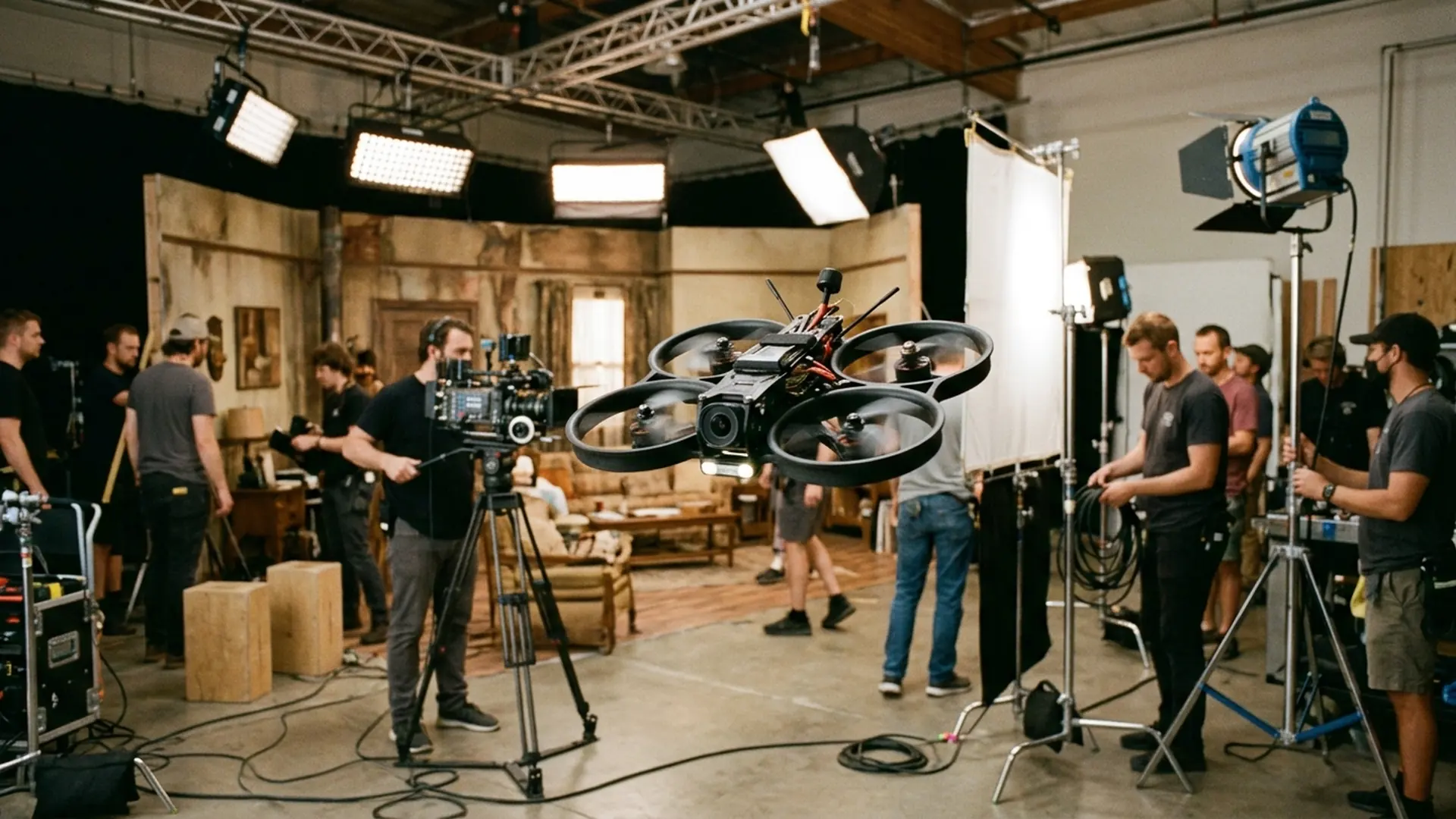
The integration of First Person View (FPV) drones on commercial soundstages and film productions has permanently transformed visual storytelling. Where traditional camera movements once required dolly tracks, complex technocranes, or heavy cable systems, ultra-compact FPV cinewhoops navigate effortlessly through narrow doorways, spiral staircases, and within inches of actors. This fluid agility enables breathtaking continuous one-takes and dynamic perspectives that were previously impossible to achieve.
However, flying inside confined interior sets adjacent to cast and crew introduces unique physical and operational hazards. Within studio stages, satellite GPS positioning is non-existent, aerodynamic prop-wash rebounds violently off solid walls and props, and the local radio frequency (RF) spectrum is heavily congested with wireless video transmitters, remote follow-focus motors, and audio gear. Consequently, a rigorous, multi-layered safety protocol is not merely a formality, but an indispensable foundation for professional film productions.
Technical Specifications for Indoor Cinewhoops and Cinelifters
Not every FPV drone is suitable for indoor cinematic sets. On an active film set, pilots must exclusively deploy purpose-built cinewhoops engineered to satisfy strict mechanical safety standards. The cornerstone of indoor FPV hardware is the ducted propeller guard: aerodynamic polycarbon ducts that encapsulate the rotating propeller blades in a full 360-degree protective barrier.
The total aircraft weight (All-Up Weight or AUW) plays a decisive role in risk mitigation. Ultra-compact micro cinewhoops under 250 grams (sub-250g) carry exceptionally low kinetic energy (frequently under 50 to 80 Joules at cruising speeds), reducing physical risk to actors or crew to near zero even in the rare event of accidental contact. To achieve this ultra-low takeoff mass without sacrificing image fidelity, our operators deploy 'naked' camera systems (stripped-down GoPro or DJI O4 Pro sensor modules with heavy shells and battery enclosures removed).
These ducts serve a vital dual purpose: they prevent any direct physical contact between spinning blades and on-set personnel or delicate set dressing, while also generating ground-effect thrust that enhances low-speed hover stability in tight interior spaces. Furthermore, indoor cinewhoops are equipped with closed-cell EVA foam bumpers around the carbon fiber chassis to absorb kinetic energy in the event of minor collisions.
For heavier cinelifter platforms carrying high-end cinema cameras like the RED Komodo or Sony FX6 (weighing 1.2 to over 2.2 kg), safety margins are even more demanding. These aircraft feature electronic motor power limiters, redundant flight controllers, and instantaneous remote kill-switches. Our fleet of specialized indoor FPV drones undergoes rigorous multi-point airworthiness inspections before every production day to eliminate hardware failure on set.
Comparison: FPV Drone Platforms and Weight Classes on European Film Sets
Depending on camera payload, available set clearance, all-up weight, and proximity to actors, camera departments select the appropriate aerial platform. The parameters below illustrate typical configurations by weight category:
| Platform | Takeoff Weight (AUW) | Camera Payload | Propeller Guarding | Minimum Safe Distance | Acoustics & Airflow | Indoor Set Suitability |
|---|---|---|---|---|---|---|
| Micro Cinewhoop (2-2.5") | < 250 grams (Typically 120-220g) | Naked GoPro / DJI O4 Pro Module | Fully enclosed ducts with EVA foam | 0.5 meters (Ultra close-up) | Very quiet (< 65 dB), negligible turbulence | Perfect for tight rooms and dialogue passes |
| Standard Cinewhoop (3.5") | 450 - 750 grams | Full GoPro Hero 13 / DJI Action 5 | Rigid polycarbonate ducting | 1.0 to 1.5 meters | Moderate noise (75 dB), light airflow | Industry standard for studio interiors |
| Naked Cinelifter (5-6") | 1,200 - 2,200 grams (1.2 - 2.2 kg) | Sony FX3 / FX30 / BMPCC 4K | Optional carbon bumper rings | 2.5 to 3.0 meters | Loud (85 dB), significant prop-wash | Large soundstages with high ceilings |
| Heavy Cinema Drone (Dual-Op) | 5,500 - 9,500 grams (5.5 - 9.5 kg) | DJI Ronin 4D / ARRI Alexa Mini LF | Open propellers (No ducts) | 5.0+ meters (Strict exclusion zone) | Very loud, powerful downwash | Outdoor only or massive aircraft hangars |
RF Spectrum Management and Video Signal Integrity
One of the most insidious risks on a modern film set is radio frequency (RF) congestion. A typical high-end soundstage is saturated with wireless signals: uncompressed 5 GHz video transmitters (such as Teradek Bolt or DJI Transmission), wireless follow-focus units (ARRI WCU-4 or Tilta Nucleus), DMX wireless lighting grids (CRMX/LumenRadio), and UHF audio microphones.
If an FPV drone operator powers on a digital or analog video transmitter without coordinating with the Digital Imaging Technician (DIT) and sound department, severe signal degradation can occur. For the pilot, a sudden video lockout causes the FPV goggles to go black while the drone is traveling at 40 km/h across a crowded studio set.
To eliminate RF conflict, professional drone crews enforce rigid transmission guidelines:
- Mandatory Frequency Scheduling: Assigning dedicated, interference-free channels in direct consultation with the 1st AC and audio mixer during pre-production.
- 868/915 MHz Control Links: Operating drone control links on Crossfire, Tracer, or ExpressLRS (ELRS) on lower sub-GHz bands, completely isolating telemetry from 2.4 GHz and 5.8 GHz video gear.
- Real-Time RF Sweeps: Conducting spectrum analyzer sweeps across the soundstage to identify blind spots caused by steel support beams and soundproof insulation.
Briefings, Rehearsals, and 1st AD Set Coordination
No FPV flight take place without comprehensive alignment with the 1st Assistant Director (1st AD), Director of Photography (DOP), and on-camera talent. In our dedicated guide on 1st AD and drone operator workflows, we detail the structured communication tree that prevents unexpected incidents.
The standard operating procedure for an indoor FPV scene follows four sequential phases:
- Cast & Crew Safety Briefing: The pilot and spotter outline the exact flight corridor, safety margins, and the emergency abort command ("Kill / Abort"). Actors are instructed to remain stationary in the event of an unexpected approach and never reach out towards the aircraft.
- Dry Walkthrough: The pilot walks the exact flight path holding the drone by hand, inspecting clearances, ceiling rigging, loose cables, and lighting stands.
- 50% Velocity Rehearsal Flight: A controlled rehearsal flight with stand-ins at half operational speed to evaluate prop-wash effects on hair, wardrobe, and delicate set dressing.
- Live Take with Dedicated Spotter: During the recorded take, a certified Visual Observer (Spotter) stands alongside the pilot, maintaining direct line-of-sight across the entire room while the pilot focuses on the FPV goggle feed.
Regulatory Guidelines and Insurance Liability in Europe
Under EASA European aviation law, flights within fully enclosed indoor structures fall outside the definition of open public airspace. However, this does not mean indoor flights are unregulated: occupational health and safety laws (such as Arbo legislation in the Netherlands and HSE standards in the UK) and strict film liability insurance requirements apply in full force.
Production insurance carriers require commercial operators to hold valid European drone certifications (A1/A3, A2, and Specific Category STS/SORA qualifications), documented indoor flight hours, and dedicated aviation third-party liability insurance covering cinematic sets. Our team of certified drone pilots combines thousands of logged flight hours with spotless safety track records across major television series and international feature films.
For large-scale productions requiring both dynamic indoor FPV maneuvers and heavy-lift exterior wide shots, our teams coordinate seamlessly with our cinema drone operators utilizing platforms like the DJI Inspire 3 to maintain uniform image quality and color science across all aerial footage.
The Gold Standard for Indoor Flight Safety in Film Production
Indoor FPV cinematography has undeniably expanded the visual vocabulary of cinema. The ability to fly alongside actors and navigate complex architectural spaces delivers visceral, immersive storytelling. Yet this technical artistry can only succeed when safety engineering, frequency discipline, and clear set communication form the absolute core of every flight.
By investing in ducted airframes, strict RF coordination, and disciplined rehearsal protocols, professional drone teams ensure that directors achieve breathtaking cinematography without compromising the safety of cast and crew. The result is extraordinary, unforgettable imagery captured seamlessly on schedule and on budget.
Frequently Asked Questions
Does the prop-wash from indoor FPV drones disturb audio recording or set props?
On micro and standard ducted cinewhoops, air displacement is minimal. However, delicate props like loose papers or sheer curtains must be secured. Regarding sound, FPV drones produce audible motor pitch; dialogue is typically recorded via lavalier microphones, wild tracks, or automated dialogue replacement (ADR) if the drone flies in close proximity to actors.
What happens if the pilot loses video feed in the FPV goggles?
All professional cinewhoops feature an instantaneous electronic failsafe. In the event of video or radio link loss, the flight controller disarms the motors within milliseconds ('instant disarm'), causing the lightweight aircraft to drop immediately to the floor rather than drift uncontrollably through the studio.
Can FPV drones fly directly over seated or walking actors?
Yes, provided the drone is a certified ducted cinewhoop with prop guards, comprehensive safety briefings have been completed, and the flight path has been rehearsed. In high-speed action scenes, performers may wear low-profile eye or body protection for additional peace of mind.
How many drone crew members are required on set for indoor FPV?
A professional indoor FPV unit requires a minimum of two specialists: the FPV Pilot (operating the aircraft via goggles) and a Visual Observer / Set Spotter (standing beside the 1st AD to oversee the set perimeter). On larger commercial sets, a Drone Technician / DIT is added for rapid battery management and data offloading.