 NL
NL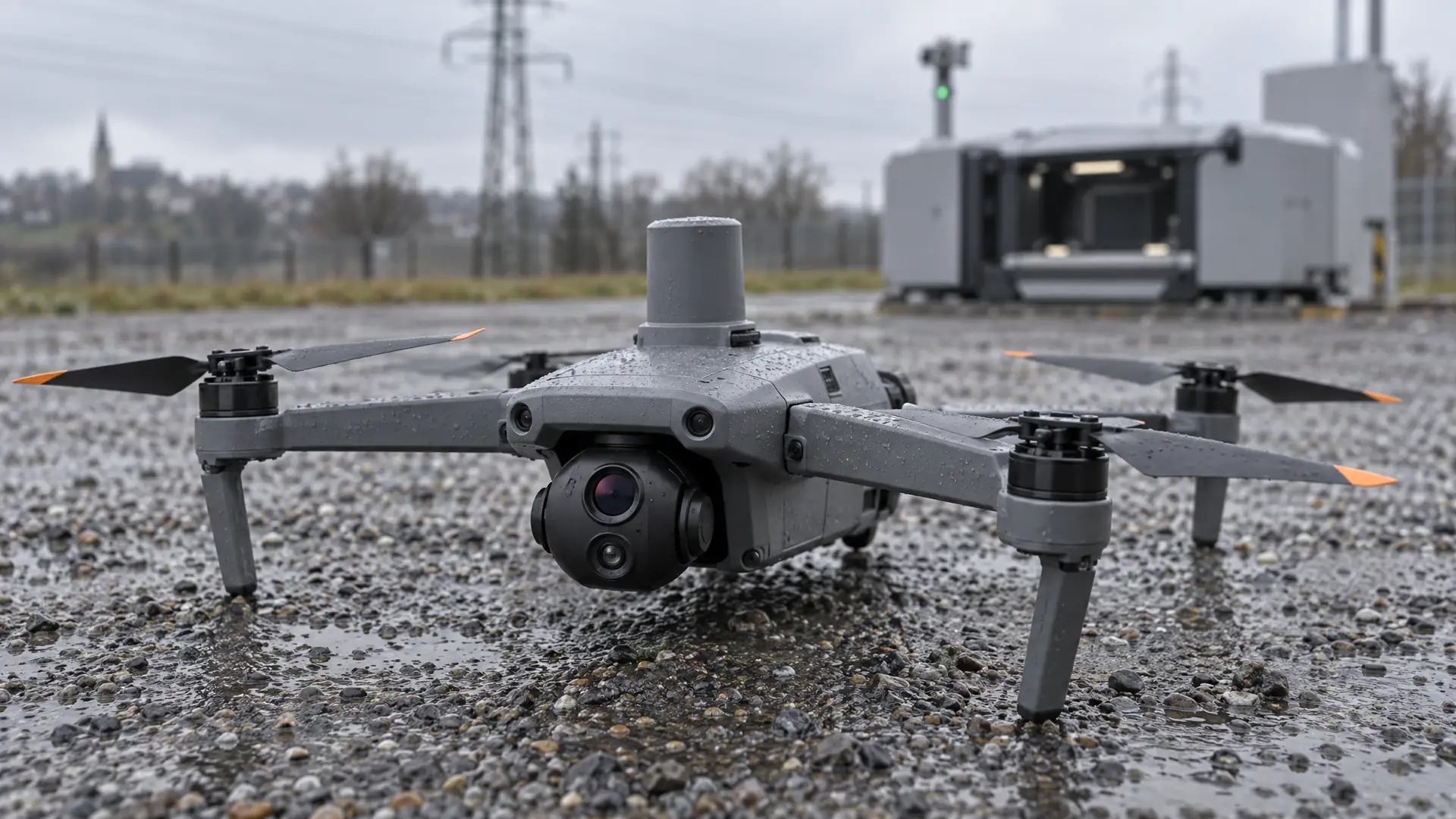
The DJI Matrice 5TD has a name in an official record for the first time. A filing on the UOM platform, the national unmanned aircraft registry of China's civil aviation authority CAAC, lists the aircraft as "DJI Matrice 5TD" with model code M5TD, a 2.6 kilogram empty weight and a 3.05 kilogram maximum takeoff weight. Power line and oil pipeline inspection are given as the intended use, inside the light category of 250 grams to 4 kilograms.
Those numbers matter to European operators for two reasons. First, the Matrice 5TD is roughly 750 grams heavier than the Matrice 4TD that has lived in the DJI Dock 3 since February 2025. Second, the successor lands in a market that is splitting sharply in two: the United States freezes new authorisations for DJI hardware, while Europe holds to a risk-based licensing framework. For utilities, rail operators, ports and public safety agencies that have built an automated inspection fleet on the Matrice 4 series, whether a successor arrives is not a detail.
What the Chinese filing records
The entry sits on the UOM platform, the national register where owners of civil drones in China record their aircraft. The leaker Igor Bogdanov shared screenshots of the entry on 21 September 2026, followed on 25 September with a product render that prints "DJI Matrice 5TD" under a white airframe, then on 26 September with a new photo of a grey prototype with its arms folded on wet asphalt.
The filing names SZ DJI Technology Co. as manufacturer, M5TD as the model and lists power line and oil pipeline inspection alongside the light class, China's 250 gram to 4 kilogram band. The serial number and production date are left blank, which means the aircraft had not been built when the form was completed, or the screenshot was taken before those fields were filled in. The same batch of records also contained an entry for the DJI Neo 3 at 192.7 grams.
The TD suffix and the Dock 3 lineage
The letters TD are no arbitrary addition. DJI uses them for the thermal version of an enterprise drone that lives in a dock. The Matrice 4TD is the aircraft that sits in the DJI Dock 3 and takes off, flies its route and lands again without a pilot on site. According to DJI's specifications it weighs around 1,850 grams including the battery and tops out at a 2,090 gram maximum takeoff weight. Flight time is 54 minutes and the airframe carries an IP55 rating against dust and rain.
Measured against the new filing, that is a jump of roughly 750 grams on the airframe and 960 grams at maximum takeoff weight. A heavier airframe on the same battery class does not normally fly longer. Whether DJI held the flight time or had to give some back is not in the filing. That figure is missing entirely, and without official product specifications it remains guesswork.
| Specification | Matrice 4TD | Matrice 5TD (filing) |
|---|---|---|
| Empty weight with battery | 1,850 grams | 2,600 grams |
| Maximum takeoff weight | 2,090 grams | 3,050 grams |
| Difference | baseline | +750 grams and +960 grams |
| Flight time | 54 minutes | not listed |
| Intended use per source | Dock 3, thermal | power line and pipeline inspection |
| Status | in production since 27 February 2025 | filing only, no announcement |
Where the extra 750 grams likely comes from
The weight gain has a plausible home. Photos of a Matrice 5 prototype from July 2026 showed a dome on the top deck consistent with integrated LiDAR, and a cylinder that looks like a built-in RTK antenna. The Matrice 4 series sells LiDAR and RTK as external add-ons. Move that hardware into the airframe and the pilot no longer spends time mounting or calibrating it, the weight sits lower and closer to the centre of gravity, and the housing stays closed in rain. For an inspection crew flying along power lines every day, that is exactly the gain that counts: less add-on equipment, fewer failure points and a sensor mounted closer to the source.
The trade-off is margin. The Matrice 4TD has a 2,090 gram maximum takeoff weight, of which 1,850 grams is the aircraft itself. That 240 gram gap is the room for a heavier battery or an extra payload. At a 2,600 gram empty weight and a 3,050 gram ceiling, the spacing grows to 450 grams, close to double.
Dock 4: a rumour with a long run-up
A second claim hangs around the Matrice 5TD. On 25 September Bogdanov wrote that a DJI Dock 4 is coming and that it will be used in stores soon, without naming a source. DJI's own support chatbot now lists "Matrice 5" as an example of an enterprise model. A language model filling in an example is weak evidence, however; a product page is not.
DJI has said nothing official about either product. The leaker's record on this platform is good: he had the Matrice 400A before launch and supplied accurate Matrice 4 specifications ahead of the January 2025 debut. That makes the filing credible, but not yet final.
Why Europe reads this filing differently
In the United States the successor is an awkward subject. The Dock 3 and the Matrice 4TD received their US authorisation before the so-called Covered List action of 22 December 2025 blocked new authorisations for DJI hardware. A Dock 4 and a Matrice 5TD have no such grant, and none can be issued while that designation stands. American agencies that standardised on the Dock 3 therefore cannot simply replace their platform. We covered the European consequences of that dossier in our article on the US FCC drone ban.
Europe takes a different path. The European Union Aviation Safety Agency (EASA) assesses drones on operational risk rather than country of origin. An aircraft such as the Matrice 5TD is not banned because it is registered in China; the flight it is used for determines the requirements. That does not give European operators free rein, because almost every automated dock mission falls in the Specific category and needs its own authorisation. The framework is summarised in our overview of European drone regulations.
What a heavier aircraft means for approvals
For a pilot who flies with the drone in sight from the ground, 750 grams is hardly a talking point. For an operator running a dock it changes the paperwork. As soon as a drone flies beyond visual line of sight, climbs above 120 metres or is used without a class label, the Specific category applies, with an operational authorisation based on a SORA or a pre-defined scenario. A dock platform often also carries a C5 or C6 class marking, with geocaging and a flight termination system. A new aircraft therefore means a fresh risk assessment, an updated Concept of Operations and possibly a new demonstration of the technology to the authority, in the Netherlands the Human Environment and Transport Inspectorate.
That route has become friendlier in recent years. For the Dock 3 and the Matrice 4D, DJI released a SAIL III compliance package in which the manufacturer supplies the design evidence, letting the operator focus on the site and the operation. We explain how that works in our article on SAIL III and BVLOS operations with the DJI Dock 3. For a Matrice 5TD and a Dock 4, a comparable package would again save months of engineering work. Whether and when it arrives is unknown.
Costs, import duties and supply
One more European factor sits outside aviation rules. Since 1 July 2026 the European Union charges import duty on small parcels from outside the EU, ending the old exemption below 150 euros. For loose parts and accessories from Chinese web shops that is an immediately visible difference. Enterprise platforms usually arrive through larger shipments and distributors, but the administration and the cost per parcel rise across the board. We describe the impact in our article on the new EU tax on drone parts. For a fleet manager holding spare batteries, propellers and sensor modules in stock, that is a direct cost line.
What operators should and should not do now
The sensible response to a filing like this is restraint. There is no announcement, no price, no delivery date and no product specification. A filing says an aircraft exists or is about to; it says nothing about availability in Europe, about firmware, about support, or about whether existing Dock 3 software stays compatible. Anyone investing in a Dock 3 fleet this year would do well to record in the contract how a future upgrade or replacement is handled, and to structure their own SORA and SAIL documentation so a new airframe does not force a full restart.
For European inspection firms, grid operators and public safety agencies the core stays the same. The technology gets heavier and smarter, and therefore more compelling for work close to pipes, rails and infrastructure. The authorisation, the risk assessment and the data management remain the real barrier. A new aircraft does not lower that barrier; it moves it to the paperwork that comes with it. Those who arrange that in advance can benefit from the sensor jump once the Matrice 5TD actually reaches the market.
Frequently asked questions about the DJI Matrice 5TD and European operations
What is the DJI Matrice 5TD?
The DJI Matrice 5TD is an enterprise drone with model code M5TD that appears in a filing on China's UOM platform. That entry lists 2.6 kilograms empty, a 3.05 kilogram maximum takeoff weight and power line and oil pipeline inspection as the intended use.
How much heavier is the Matrice 5TD than the Matrice 4TD?
The registered Matrice 5TD is about 750 grams heavier on the airframe and 960 grams heavier at maximum takeoff weight. According to DJI, the Matrice 4TD weighs around 1,850 grams with its battery and tops out at 2,090 grams.
Has DJI officially announced the Matrice 5TD?
No. There is a filing on China's UOM platform, a product render and a prototype photo, but DJI has not announced the aircraft and has published no specifications, price or release date.
Can I fly the DJI Matrice 5TD in Europe?
Europe assesses drones on operational risk rather than country of origin, so there is no general ban. Almost every automated dock mission nevertheless falls in the Specific category and needs an operational authorisation based on a SORA or a pre-defined scenario.
What does the filing mean for existing Dock 3 fleets?
The filing changes nothing about support for the Dock 3 and the Matrice 4TD. Anyone investing now should record in the contract how a future upgrade is handled and structure their SORA and SAIL documentation so a new airframe does not force a full restart.