 NL
NL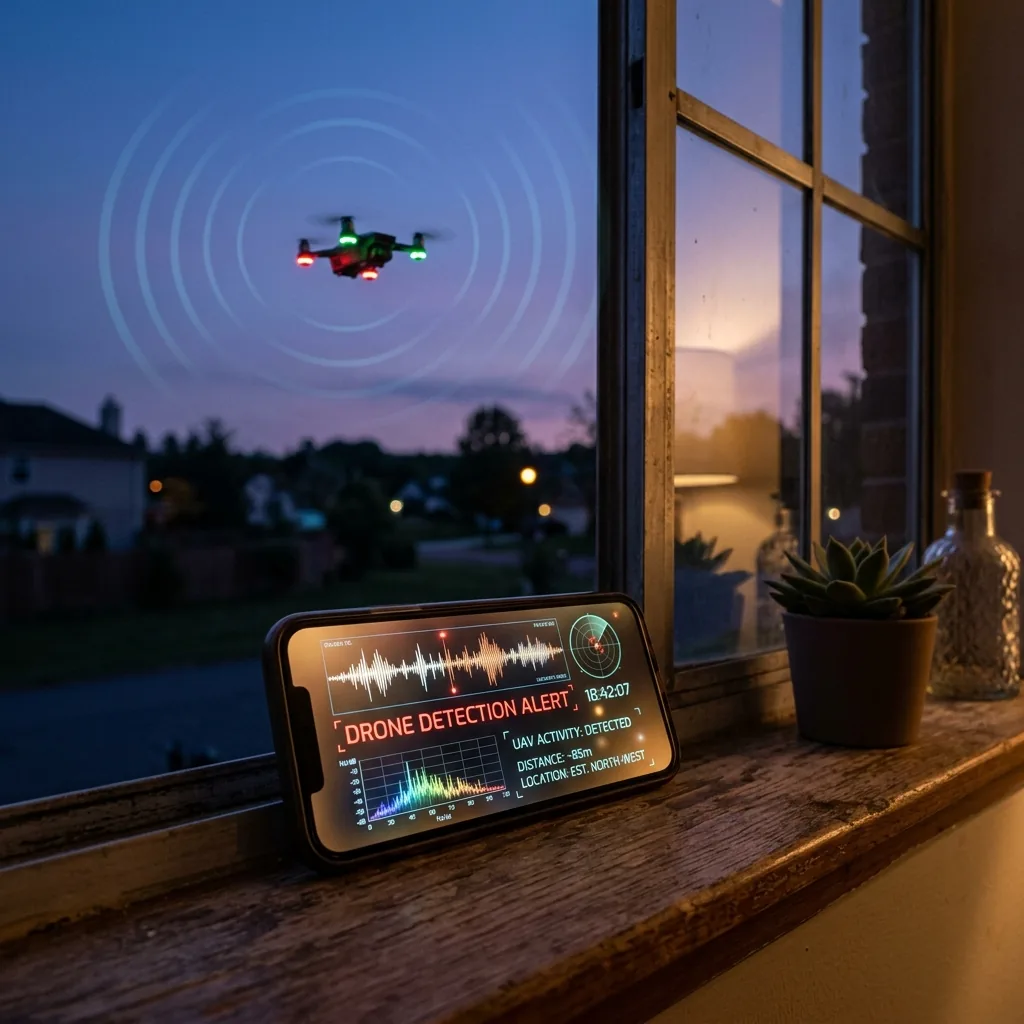
Imagine an old smartphone on your windowsill that automatically alerts you whenever a drone flies nearby. That is exactly the concept behind Sentinel, a new application from Israeli technology company Askalon Industries. The free app, currently available in a closed beta test, converts the built-in microphone of an ordinary smartphone into a fully functional acoustic drone detection system. Using artificial intelligence, Sentinel analyses incoming sounds and recognises specific frequency patterns characteristic of the rotors and motors of unmanned aircraft.
What makes this approach particularly noteworthy is that the app can also detect drones that do not broadcast a Remote ID signal. While traditional detection systems often rely on radar signals, RF scanning, or visual identification, acoustic detection offers an additional layer that functions regardless of the drone's electronic equipment. This makes the technology especially relevant at a time when European regulations around drone detection at events are becoming increasingly stringent and the demand for affordable security solutions continues to grow.
How does acoustic drone detection via a smartphone work?
The fundamental principle behind the Sentinel app centres on sound signal processing. Every drone produces a unique sound pattern, determined by factors such as the number of rotors, the motor type, propeller dimensions, and flight speed. This sound pattern, often referred to as an acoustic fingerprint, differs significantly from background sounds like wind, traffic, or birdsong. The AI models within the app have been trained on thousands of sound samples from a wide variety of drone models and brands to reliably identify these patterns.
When the app is active, the smartphone microphone continuously listens to ambient sounds. As soon as the algorithm detects a signal that matches a known drone pattern, the app sends an alert notification to the user. According to Askalon Industries, the system can recognise drones at distances of up to several hundred metres, depending on the ambient noise level and the type of drone. In a quiet outdoor environment, the app naturally performs better than in a busy city centre with significant background noise.
The technology is not entirely new. Military and industrial drone detection systems have been using acoustic sensors for some time. Companies such as Squarehead Technology and Dedrone have offered advanced microphone arrays for professional counter-drone applications for years. The difference is that Sentinel makes this technology accessible to individual users through an ordinary smartphone, without the need for expensive specialised hardware.
Applications and target audiences for the Sentinel app
The potential users of such an application are diverse. Private individuals concerned about their privacy can deploy the app as a simple early warning system around their home or property. Event organisers looking for an additional security layer alongside professional detection systems could use Sentinel as a supplement to existing measures. Additionally, there is a growing market for security firms that need to quickly and affordably monitor locations for unauthorised drone activity.
For professional drone operators, the app is also interesting from a different perspective. It provides insight into how their own flights are perceived by the surrounding environment and can help document drone activity in a given area prior to an operation. This connects to the broader trend of situational awareness that is becoming increasingly important within European drone legislation, as discussed in our article about mandatory Remote ID for drones over 100 grams.
Comparison of drone detection technologies
To better understand where acoustic detection fits within the landscape, it is useful to compare the various available technologies side by side. Each system has specific strengths and weaknesses that determine when and where it is most effective:
| Detection Method | Operating Principle | Range | Strengths | Limitations |
|---|---|---|---|---|
| Acoustic (Sentinel) | Sound analysis via microphone and AI | 100 - 500 metres | Affordable, no extra hardware, detects drones without Remote ID | Limited range, sensitive to background noise |
| RF Scanning | Detection of radio frequency signals between drone and controller | 500 m - 2 km | Greater range, can locate the pilot | Does not work for autonomous flights without active RF signal |
| Radar | Reflection of radio waves off the drone body | 1 - 5 km | Long range, works in all weather conditions | Expensive, difficulty distinguishing drones from birds |
| Remote ID | Reading the mandatory broadcast signal from the drone | 300 m - 1 km | Provides direct operator identification and registration data | Only works when the drone is broadcasting Remote ID |
The table clearly illustrates that acoustic detection via a smartphone is not intended to replace professional systems, but rather serves as an accessible and low-barrier supplement. The combination of multiple detection methods, commonly referred to as sensor fusion, is considered by security experts to be the most reliable approach for tracking unauthorised drones.
Technical limitations and challenges
While the concept is promising, the technology faces several important limitations. The primary challenge is ambient noise. In a busy urban environment with traffic, construction activity, and human chatter, it becomes considerably more difficult for the algorithm to isolate the specific drone sound. The quality of the microphone in the smartphone also plays a significant role. Modern smartphones generally feature better microphones than older models, but no consumer microphone is specifically designed for this task.
A second limitation concerns range. Acoustic detection inherently has a more limited reach compared to radar or RF scanning. Smaller drones with electric motors produce less noise than larger models, meaning they are only detected at closer distances. In windy conditions, the effective detection range decreases further as sound is scattered or masked.
There is also the risk of false alerts. Certain sounds, such as distant lawnmowers, ventilation fans, or even specific insects, can produce frequency patterns that resemble those of a drone. The AI must be continuously refined to improve its discriminative capability and minimise the rate of false positives. Askalon Industries has indicated that they are constantly updating their models based on feedback from the beta testing programme.
Acoustic detection within the European context
The launch of the Sentinel app fits into a broader European trend where drone detection is becoming increasingly important for both government agencies and private entities. EASA has emphasised the importance of detection and identification as pillars of a safe U-space ecosystem within its regulatory framework. Across several European countries, pilot projects are currently underway with integrated detection systems around airports, prisons, and event venues.
In the Netherlands, the government recently expanded the powers to bring down drones in certain zones, as discussed in our article about prison staff being authorised to bring down drones. The need for affordable detection solutions that can be deployed by non-specialist personnel is growing accordingly. A smartphone-based solution like Sentinel could serve as a valuable first line of defence in this regard.
At the same time, the availability of such apps raises questions about privacy and the legal status of airspace monitoring. The European Union has strict rules regarding audio recording and data processing. Although the Sentinel app, according to the developer, does not store audio files but only performs real-time analysis, it is important for users to be aware of local legislation regarding surveillance and data handling.
The future of accessible drone detection
The Sentinel app from Askalon Industries represents a compelling shift in the drone detection landscape. By leveraging hardware that virtually everyone already owns, namely a smartphone, the company dramatically lowers the barrier to entry for detection technology. Whether the app in its current form is sufficiently reliable for serious security applications remains to be determined through the beta test, but the potential is undeniable. The combination of increasingly powerful AI models on mobile devices with the growing need for counter-drone measures in Europe makes it likely that we will see more consumer-oriented solutions of this kind in the coming years.
For professional drone operators and security professionals, this development presents both opportunities and challenges. On one hand, it becomes easier to monitor airspace activity. On the other hand, it means that public awareness around drones is increasing, which will further strengthen the call for strict compliance with professional flight standards and certified operators.
Frequently asked questions about the Sentinel drone detection app
What is the Sentinel app?
Sentinel is a free mobile application by Askalon Industries that uses the microphone of a smartphone to detect approaching drones through acoustic analysis and artificial intelligence.
Can the app detect drones without Remote ID?
Yes, that is one of its key advantages. Because the app works based on sound rather than electronic signals, it can also identify drones that do not have a Remote ID module installed or where Remote ID has been disabled.
How far can the app detect a drone?
The detection range varies from approximately 100 to 500 metres, depending on the ambient noise, the type of drone, and weather conditions. In a quiet environment, the range is greater than in an urban setting with significant background noise.
Is the Sentinel app available to the public yet?
The app is currently in a closed beta testing phase. A specific date for the public launch has not yet been announced by Askalon Industries.