 NL
NL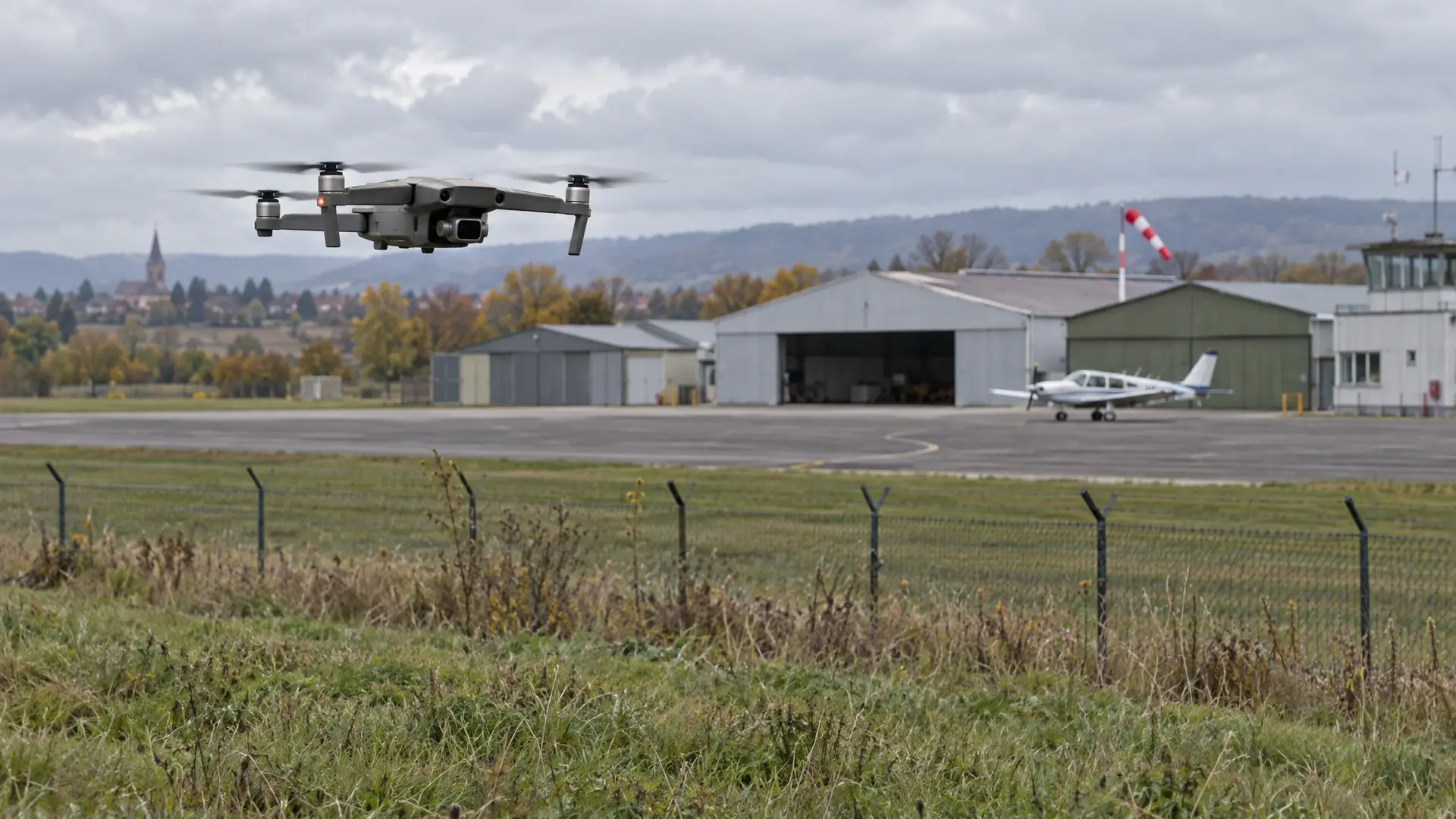
The criminal court in Colmar has sentenced a drone pilot from the city to eight months in prison. He flew over the Colmar-Houssen aerodrome several times without authorisation and posted the footage on TikTok. The ruling came on Friday 11 September 2026, after which the court converted the custodial sentence into home detention with an electronic tag. The case was handled through a comparution sur reconnaissance préalable de culpabilité, the French procedure in which a defendant admits the facts in advance.
For European drone operators this is more than a regional criminal case. It shows that an unlawful flight over an airport area in France is treated not as an administrative infringement but as an offence carrying a custodial sentence.
What the Colmar court decided
The pilot filmed the regional aerodrome about a kilometre north of the city several times and published the result on social media. The court convicted him of mise en danger de la vie d'autrui, endangering the lives of others, and of usage interdit de drone à proximité d'une zone sensible, prohibited drone use near a sensitive zone.
Eight months is substantial for a case in which nobody was injured. That is precisely the point the prosecution made: the offence exists as soon as a collision becomes realistically possible, not only once something goes wrong. The question is not whether it ended well, but whether the risk was acceptable.
A case that started on a phone screen
The Brigade de gendarmerie des transports aériens (BGTA) in Strasbourg-Entzheim, the unit that investigates offences in civil aviation, traced the pilot during the investigation. The clips he posted were a key lead, and in interview he admitted the facts.
The unit describes such flights not as harmless risk-taking but as a real and direct endangerment of the lives of others. That makes clear where French enforcement draws the line: the airspace around an aerodrome is not a playground in which altitude and location are negotiable.
Why the airspace around an aerodrome is so strict
An airport is not an ordinary place to fly over. Departing and arriving aircraft move along a predictable but narrow path, often at low altitude and with little room to manoeuvre. An aircraft that ends up in that path cannot avoid a collision, and the occupants of a light aircraft have no protection against a strike from outside. At Colmar-Houssen the field is also used for training flights and business aviation, with many low-altitude movements.
Geographic zones therefore apply around every aerodrome. Some prohibit all drone traffic, others set a maximum height or require prior authorisation. In France the Direction générale de l'aviation civile publishes those zones in the AlphaTango application and on the cartes.gouv.fr maps. On top of that the European baseline for the Open category applies: a 120-metre ceiling, visual contact with the aircraft and no flight over crowds. The European Union Aviation Safety Agency (EASA) sets that framework.
We explain the French rules, the geozones and the map layers in our guide to drone rules in France and the no-fly zone map.
The legal provisions behind the ruling
The core of the case sits in the French Transport Code, the Code des transports. Article L. 6211-4 provides that overflight of certain areas may be prohibited for military or public security reasons. Article L. 6211-5 adds that an aircraft entering such a zone must land at the nearest aerodrome outside it and must comply with the first instruction given.
The penalty provision is Article L. 6232-2. Flying over a prohibited zone through negligence carries six months in prison and a 15,000 euro fine. Continuing a flight above that zone, or disregarding an instruction, carries one year and 45,000 euro.
Under Article L. 6232-5 a court may additionally impose a ban on piloting any aircraft for three months to three years, doubled for a second conviction within five years. For professional operators that is often the heaviest additional penalty in practice, because the occupation itself comes to a standstill.
The second limb of the charge is Article 223-1 of the Criminal Code. It punishes exposing another person to an immediate risk of death or permanent injury through a manifestly deliberate breach of a safety obligation, with a maximum of one year in prison and a 15,000 euro fine. Someone who knows the zone restrictions and flies anyway can therefore be convicted under this article too.
From a prison term to home detention with a tag
A court imposing eight months and then having that sentence served outside prison is a standard combination in France. The country uses placement sous surveillance électronique: home detention with an electronic ankle tag, under which the convicted person must be at a specified address at agreed times. Article 723-7 of the Code of Criminal Procedure and Article 132-26-1 of the Criminal Code allow this where the custodial sentence does not exceed two years, or one year in the case of a repeat offender, and where the person consents. One of the statutory justifications must also apply: work or training, an essential family role, medical treatment or a serious effort at reintegration.
The procedure itself, the comparution sur reconnaissance préalable de culpabilité, is set out in Articles 495-7 and 495-8 of the Code of Criminal Procedure. Under it, the prosecutor's proposed prison term may not exceed one year and may not exceed half the sentence the offence carries. A proposal of eight months with immediate conversion into electronic monitoring fits inside those limits, which explains why the case could be concluded in a single hearing.
Colmar-Houssen aerodrome in brief
Colmar-Houssen is a public regional aerodrome near the village of Houssen, about a kilometre north of Colmar in the Haut-Rhin department. The field carries ICAO code LFGA and IATA code CMR, sits at roughly 190 metres above sea level and has a paved main runway of 1,610 by 30 metres with a parallel grass runway of 950 by 80 metres.
That makes the site sensitive: a lot of low-altitude traffic, inexperienced pilots in training and approach and departure paths that partly run over ground reachable from public roads. A drone hovering there at 50 or 100 metres sits exactly in the space where a pilot has little time to react.
What the ruling means for drone flights in Europe
The Colmar case does not stand alone. In Belgium a court previously ordered an illegal drone light show company to stop flying, as we covered in our article on the Belgian aviation authority and illegal drone shows. In the Netherlands the debate is moving the other way, towards more room for civil drones inside controlled airspace, as shown by the plans for civil drones in CTR areas from 26 November. The difference in outcome is not in the standard but in how countries handle infringements.
Distributing the footage has also turned out not to be a neutral act. Social media make an unlawful flight visible, traceable and sometimes better known than the pilot intended. For operators producing vertical video for social platforms, as described in our article on vertical video with DJI drones, the practical consequence is clear: check the location and the authorisation first, publish afterwards.
The third development is a growing willingness to stop drones as well. In the Netherlands prison staff were given powers to jam or land drones around custodial institutions, as we described in our article on prison staff and bringing down drones. Such powers are the mirror image of the Colmar case: where a French court punishes after the fact, other countries try to make the flight impossible in advance.
Five things to check before every flight
- Check the geozone on the day of the flight. Zones change with temporary restrictions, military activity and events. A screenshot from last month is not valid preparation.
- Obtain authorisation where it is required. At a controlled airport or a sensitive zone, an instruction from the authority is not a formality but a condition for flying.
- Keep your flight records. Logbooks, authorisations and timestamps are the first evidence that you complied if questions arise.
- Do not publish blindly. Footage can be found years later and linked to a location. What is online can function as an admission in an investigation.
- Know the differences between countries. The Netherlands, Belgium and France apply the same European baseline regulation, but enforcement and sentencing vary widely.
Frequently asked questions about the Colmar drone case
Why did the pilot receive a prison sentence rather than a fine?
Because unlawful drone flights over an airport area in France fall under criminal law rather than administrative law. Article L. 6232-2 of the Transport Code punishes continuing a flight over a prohibited zone with one year in prison and a 45,000 euro fine, and Article 223-1 of the Criminal Code separately punishes endangering others with up to one year.
What does mise en danger de la vie d'autrui mean?
Literally: endangering the lives of others. Article 223-1 of the French Criminal Code punishes exposing another person to an immediate risk of death or permanent injury through a manifestly deliberate breach of a safety obligation. No accident has to occur: the risk simply has to have been unacceptable.
What is a comparution sur reconnaissance préalable de culpabilité?
The French procedure in which the defendant admits the facts in advance and the public prosecutor proposes a sentence, which a judge then reviews in open court. Articles 495-7 and 495-8 of the Code of Criminal Procedure state that the proposed prison term may not exceed one year and may not exceed half the sentence the offence carries.
How does home detention with an electronic tag work in France?
Placement sous surveillance électronique means the convicted person serves the sentence at home under electronic monitoring, with fixed hours at which they must be at a specified address. Article 723-7 of the Code of Criminal Procedure and Article 132-26-1 of the Criminal Code permit this for a custodial sentence of up to two years, with the person's consent and a statutory justification such as work, training, family circumstances or medical treatment.
Can you fly a drone near an airport?
Only where it is permitted. Geographic zones apply around every aerodrome, imposing a ban, a maximum height or a requirement to obtain prior authorisation. In France the Direction générale de l'aviation civile publishes those zones in the AlphaTango application and on cartes.gouv.fr, on top of the European Open category rules of a 120-metre ceiling and visual contact with the aircraft.