 NL
NL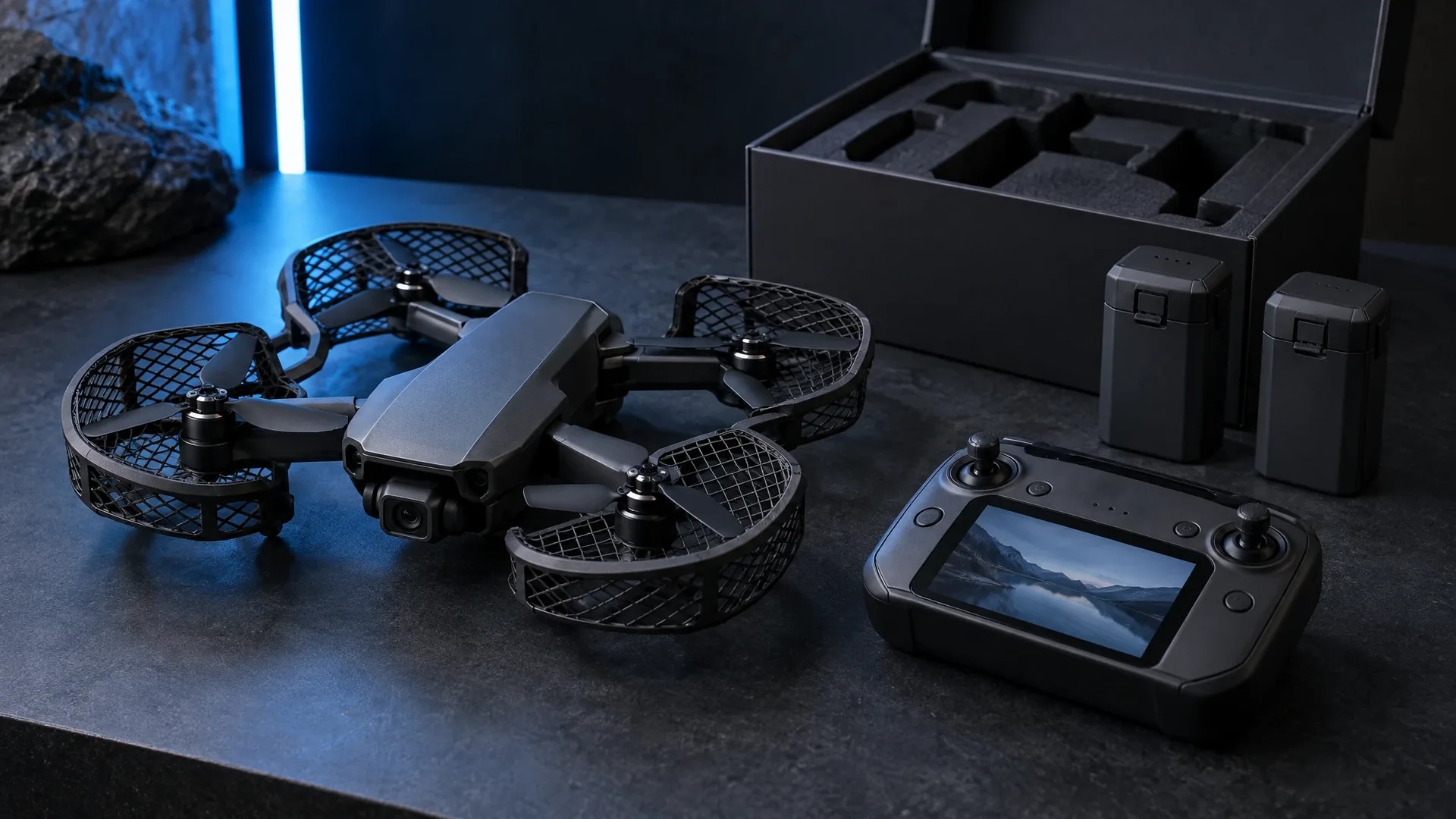
The DJI Neo 3 has still not been announced, but its specifications are becoming clearer. On 1 October 2026 leaker Igor Bogdanov, who posts as @Quadro_News, shared a photo of a printed spec sheet that gives the new selfie drone a square 1/1.1-inch image sensor. The French side of that sheet states what the sensor is for: native vertical shooting and 2x lossless zoom. The remaining lines list palm takeoff and landing, high-speed ActiveTrack, omnidirectional obstacle sensing, the DJI RC Mini, SelfieShot 2.0 and fast file transfer.
For European buyers there is a second detail that matters just as much. A production registry entry lists a weight of 192.7 grams, comfortably below the 250 gram threshold where European rules become stricter. Below is what is known, what is missing, and which rules apply to a drone of this size in Europe.
What the leaked spec sheet does and does not say
The photo shows a marketing sheet in Chinese and French, not a product page from DJI. The features are consistent with earlier leaks: in September a photo of the back of the retail box appeared, showing the same RC Mini and no separate radio module for the Neo 2. The Dutch drone publication Dronewatch described that same box and lists ActiveTrack 2.0, improved obstacle sensing and a new controller.
The sheet reportedly lists:
- A square 1/1.1-inch image sensor with native vertical shooting and 2x lossless zoom.
- Palm takeoff and landing with gesture control.
- High-speed ActiveTrack with automatic camera moves.
- Omnidirectional obstacle sensing, described in Chinese as an improved system.
- The DJI RC Mini as controller, with SelfieShot 2.0 as a capture mode.
- Fast startup and fast file transfer.
Just as important is what is missing. The sheet gives no resolution in megapixels, no aperture, no maximum video resolution, no flight time, no price and no launch date. DJI has said nothing about the Neo 3 on its own channels, so anyone deciding on this list alone is deciding on a leak.
The square sensor comes from the Osmo Action 6
The size and shape are no accident. DJI uses the same format in the Osmo Action 6, which arrived in November 2025 with a variable aperture from f/2.0 to f/4.0. A square sensor captures vertical and horizontal footage with the same number of pixels, without rotating the camera or lens and without cropping a wider frame.
On an action camera that means shooting 9:16 without a different mount. On a drone it means one flight can deliver both a vertical clip for TikTok or Instagram Reels and a horizontal take for YouTube, each at full resolution. We covered that shift in our article on shooting vertical video with DJI drones. Until now drones solved it with a crop or a gimbal that rotates ninety degrees, a workaround a square sensor removes.
The 2x lossless zoom fits the same story. On DJI drones that zoom is a crop from the centre of the sensor: the lens does not change and no pixels are lost to upscaling. Because the Neo 3 is listed with a larger sensor than its predecessor, a half-size crop leaves more image behind.
Bigger than the Mini 4 Pro sensor
For scale, 1/1.1 inch is larger than the 1/1.3-inch sensor DJI uses in the Mini 4 Pro and nearly twice the size of the 1/2-inch sensor in the DJI Neo 2, which captures 12 megapixels. At a comparable pixel count, larger pixels mean more light per frame. The Neo series also targets people who want to shoot without pilot experience and publish straight from a phone, where vertical video is the default format, so a sensor designed for it matters more than a few megapixels on a spec sheet.
From 151 grams to 192.7 grams
The second hard datapoint comes from a production registry. Bogdanov found an entry with model number DEN326 and a production date of 21 September 2026, listing both the empty weight and the maximum takeoff weight at 0.1927 kilograms. Notebookcheck did the maths: 41.7 grams, roughly 28 percent, heavier than the Neo 2.
| Specification | DJI Neo 2 | DJI Neo 3 (leak) |
|---|---|---|
| Weight | 151 grams | 192.7 grams |
| Camera | 12 MP 1/2-inch CMOS | 1/1.1-inch square sensor, resolution not stated |
| Zoom | none listed | 2x lossless zoom |
| Vertical video | via crop or gimbal position | native vertical per the leaked sheet |
| Controller in the combo | RC-N3, requires a phone | DJI RC Mini with built-in screen |
| Obstacle sensing | omnidirectional since the Neo 2 | omnidirectional, reportedly improved |
| Status | on sale since November 2025 | leaks only, no announcement |
Those 42 grams are more than a registry figure. Earlier leaks show a redesigned propeller guard using a hub-and-spoke layout, extra rear ventilation and a new sensor on top of the body. More plastic, electronics and a larger sensor add up, and flight time is unknown because the sheet mentions none.
The RC Mini and SelfieShot 2.0
The controller in the leaked combo is the DJI RC Mini. According to earlier photos it has a built-in screen of roughly 1.97 inches at 410 by 494 pixels and up to 800 nits, and reportedly uses OcuSync 4 for a range well beyond a direct Wi-Fi link with a phone. Those figures do not appear on the Neo 3 box and remain unconfirmed.
The direction is clear enough. The Neo 2 ships with the RC-N3, a controller that uses the phone as its screen. A compact controller with its own display takes the phone out of the chain and gives the pilot more range and more controls, and it puts the radio inside the drone itself, which fits the disappearance of the separate radio module from the Neo 2 package.
Europe yes, the United States no
The RC Mini received its US authorisation from the Federal Communications Commission on 19 December 2025. The Neo 3 itself has no FCC grant, and without one a radio transmitter cannot legally be sold in the United States. The pattern is familiar: DJI did not release the Neo 2 in the US while Europe, Canada and Brazil received it.
Europe takes a different view of these devices. The European Union Aviation Safety Agency (EASA) assesses drones on operational risk rather than country of origin or the brand of the radio chip. As long as the Neo 3 stays under 250 grams and reaches the market with a class label, it lands in the lowest risk class and no ban is in prospect.
What 192.7 grams means under European rules
Legally, staying under 250 grams changes little about the appeal of this drone. A drone with a C0 class label in the Open category, subcategory A1, may be flown without a licence or online training. The pilot must still follow the manufacturer instructions, respect the airspace, and keep the aircraft in sight. In the Netherlands the no-fly zones are on our Dutch drone map, and the wider European framework is set out on the EASA drone rules overview.
That threshold is not fixed. In 2026 EASA published proposal NPA 2026-103, which includes requiring theory certificates and Remote ID for drones from 100 grams upwards. That hits exactly this segment. We covered the consequences in our article on the proposed licence requirement from 100 grams. If that proposal becomes law, the Neo 3's 192.7 grams stops being a free pass and becomes a factor buyers have to plan for.
A second change is that the Neo 3 reportedly works without a separate radio module. That is convenient, but it also makes the drone more dependent on the supplied RC Mini for full functionality. Anyone buying the aircraft loose or second-hand should check which parts are included.
What European buyers can sensibly do now
The honest summary is that there is no product to buy yet, only a leaked marketing sheet, a box photo and a production registry entry. The leaker has a strong record: he previously obtained the Matrice 400A and the Matrice 4 series specifications before DJI announced anything, and he featured in the trail around the Matrice 5TD. At the same time, a Neo 3 image circulated in September that turned out to be recycled packaging art with artificially drawn battery vents. One badly made image does not discredit every leak, but it is a reason to stay cautious.
In practice it comes down to three questions before spending money: has DJI announced the aircraft with an official spec list and a European price, which class label will the European version carry, and will batteries, propellers and the RC Mini be sold separately? Anyone who waits misses nothing, because the Neo 2 stays on sale.
Frequently asked questions about the DJI Neo 3 and EU drone rules
Has DJI announced the Neo 3?
No. DJI has not announced the Neo 3 and publishes no specifications, price or release date. Everything in circulation comes from a leaked spec sheet, a photo of the retail box and a production registry entry carrying a production date of 21 September 2026.
What does a square 1/1.1-inch sensor mean in practice?
A square sensor captures vertical and horizontal footage with the same number of pixels, without rotating the camera. DJI uses the same size and shape in the Osmo Action 6, which has a variable aperture from f/2.0 to f/4.0. The leaked sheet lists native vertical video and 2x lossless zoom for the Neo 3, which is a crop of the sensor rather than a lens change.
Does the DJI Neo 3 stay under 249 grams?
According to the production registry entry the Neo 3 weighs 192.7 grams, so it stays under 250 grams. The Neo 2 weighs 151 grams, making the Neo 3 roughly 42 grams or 28 percent heavier.
Do I need a pilot licence for the DJI Neo 3?
A drone under 250 grams with a C0 class label falls in the Open category, subcategory A1, which requires no licence or online training. That does not mean there are no rules: operator registration, a visible operator number and the manufacturer instructions still apply. EASA is examining whether the threshold should drop to 100 grams under NPA 2026-103.
When will the DJI Neo 3 launch and what will it cost?
There is no official release date and no official price. The production registry entry carries the date 21 September 2026, and rumours point to a launch around December 2026 or January 2027 at around 469 dollars for the Fly More Combo. None of those figures has been confirmed by DJI. The Neo 2 launched at 239 euros for the drone alone and 399 euros for the Fly More Combo.