 NL
NL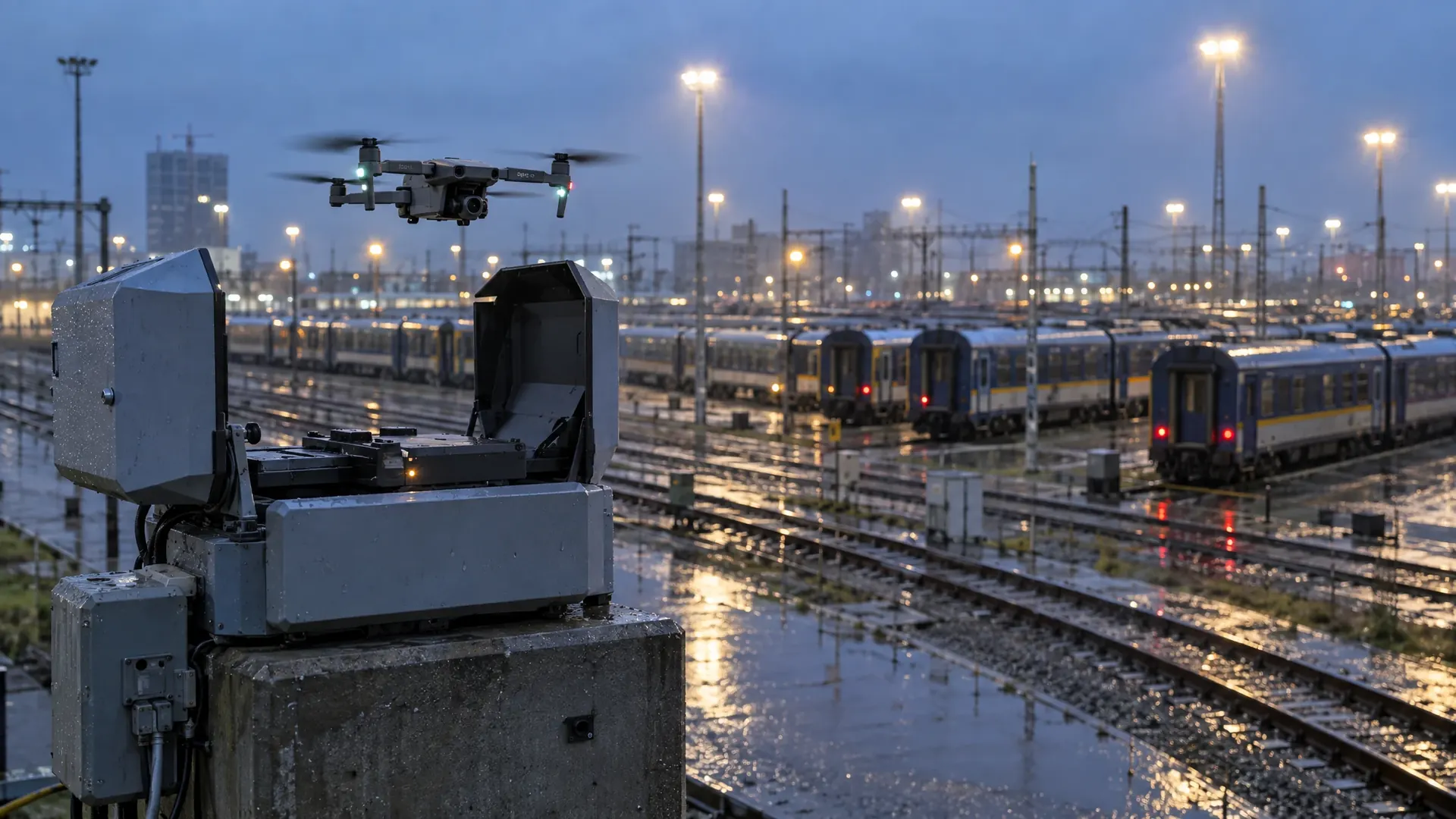
Nederlandse Spoorwegen (NS), the Dutch national railway operator, began a trial on 2 October 2026 in which drones fly from train depots to catch graffiti writers in the act. The aircraft launch from so-called drone boxes, fixed docking stations from which a drone departs, returns and recharges autonomously. NS pairs the deployment with a second, much simpler measure: a No Graffiti! sticker placed over a writer's signature so the tag is no longer visible.
For European drone operators this is more than a railway story. The combination of ground sensors, a docking station and automated flights is exactly the model that has appeared in recent years around energy infrastructure inspection, port areas and now railway stabling yards. It shows where commercial demand is heading and, at the same time, where the limits sit: aviation rules, privacy law and the evidential value of camera footage.
Why stabling yards are so exposed
Trains that are out of service make attractive targets. At a stabling yard dozens of units stand still for hours, often on a site that borders public space along its edges. NS already secures those locations with fences, access gates, cameras, alarm systems and sensors, and deploys security guards with dogs at irregular intervals. The drone is an addition to that mix, not a replacement.
The mechanism is straightforward. When an unauthorised visitor is detected, a drone flies to the location to observe the person from the air and record their activity on camera. According to NS, the aircraft can also address unwanted visitors and deter them that way. That is a real difference from a fixed camera: a fixed camera always looks from the same position, while a drone can follow movement across a site that may cover dozens of hectares.
A drone box as a remote security post
The core of the trial is the drone box. It is a weatherproof housing in which the drone lands and recharges automatically after each flight, so it can be deployed again without a pilot on site. That removes the biggest cost driver of traditional drone operations: travel time and the presence of a pilot for every flight.
LUGN Security is involved in the trial. The security company manages the drone boxes at the stabling yards and delivers a complete Drone-as-a-Service, integrating the drones with existing sensor and video management systems and controlling them 24/7 from its own control centre. It is a model that is now appearing among other European infrastructure operators as well, from grid companies to port authorities and airports. We described a comparable setup in our article about autonomous dock missions with the DJI Dock 3.
Is this allowed? Two regulatory regimes at once
A drone that takes off automatically and flies to a detection beyond the pilot's line of sight does not sit in the Open category in Europe. That is the category covering most recreational and simple commercial flights, with a 120-metre ceiling and visual contact with the aircraft. As soon as a flight takes place beyond visual line of sight, or is automated, the Specific category applies, and that requires an operational authorisation based on a risk assessment (SORA) or a pre-defined scenario. The European Union Aviation Safety Agency (EASA) sets that framework; in the Netherlands the Human Environment and Transport Inspectorate assesses the applications.
The second regime concerns the footage. Camera images in which people are identifiable are personal data under the General Data Protection Regulation. An organisation that captures such footage needs a lawful basis, must document the purpose and the retention period, and must keep the deployment as limited as possible. Large-scale systematic monitoring of an area requires a data protection impact assessment. In the Netherlands the Dutch Data Protection Authority supervises that side. We explain the trade-offs in more detail in our article about privacy and DPIA guidelines for drone flights.
For a fenced private site such as a stabling yard with gates, the balance differs from public space. There is no general public being filmed while shopping, but people who are present without permission are being observed. The footage may therefore not be stored indefinitely or reused for purposes other than the one it was captured for.
From observation to evidence
The drone is not there to issue a fine but to support a criminal complaint. NS files a police report for every act of defacement, and drone footage can then be used to try to identify the perpetrators and recover the damage from them. That makes image quality legally relevant: the timestamp, the location, the continuity of the recording and a demonstrable chain of custody determine whether a court attaches weight to it.
There is a practical limit too. A drone can only capture something if it is in the right place at the right time. That requires a detection system that reliably distinguishes a graffiti writer from a lost walker or a traveller who took the wrong gate. Police work with comparable systems at major events, including a whitelist of permitted drones, as we described in our article about drone detection during the Vierdaagsefeesten. The difference is that NS is not detecting to keep unwanted drones out, but to get people on the ground in frame.
The sticker as a strategy against the tag
The No Graffiti! sticker is the low-tech counterpart to the drone. Where the drone targets the writer, the sticker targets the attractiveness of the train itself. For many writers a tag is a calling card; covering it with a sticker carrying a QR code removes the visibility and with it part of the motivation. The QR code links to information about the NS approach to graffiti.
That fits what NS already does: defacement is removed as quickly as possible. A graffitied train is temporarily taken out of service for cleaning, which can lead to shorter trains and fewer seats for passengers. According to Sevgi Akseki, director of Corporate Security at NS, the operator sees graffiti on trains as vandalism that makes passengers feel unsafe and takes rolling stock out of service. The annual cost of all anti-graffiti measures, including removal, runs into millions according to her. That is a bill that largely goes on cleaning and downtime rather than technology.
Cleaning partner Vebego handles the removal of the defacement. The combination of fast cleaning, a sticker over the tag and camera footage from the air is essentially an attempt to shift the cost of vandalism onto the offender.
What operators can take from this
For companies considering their own drone box, there are three lessons that have nothing to do with railways.
- Sort the authorisation before you install the box. An automated flight beyond visual line of sight is a Specific operation. Without an operational authorisation the system is technically ready and legally unusable.
- Treat privacy as a design requirement, not an afterthought. Document what the footage is for, how long it is kept and who may view it. A clear retention period and access logging are much easier to arrange up front than to repair later.
- Budget for integration, not for a standalone aircraft. The value of a drone box lies in the link with sensors and a control room. Buying it as loose hardware means paying for a drone rather than for a security process.
NS expects the new measures to lead to more cases caught in the act than the existing mix of fences, cameras and guards. The operator has not published hard figures on how many writers were caught or how many flights are made per site. The coming months will show whether the drone genuinely delivers more than foot patrols. For the wider European market the significance is mainly that autonomous aerial observation has moved past the pilot-project stage: the question is no longer whether infrastructure operators will use this, but how they organise it within the authorisation and privacy frameworks.
Frequently asked questions about drones, security and graffiti at NS
What will NS use drones for?
NS is testing drones that launch from so-called drone boxes at depots where trains are stabled out of service. When sensors or cameras detect unauthorised visitors, a drone can fly to the location to observe the people from the air and record their activity on camera.
What is a drone box?
A drone box is a weatherproof docking station in which a drone can take off, land and recharge autonomously. That allows the aircraft to fly on demand without a pilot travelling to the site for every flight. In the NS trial the security company LUGN Security manages the boxes and controls the flights from its own control centre.
Can a company simply record camera footage with a drone?
No. Footage in which people are identifiable is personal data under the GDPR. An organisation needs a lawful basis, must document the purpose and retention period, must keep the deployment as limited as possible and must carry out a data protection impact assessment for large-scale systematic monitoring. The considerations on a fenced private site differ from those in public space.
Does a flight from a drone box fall under the open category?
Usually not. Automated flights beyond visual line of sight fall in the Specific category of the European drone regulation. That requires an operational authorisation based on a SORA or a pre-defined scenario, and in the Netherlands the Human Environment and Transport Inspectorate assesses the application.
What is the NS No Graffiti! sticker?
The No Graffiti! sticker is placed over a graffiti writer's signature so the tag is no longer visible. The sticker carries a QR code that links to information about the NS approach to graffiti. The measure fits the strategy of removing defacement as quickly as possible, because short visibility makes a train less attractive to writers.