 NL
NL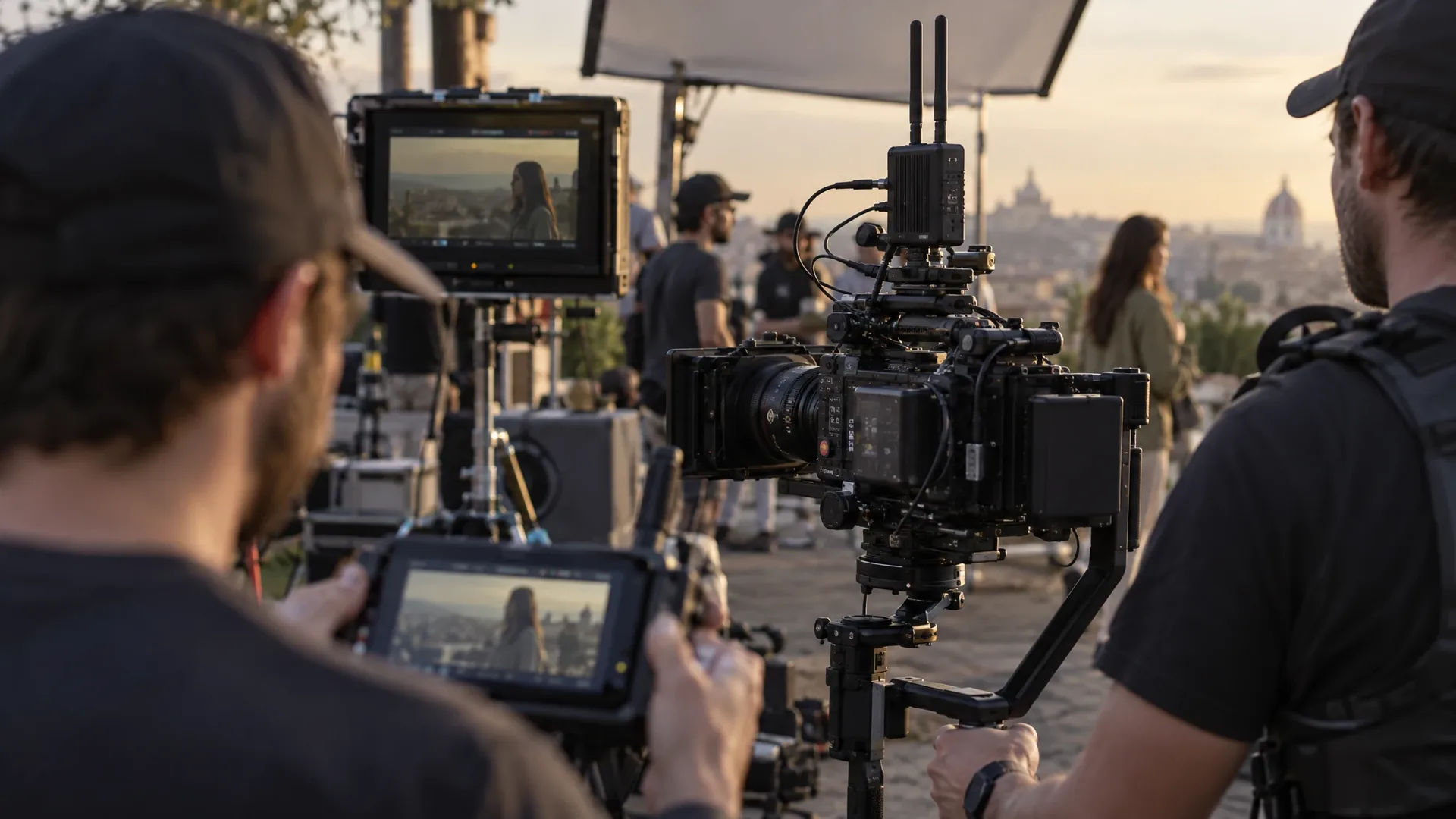
DJI announced the DJI SDR Transmission 2 on September 18, 2026. It is a wireless video system that sends camera feeds from the set to monitors, directors and camera crew. It transmits DCI 4K at 60fps in 10-bit HDR and H.265 at bitrates up to 50 Mbps, keeps latency as low as 35 milliseconds and reaches up to 4 kilometers according to the manufacturer. Every unit can act as either a transmitter or a receiver.
For drone operators it becomes relevant the moment a camera cannot be tethered to a ground station: FPV runs over a course, car-to-car work, a camera on a crane or a second body in a different spot. Once two departments need the same image, the link between camera and monitor becomes the weak point on set.
What DJI promises with the SDR Transmission 2
The transmitter and receiver share one housing and weigh approximately 136 grams. That is light enough to mount on a camera, gimbal or handheld rig without disturbing the balance too much. An optional expansion plate adds one SDI port, one HDMI port and four USB-C ports, including SDI metadata pass-through for cinema cameras from brands such as ARRI and RED. A separate protective cage is intended for vehicle mounts and other outdoor setups.
The published figures are DCI 4K at 60fps, 10-bit HDR, H.265 up to 50 Mbps, latency as low as 35 ms and a range of up to 4 km. DJI measures that range under CE conditions with one transmitter and one receiver, in open line of sight and without interference. On a full set with a lot of wireless traffic, those are reference values rather than guarantees.
One transmitter, eight receivers
According to DJI, a single transmitter can connect to as many as eight receivers, and every receiver supports remote control. That lets a director watch along while the camera operator or focus puller sees the same image and can change supported camera settings remotely. For larger productions DJI states that up to five transmitters and 40 receivers can operate simultaneously in the same area.
That requires channel management that organises itself. Auto Channel 2.0 recognises the units and allocates frequency bands automatically, with frequency scans and channel-conflict diagnostics. In practice that replaces manually hunting for a free channel at the moment a feed drops out. Mind the local rules though: the 5.8 GHz band and DFS channels are not permitted in every country.
Switching between cameras without re-pairing
The most irritating moment on a set is often the moment the feed has to change. Instead of rebooting equipment and going through pairing again, a user can switch between camera feeds directly on the receiver or through the DJI Ronin app. The unit outputs video over SDI, HDMI or DisplayPort, and over USB-C phones and tablets can join as a mobile monitor.
The Ronin app contains the tools that normally make a monitor expensive: LUTs, focus peaking, waveform and false colour. Compatible cameras can be controlled from the app for aperture, shutter speed, ISO and starting or stopping recording. The system works with the DJI Ronin series, including the RS 5, RS 4 Pro, RS 4, RS 3 Pro, Ronin 2 and Master Wheels.
Power and weight on set
The units run on NP-F batteries or over USB-C PD, where an adapter of 65 watts or more is required for fast charging. On an RS gimbal the transmitter can be powered directly from the gimbal battery, saving a separate battery and its weight. For crews working with cameras with interchangeable lenses that adds up: less ballast on the gimbal head means easier balancing and longer usable recording time.
What this means for drone work
The combination of 4K HDR, low latency and a range of several kilometres is interesting as soon as the camera moves and the monitor stays still. In live broadcasting from a drone the video link determines how stably the image reaches the gallery, and a system that reconfigures itself reduces the chance of a dropout during a broadcast. In dual-operator work with an Inspire 3 a second monitoring position can benefit from the same flexibility: the gimbal operator frames the shot while the director watches on a separate screen.
For FPV work the weight is the main factor. A 136 gram unit changes the balance of a light cinewhoop or an FPV air unit less than a classic transmitter with a separate battery. On short, fast flights every gram counts, because it comes straight off flight time.
The HDR promise also raises a post-production question. A beautiful image on set says nothing yet about the colour space in which footage is recorded and graded. Crews that take HDR monitoring seriously must also have their colour profiles and post-production pipeline in order, otherwise the benefit stays limited to the monitor on set.
What to check before ordering
- Frequencies. The 5.8 GHz band and DFS channels are prohibited in certain countries and regions. Check local laws and regulations before fixing a band.
- Cables and accessories. The SDI port sits on the separate expansion plate, and the Ronin 2 and Master Wheels require a dedicated gimbal control cable.
- Compatibility. The system cannot be cross-connected with other DJI video transmission products, so existing transmitters and receivers will sit alongside the new system.
- Operating density. DJI recommends running no more than five transmitters in the same area.
DJI has not yet published a price for the European market. The system complements the existing DJI Transmission line and the wireless solutions that are already common on film sets. More important than the specifications is therefore whether automatic channel allocation delivers in practice what the brochure promises: less time hunting for a stable feed and more time shooting.
Frequently asked questions about the DJI SDR Transmission 2
What is the DJI SDR Transmission 2?
The DJI SDR Transmission 2 is a wireless video system from DJI that sends camera feeds from the set to monitors and crew. It transmits DCI 4K at 60fps in 10-bit HDR and H.265 at bitrates up to 50 Mbps, keeps latency as low as 35 milliseconds and reaches up to 4 kilometers according to DJI. Every unit works as either a transmitter or a receiver.
What does a software-defined radio mean in a video system?
In a software-defined radio, signal processing is largely determined by software rather than fixed hardware. That allows DJI to change bandwidth, channel management and error correction through firmware without replacing the hardware. The SDR Transmission 2 uses that platform for stronger interference resistance and automatic channel allocation.
How many receivers can connect to a single transmitter?
According to DJI, a single transmitter can connect to as many as eight receivers, and every receiver supports remote control. For larger productions DJI states that up to five transmitters and 40 receivers can operate simultaneously, with the recommendation to run no more than five transmitters in the same area.
Can you use the DJI SDR Transmission 2 without restrictions in Europe?
No. The 5.8 GHz and DFS frequency bands are prohibited in certain countries and regions, so the permitted frequencies differ per country. Radio equipment must also meet European requirements and carry CE marking. Check local laws and regulations before fixing a band.
Does the system work with existing DJI video transmitters?
No. The SDR Transmission 2 cannot be cross-connected with other DJI video transmission products. Within its own system it works with the DJI RS 5, RS 4 Pro, RS 4, RS 3 Pro, Ronin 2 and Master Wheels, and separate cables are required for gimbal control and camera control.